

1. Goal of IA
The IB Biology Internal Assessment (IA) is a self-directed investigation that allows you to design, conduct, and analyze a scientific experiment on a biology-related topic. This laboratory-based report is an integral component of the IB Biology curriculum, providing you with the opportunity to explore and investigate a topic of your choice.
According to the IB, it is suggested that you dedicate 10–15 hours of effort to complete your IA. This includes planning, conducting experiments, analyzing data, and writing the report. However, brainstorming ideas, conducting background research, and drafting your report may require additional hours outside the typical 5–6 hours of laboratory experience. In the end, you will submit a final IA report with a maximum word count of 3,000 words.
The IA is more than just a written task; it reflects your ability to think and work like a scientist. You will formulate a testable research question, conduct a systematic investigation, and present your findings in a clear, structured format. Beyond demonstrating technical proficiency, the IA challenges you to think critically and creatively about biological concepts, helping you showcase both your analytical and problem-solving skills.
2. Grading Criteria
The IA contributes 20% of your final IB Biology grade, which can make a significant difference in achieving a top score. With a maximum of 24 points available, the IA is assessed based on four key criteria:
1.
Research design (6 pts): This criterion assesses the clarity, focus, and appropriateness of your research question, variables, and methodology.
2.
Data Analysis (6 pts): This criterion assesses the accuracy and relevance of your data processing, analysis, and presentation.
3.
Conclusion (6 pts): This criterion assesses your interpretation of results and how well they answer your research question
4.
Evaluation (6 pts): This criterion assesses your critical evaluation of your methodology, data, and conclusion.
Success in the IA can bolster your overall IB score and help you stand out in university applications. Conversely, underperformance can affect your final grade, making it vital to approach the IA with meticulous preparation and strategic focus.
3. General Process
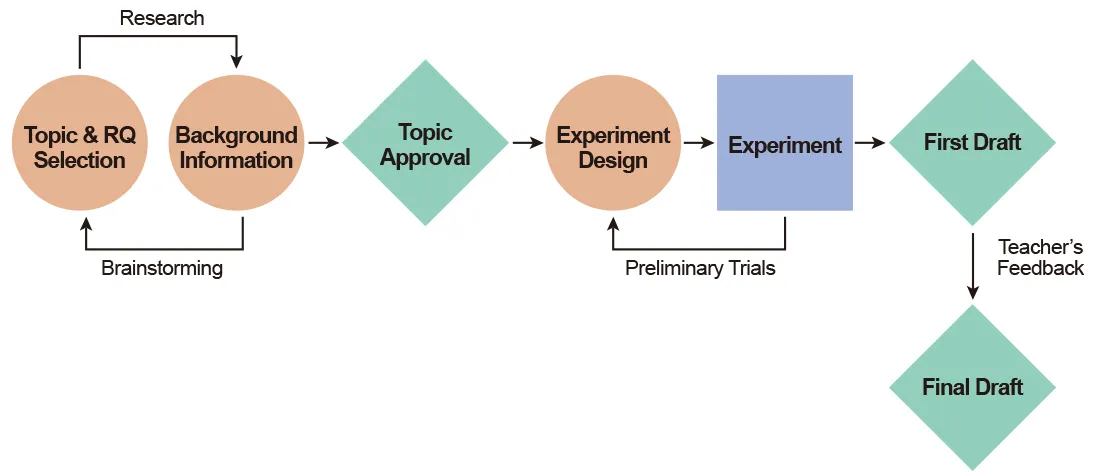
1.
Topic and RQ selection
•
Brainstorm topics of interest and conduct background research.
•
Refine your idea into a focused, testable research question (RQ).
2.
Topic Approval
•
Submit a Research Proposal to your teacher for RQ approval.
•
Revise your topic based on feasibility and available resources if needed.
3.
Experiment Design
•
Develop a clear methodology, outlining variables, materials, and procedures.
•
Conduct preliminary trials to fine-tune the experimental setup and procedure.
4.
Experiment
•
Execute the experiment, collect data, and document observations, including photos.
5.
First Draft
•
Write a polished first draft and submit it for teacher feedback.
•
You will only have one opportunity to receive teacher feedback, so your draft must be as complete, polished, and detailed as possible. Submitting a thorough draft will allow your teacher to provide meaningful, constructive feedback to help you improve.
•
Use this feedback carefully to refine and strengthen your IA, addressing any areas that need improvement.
6.
Final Draft
•
Edit, finalize, and ensure the IA adheres to IB criteria before submission.
4. Outline of IA Written Report
A well-organized IA report is essential for meeting the assessment criteria. While the IBO does not mandate a fixed format, the following structure mirrors that of a formal scientific article and aligns with the assessment rubrics:
1. Title Page (Optional): While it is not mandatory to have a title page, you must include the following information at the beginning of the written report.
•
Title of the IA: A concise and descriptive title reflecting your research question.
•
Student Information: Candidate’s personal code (and group members’ codes if applicable).
•
Word Count
2.
Introduction
•
Research Question
•
Background Information:
◦
Provide relevant biological concepts, theories, or prior research to justify your investigation.
◦
Establish the specific context of your experiment.
•
Variables: Identify and define:
◦
Independent Variable (IV): The variable you will manipulate.
◦
Dependent Variable (DV): The variable you will measure.
◦
Controlled Variables (CV): Variables you will keep constant to ensure reliability.
•
Hypothesis (Optional): State a hypothesis with justification based on background research.
3.
Research Design (Methodology)
•
Materials: List all equipment and materials used with quantities and uncertainties.
•
Preliminary Testing (Optional): Describe any preliminary trials and how they influenced the final procedure.
•
Procedure: Provide a clear, step-by-step method that is detailed enough for replication. Include diagrams if necessary.
•
Risk Assessment: Address safety, ethical, and environmental considerations, and explain how they were mitigated.
4.
Data Analysis
•
Raw Data:
◦
Present quantitative data in organized tables with appropriate headings, units, and uncertainties.
◦
Include qualitative observations, including photos.
•
Processed Data:
◦
Perform calculations (e.g., averages, standard deviations, rates).
◦
Provide sample calculations to show methodology.
◦
Present processed data using organized tables and graphs. Ensure all graphs include clear titles, labeled axes, and units.
•
Statistical Analysis: Apply appropriate statistical tools (e.g., t-test, chi-squared) and explain how they support the analysis.
5.
Conclusion
•
Answer to the Research Question: Provide a clear and direct answer based on your findings.
•
Interpretation of Results:
◦
Analyze trends, patterns, and anomalies in the data.
◦
Relate your findings to the research question and hypothesis.
•
Biological Explanation: Use biological principles or theories to justify and explain the results.
•
Comparison with Literature: Compare your findings with established scientific studies or expected outcomes, citing sources where relevant.
6.
Evaluation
•
Strengths and Weaknesses:
◦
Assess the reliability and validity of your experimental design and data.
◦
Discuss systematic errors (e.g., equipment precision) and random errors (e.g., measurement inconsistencies).
•
Improvements:
◦
Suggest realistic and specific improvements to address identified weaknesses (e.g., more precise equipment, increased sample size, etc.).
•
Limitations:
◦
Evaluate the extent to which your results answer the research question.
◦
Discuss constraints such as small sample sizes, variable limitations, or uncontrolled factors.
7.
References
•
Citation Style: Use a consistent style (e.g., APA, MLA) as per school or teacher guidelines. Citations should include both in-text and bibliography at the end of the document.
•
Bibliography: Include all referenced books, articles, websites, and other resources.
8.
Appendices (Optional): TInclude supplementary materials that support the report but are too detailed for the main body:
•
Raw Data: Include any raw data that could not fit in the main report, such as extensive tables, raw graphs, or logs that couldn’t fit earlier.
◦
E.g. The raw absorbance graph that’s obtained with a colorimeter
•
Sample Calculations: Step-by-step demonstration of calculations.
•
Additional Materials: Diagrams, protocols, or photographs relevant to the experiment.
Note: The main body of the report should be clear and concise. Avoid overwhelming readers with lengthy tables, graphs, or descriptions—include only the most relevant information to analyze and interpret your results effectively.
5. Word Count Limit
The IA report has a strict word limit of 3,000 words, which applies to the main body of the text. This includes sections such as the introduction, methodology, data analysis, conclusion, and evaluation. However, specific elements are excluded from the word count:
•
Charts and diagrams
•
Data tables
•
Equations, formulas, and calculations
•
Citations/references (whether parenthetical, numbered, footnotes, or endnotes)
•
Bibliography
•
Headers
Tips to Stay Within the Word Limit:
•
Use clear, concise scientific language — avoid redundancy or unnecessary jargon.
•
Prioritize clarity: focus on precision while communicating critical findings and analysis.
•
Present data efficiently using tables, graphs, or diagrams where possible to minimize excessive descriptions.
By adhering to the word count, you demonstrate your ability to communicate effectively—a key skill in scientific reporting.
6. Healthy Use of AI
AI resources like ChatGPT and Gemini can be incredibly helpful when designing your IA. You can use them to support your topic exploration, obtain useful sources while researching background information, and clarify complex biological concepts in scientific articles. AI can also help you summarize scientific literature, identify key variables, or refine your methodology. However, their primary role should be to support your understanding and planning, not to replace your independent work. Your IA must reflect your original thought process and personal engagement, so ensure the experiment and analysis remain entirely your own.
According to the IB Academic Integrity guidelines, any use of AI-generated information must be cited, just like any other external source. This includes instances where you either quote or paraphrase AI-generated text. Failing to acknowledge AI use could be considered a violation of academic integrity. Be transparent about how AI supported your work and avoid using it to generate data or plagiarize content, as this undermines the originality required for an IA. Always verify the accuracy of AI-generated information against reliable scientific sources, as AI-generated information can be false.
Demonstration of AI Usage
Tips for Research:
•
Use tools like Zotero to organize and keep track of all articles and resources collected during your research.
•
Carefully record key facts and details that will help determine the conditions of your experiment, ensuring you can cite them appropriately in your report.