
Mission
home

5.5 Application of Integration

Q1

Topic
5.5 Applications of integration
Tag
Integration Area Inverse Function Area Between Two Functions Solids of Revolution Kinematics Trigonometric Functions Logarithmic Functions Intercepts By Parts Substitution Partial Fractions Related Rates
Source
N17/5/MATHL/HP1/ENG/TZ0/XX/5
Question Text
A particle moves in a straight line such that at time tt seconds (t0)(t \geq 0), its velocity vv, in ms1m s^{-1}, is given by v=8te2tv=8 t e^{-2 t}. The exact distance travelled by the particle in the first second can be written as abe2a-\frac{b}{e^2} where a,bZ+a, b \in \mathbb{Z}^{+}. Find the value of a+ba+b.
Total Mark
5
Correct Answer
8
Explanation
na
Mark Scheme
Tip 1: Distance travelled can be found by integrating the velocity at a given time interval. s=018te2tdts=\int_0^1 8 t e^{-2 t} d t Tip 2: Notice that integration by parts can be applied =[4te2t]0101(4e2t)dt=[4te2t2e2t]01s=6e2+2=26e2\begin{aligned} & =\left[-4 t e^{-2 t}\right]_0^1-\int_0^1\left(-4 e^{-2 t}\right) d t \\ = & {\left[-4 t e^{-2 t}-2 e^{-2 t}\right]_0^1 } \\ s & =-6 e^{-2}+2=2-\frac{6}{e^2} \end{aligned} Answer: a=2,b=6a=2, b=6

Q2

Topic
5.5 Applications of integration
Tag
Source
M16-TZ1-P1-13(HL)
Question Text
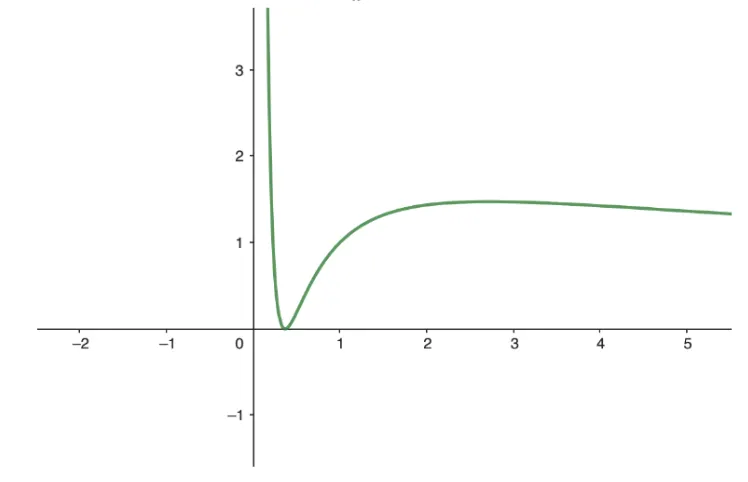
The following diagram shows the graph of y=(lnx+1)2x,x>0y=\frac{(\ln x+1)^2}{x}, x>0.
Question Text
The region RR is enclosed by the curve, the xx-axis and the line x=e2x=e^2. (a) Use an appropriate substitution to find the area of region RR.
Total Mark
6
Correct Answer
9
Explanation
na
Mark Scheme
Set lnx+1=u\ln x+1=u, dudx=1x(lnx+1)2xdx=u2dudxdx=u2du\begin{gathered} \frac{d u}{d x}=\frac{1}{x} \\ \int \frac{(\ln x+1)^2}{x} d x=\int u^2 \frac{d u}{d x} d x=\int u^2 d u \end{gathered} As lne2+1=3,ln(e)+1=0\ln e^2+1=3, \ln (-e)+1=0  area =[13u3]03=9\text { area }=\left[\frac{1}{3} u^3\right]_0^3=9 Answer: 9
Question Text
Let In=1e(lnx+1)nx2dx,nNI_n=\int_1^e \frac{(\ln x+1)^n}{x^2} d x, n \in N (b) (i) Find the value of I0I_0. [multuiple choice] (a) 1 (b) ee (c) 1e-\frac{1}{e} (d) 11e1-\frac{1}{e} Total Mark : 1 Correct Answer : d Explanation : na Mark Scheme : I0=1e1x2dx=[1x]1e=11eI_0=\int_1^e \frac{1}{x^2} d x=\left[-\frac{1}{x}\right]_1^e=1-\frac{1}{e} Answer: D (ii) Which statement correctly relates InI_n with In1I_{n-1} ? [multiple choice] (a) In=1e+nIn1I_n=-\frac{1}{e}+n I_{n-1} (b) In=2e+1+nIn1I_n=-\frac{2}{e}+1+n I_{n-1} (c) In=1e+nIn1I_n=\frac{1}{e}+n I_{n-1} (d) In=1e+1+nIn1I_n=\frac{1}{e}+1+n I_{n-1} Total Mark : 2 Correct Answer : b Explanation : na Mark Scheme : use of integration by parts u=(lnx+1)n,dudx=n(lnx+1)n1x,dvdx=1x2,v=1xIn=[1x(lnx+1)n]1e+1en(lnx+1)n1x2dxIn=2e+1+nIn1\begin{aligned} & u=(\ln x+1)^n, \frac{d u}{d x}=\frac{n(\ln x+1)^{n-1}}{x}, \frac{d v}{d x}=\frac{1}{x^2}, v=-\frac{1}{x} \\ & I_n=\left[-\frac{1}{x}(\ln x+1)^n\right]1^e+\int_1^e \frac{n(\ln x+1)^{n-1}}{x^2} d x \\ & \\ & I_n=-\frac{2}{e}+1+n I{n-1} \end{aligned} Answer: B (iii) Hence find the value of I1I_1. (a) 2+1e2+\frac{1}{e} (b) 2+3e2+\frac{3}{e} (c) 21e2-\frac{1}{e} (d) 23e2-\frac{3}{e} Total Mark : 7 Correct Answer : d Explanation : na Mark Scheme : I1=2e+1+I0I1=2e+1+11e=23e\begin{gathered} I_1=-\frac{2}{e}+1+I_0 \\ I_1=-\frac{2}{e}+1+1-\frac{1}{e}=2-\frac{3}{e} \end{gathered} Answer: DD

Q3

Topic
5.5 Applications of integration
Tag
Integration Area Inverse Function Area Between Two Functions Solids of Revolution Kinematics Trigonometric Functions Logarithmic Functions Intercepts By Parts Substitution Partial Fractions Related Rates
Source
N16-TZ0-P1-11(HL)
Question Text
Let y=excosxy=e^x \cos x (a) Find an expression for dydx\frac{d y}{d x}. [multiple choice] (a) dydx=exsinx\frac{d y}{d x}=-e^x \sin x (b) dydx=exsinx\frac{d y}{d x}=e^x \sin x (c) dydx=excosxexsinx\frac{d y}{d x}=e^x \cos x-e^x \sin x (d) dydx=excosx+exsinx\frac{d y}{d x}=e^x \cos x+e^x \sin x
Total Mark
2
Correct Answer
c
Explanation
na
Mark Scheme
Using the product rule dydx=excosxexsinx\frac{d y}{d x}=e^x \cos x-e^x \sin x Answer: C
Question Text
(b) Find an expression for d2ydx2\frac{d^2 y}{d x^2}. (a) d2ydx2=2exsinx\frac{d^2 y}{d x^2}=2 e^x \sin x (b) d2ydx2=2exsinx\frac{d^2 y}{d x^2}=-2 e^x \sin x (c) d2ydx2=excosxexsinx\frac{d^2 y}{d x^2}=e^x \cos x-e^x \sin x (d) d2ydx2=excosx+exsinx\frac{d^2 y}{d x^2}=e^x \cos x+e^x \sin x
Total Mark
2
Correct Answer
b
Explanation
na
Mark Scheme
d2ydx2=ex(cosxsinx)ex(sinx+cosx)=2exsinx\frac{d^2 y}{d x^2}=e^x(\cos x-\sin x)-e^x(\sin x+\cos x)=-2 e^x \sin x Answer: B
Question Text
Consider the function ff defined by f(x)=excosx,π2xπ2f(x)=e^x \cos x,-\frac{\pi}{2} \leq x \leq \frac{\pi}{2}. (c) The function ff has a local maximum value when x=πnx=\frac{\pi}{n}. Find the value of nn when nZ+n \in Z^{+}
Total Mark
2
Correct Answer
4
Explanation
na
Mark Scheme
dydx=ex(cosxsinx)=0cosx=sinx\begin{gathered} \frac{d y}{d x}=e^x(\cos x-\sin x)=0 \\ \cos x=\sin x \end{gathered} x=π4x=\frac{\pi}{4} hence maximum at x=π4x=\frac{\pi}{4} Answer: 4
Question Text
(d) Find the xx-coordinate of the point of inflextion of the graph f(x)f(x)
Total Mark
2
Correct Answer
0
Explanation
na
Mark Scheme
d2ydx2=2exsinx=0x=0\begin{gathered} \frac{d^2 y}{d x^2}=-2 e^x \sin x=0 \\ x=0 \end{gathered} Answer: 0
Question Text
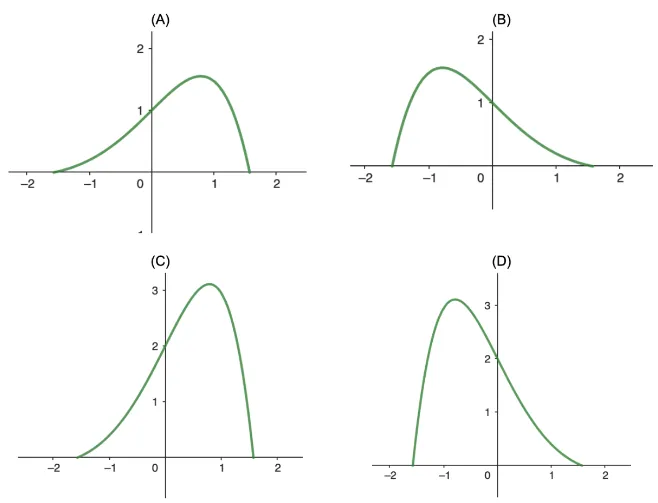
(e) Sketch the graph of ff, clearly indicating the position of the local maximum point, the point of inflexion and the axes intercepts.
Total Mark
3
Correct Answer
a
Explanation
na
Mark Scheme
na
Question Text
(f) Find the area of the region enclosed by the graph of ff and the xx - axis. (a) eπ/22\frac{e^{-\pi / 2}}{2} (b) eπ/22\frac{e^{\pi / 2}}{2} (c) eπ+eπ2\frac{e^\pi+e^{-\pi}}{2} (d) eπ/2+eπ/22\frac{e^{\pi / 2}+e^{-\pi / 2}}{2}
Total Mark
6
Correct Answer
d
Explanation
na
Mark Scheme
Integration by parts π/2π/2excosxdx=[excosx]π/2π/2+π/2π/2exsinxdx=[excosx]π/2π/2+[exsinx]π/2π/2π/2π/2excosxdx\begin{aligned} & \int_{-\pi / 2}^{\pi / 2} e^x \cos x d x=\left[e^x \cos x\right]{-\pi / 2}^{\pi / 2}+\int{-\pi / 2}^{\pi / 2} e^x \sin x d x \\ & =\left[e^x \cos x\right]{-\pi / 2}^{\pi / 2}+\left[e^x \sin x\right]{-\pi / 2}^{\pi / 2}-\int_{-\pi / 2}^{\pi / 2} e^x \cos x d x \end{aligned} Setting I=π/2π/2excosxdxI=\int_{-\pi / 2}^{\pi / 2} e^x \cos x d x, I=[excosx]π/2π/2+[exsinx]π/2π/2I2I=[excosx]π/2π/2+[exsinx]π/2π/2I=eπ/2+eπ/22\begin{gathered} I=\left[e^x \cos x\right]{-\pi / 2}^{\pi / 2}+\left[e^x \sin x\right]{-\pi / 2}^{\pi / 2}-I \\ 2 I=\left[e^x \cos x\right]{-\pi / 2}^{\pi / 2}+\left[e^x \sin x\right]{-\pi / 2}^{\pi / 2} \\ I=\frac{e^{\pi / 2}+e^{-\pi / 2}}{2} \end{gathered} Answer: D

Q4

Topic
5.5 Applications of integration
Tag
Integration Area Inverse Function Area Between Two Functions Solids of Revolution Kinematics Trigonometric Functions Logarithmic Functions Intercepts By Parts Substitution Partial Fractions Related Rates
Source
M16-TZ2-P1-11(HL)
Question Text
The graph of x=2sin2y+3,0yπx=2 \sin 2 y+3,0 \leq y \leq \pi is rotated 360 degrees about the yy-axis to form a volume of revolution. (a) The volume generated can be written in the form aπ2a \pi^2 where aZ+a \in Z^{+}. Find the value of aa.
Total Mark
8
Correct Answer
11
Explanation
na
Mark Scheme
use of πabx2dy\pi \int_a^b x^2 d y V=π0π(2sin2y+3)2dy=π0π(4sin22y+12sin2y+9)dy\begin{gathered} V=\pi \int_0^\pi(2 \sin 2 y+3)^2 d y \\ =\pi \int_0^\pi\left(4 \sin ^2 2 y+12 \sin 2 y+9\right) d y \end{gathered} As 4sin22y=2(1cos4y)4 \sin ^2 2 y=2(1-\cos 4 y) =π0π(12sin2y2cos4y+11)dy=π[6cos2y12sin4y+11y]0π=π(6+11π+6)=11π2\begin{aligned} & =\pi \int_0^\pi(12 \sin 2 y-2 \cos 4 y+11) d y \\ & =\pi\left[-6 \cos 2 y-\frac{1}{2} \sin 4 y+11 y\right]_0^\pi \\ & =\pi(-6+11 \pi+6)=11 \pi^2 \end{aligned} Answer: 11
Question Text
(b) A container with this shape is made with a solid base of diameter 6 cm . The container is filled with water a tt a rate of 1 cm3 min11 \mathrm{~cm}^3 \mathrm{~min}^{-1}. At time tt minutes, the water depth is h cm,0hπh \mathrm{~cm}, 0 \leq h \leq \pi and the volume of water in the container V cm3V \mathrm{~cm}^3. (i) Given that dVdh=π(2sin2h+3)2\frac{d V}{d h}=\pi(2 \sin 2 h+3)^2, find an expression for dhdt\frac{d h}{d t}. (a) dhdt=1π(2cos2h+3)2\frac{d h}{d t}=\frac{1}{\pi(2 \cos 2 h+3)^2} (b) dhdt=1π(2sin2h+3)2\frac{d h}{d t}=\frac{1}{\pi(2 \sin 2 h+3)^2} (c) dhdt=π(2cos2h+3)2\frac{d h}{d t}=\pi(2 \cos 2 h+3)^2 (d) dhdt=π(2sin2h+3)2\frac{d h}{d t}=\pi(2 \sin 2 h+3)^2 Total Mark : 3 Correct Answer : b Explanation : na Mark Scheme : use dhdt=dVdt×dhdV\frac{d h}{d t}=\frac{d V}{d t} \times \frac{d h}{d V} with dVdt=1\frac{d V}{d t}=1 dhdt=1π(2sin2h+3)2\frac{d h}{d t}=\frac{1}{\pi(2 \sin 2 h+3)^2} Answer: B (ii) The value of dhdt\frac{d h}{d t} when h=π4h=\frac{\pi}{4} can be written as 1nπ\frac{1}{n \pi} where nZ+n \in Z^{+}. Find the value of nn. Total Mark : 4 Correct Answer : 25 Explanation : na Mark Scheme : substituting h=π4h=\frac{\pi}{4} into dhdt\frac{d h}{d t} dhdt=1π(2sin(π4)+3)2=125π\frac{d h}{d t}=\frac{1}{\pi\left(2 \sin \left(\frac{\pi}{4}\right)+3\right)^2}=\frac{1}{25 \pi} Answer: 25
Question Text
(c) (i) Find d2hdt2\frac{d^2 h}{d t^2}. Total Mark : ? Correct Answer : 8cos2hπ2(2cos2h+3)5\frac{-8 \cos 2 h}{\pi^2(2 \cos 2 h+3)^5} Explanation : na Mark Scheme : d2hdt2=ddt(dhdt)=dhdt×ddh(dhdt)\frac{d^2 h}{d t^2}=\frac{d}{d t}\left(\frac{d h}{d t}\right)=\frac{d h}{d t} \times \frac{d}{d h}\left(\frac{d h}{d t}\right) =1π(2sin2h+3)2×2×4cos2hπ(2sin2h+3)3=8cos2hπ2(2cos2h+3)5\begin{gathered} =\frac{1}{\pi(2 \sin 2 h+3)^2} \times \frac{-2 \times 4 \cos 2 h}{\pi(2 \sin 2 h+3)^3} \\ =\frac{-8 \cos 2 h}{\pi^2(2 \cos 2 h+3)^5} \end{gathered} (ii) Select all the values of hh for which d2hdt2=0\frac{d^2 h}{d t^2}=0 (select all that apply) (a) 0 (b) π4\frac{\pi}{4} (c) π2\frac{\pi}{2} (d) 3π4\frac{3 \pi}{4} (e) π\pi Total Mark : 5 Correct Answer : b,d Explanation : na Mark Scheme : cos2h=0h=π4,3π4\begin{aligned} & \cos 2 h=0 \\ & h=\frac{\pi}{4}, \frac{3 \pi}{4} \end{aligned} Answer: B, D

Q5

Topic
5.5 Applications of integration
Tag
Integration Area Inverse Function Area Between Two Functions Solids of Revolution Kinematics Trigonometric Functions Logarithmic Functions Intercepts By Parts Substitution Partial Fractions Related Rates
Source
M15-TZ2-P1-11(HL)
Question Text
Consider the functions f(x)=tanx,0x<π2f(x)=\tan x, 0 \leq x<\frac{\pi}{2} and g(x)=x1x+1,xR,x1g(x)=\frac{x-1}{x+1}, x \in R, x \neq 1. (a) Find the correct expression for gf(x)g \circ f(x)[multiple choice] (a) gf(x)=tanx+1tanx1g \circ f(x)=\frac{\tan x+1}{\tan x-1} (b) gf(x)=sinxcosxsinx+cosxg \circ f(x)=\frac{\sin x-\cos x}{\sin x+\cos x} (c) gf(x)=sinx+cosxsinxcosxg \circ f(x)=\frac{\sin x+\cos x}{\sin x-\cos x} (d) gf(x)=sinxcosxg \circ f(x)=\frac{\sin x}{\cos x}
Total Mark
2
Correct Answer
b
Explanation
na
Mark Scheme
gf(x)=tanx1tanx+1tanx+1tanx1=sinxcosx1sinxcosx+1=sinxcosxsinx+cosx\begin{gathered} g \circ f(x)=\frac{\tan x-1}{\tan x+1} \\ \frac{\tan x+1}{\tan x-1}=\frac{\frac{\sin x}{\cos x}-1}{\frac{\sin x}{\cos x}+1}=\frac{\sin x-\cos x}{\sin x+\cos x} \end{gathered} Answer: B
Question Text
(b) Find the area bounded by the graph of y=gf(x)y=g \circ f(x), the xx-axis and the lines x=0x=0 and x=π6x=\frac{\pi}{6}. (a) 3+1\sqrt{3}+1 (b) ln(3+1)\ln (\sqrt{3}+1) (c) 31\sqrt{3}-1 (d) ln(31)\ln (\sqrt{3}-1)
Total Mark
6
Correct Answer
d
Explanation
na
Mark Scheme
 Area =0π6sinxcosxsinx+cosxdx=[lnsinx+cosx]0π6=lnsinπ6+cosπ6+lnsin0+cos0=ln12+32=ln23+1=ln(31)\begin{aligned} & \text { Area }=\left|\int_0^{\frac{\pi}{6}} \frac{\sin x-\cos x}{\sin x+\cos x} d x\right| \\ & =\left|[-\ln |\sin x+\cos x|]_0^{\frac{\pi}{6}}\right| \\ & \left.=|-\ln | \sin \frac{\pi}{6}+\cos \frac{\pi}{6}|+\ln | \sin 0+\cos 0 \right\rvert\, \\ & =-\ln \left|\frac{1}{2}+\frac{\sqrt{3}}{2}\right|=\ln \frac{2}{\sqrt{3}+1}=\ln (\sqrt{3}-1) \end{aligned} Answer: D

Q6

Topic
5.5 Applications of integration
Tag
Integration Area Inverse Function Area Between Two Functions Solids of Revolution Kinematics Trigonometric Functions Logarithmic Functions Intercepts By Parts Substitution Partial Fractions Related Rates
Source
N13-TZ0-P1-12(HL)
Question Text
Consider the complex number z=cosθisinθz=\cos \theta-i \sin \theta. (a) The value of 16cos4θ16 \cos ^4 \theta can be written as acos4θ+bcos2θ+c,a,b,cZ+a \cos 4 \theta+b \cos 2 \theta+c, a, b, c \in Z^{+}. By considering (z+z1)4\left(z+z^{-1}\right)^4, find the value of a+b+ca+b+c
Total Mark
5
Correct Answer
16
Explanation
na
Mark Scheme
(z+z1)4=z4+4z3(1z)+6z2(1z2)+4z(1z3)+1z4(z+z1)4=(z4+1z4)+4(z2+1z2)+6\left(z+z^{-1}\right)^4=z^4+4 z^3\left(\frac{1}{z}\right)+6 z^2\left(\frac{1}{z^2}\right)+4 z\left(\frac{1}{z^3}\right)+\frac{1}{z^4} \\ \left(z+z^{-1}\right)^4=\left(z^4+\frac{1}{z^4}\right)+4\left(z^2+\frac{1}{z^2}\right)+6 \\ As z=cos(θ)+isin(θ)z=\cos (-\theta)+i \sin (-\theta) (2cos(θ))4=2cos4θ+8cos2θ+6\quad(2 \cos (-\theta))^4=2 \cos 4 \theta+8 \cos 2 \theta+6 Answer: 16
Question Text
(b) Hence find the value of 0π2cos4θdθ\int_0^{\frac{\pi}{2}} \cos ^4 \theta d \theta. (a) 3π16\frac{3\pi }{16} (b) 5π16\frac{5\pi }{16} (c) π4\frac{\pi }{4} (d) π16\frac{\pi }{16}
Total Mark
3
Correct Answer
a
Explanation
na
Mark Scheme
0π2cos4θdθ=0π2(18cos4θ+12cos2θ+38)dθ=[132sin4θ+14sin2θ+38θ]0π2=3π16\begin{aligned} & \int_0^{\frac{\pi}{2}} \cos ^4 \theta d \theta=\int_0^{\frac{\pi}{2}}\left(\frac{1}{8} \cos 4 \theta+\frac{1}{2} \cos 2 \theta+\frac{3}{8}\right) d \theta \\ & \quad=\left[\frac{1}{32} \sin 4 \theta+\frac{1}{4} \sin 2 \theta+\frac{3}{8} \theta\right]_0^{\frac{\pi}{2}}=\frac{3 \pi}{16}\end{aligned}
Question Text
(c) (i) Write down an expression for the constant term in the expansion of (z+z1)6,kZ+\left(z+z^{-1}\right)^6, k \in Z^{+}. Total Mark : 4 Correct Answer : 20 Explanation : na Mark Scheme : constant term = 6!3!3!=20\frac{6!}{3!3!}=20 Answer: 20 (ii) Hence, if 0π2cos6θdθ\int_0^{\frac{\pi}{2}} \cos ^6 \theta d \theta can be written as aπb\frac{a \pi}{b} where a,ba, b are positive integers in lowest terms, find the value of a+ba+b. Total Mark : 5 Correct Answer : 37 Explanation : na Mark Scheme : Considering the answer found in part (b), all other terms except for the constant term is equal to 0. 20π2cos6θdθ=[20×θ]0π20π2cos6θdθ=10π64=5π32\begin{aligned} & 2 \int_0^{\frac{\pi}{2}} \cos ^6 \theta d \theta=[20 \times \theta]_0^{\frac{\pi}{2}} \\ & \int_0^{\frac{\pi}{2}} \cos ^6 \theta d \theta=\frac{10 \pi}{64}=\frac{5 \pi}{32} \end{aligned} Answer: 37
Question Text
(d) The graph of f(x)=sinxcos2x0xπ2f(x)=\sin x \cos ^2 x 0 \leq x \leq \frac{\pi}{2} is rotated by around the xx-axis. The volume of this solid can be written as aπ2b\frac{a \pi^2}{b} where a,ba, b are positive integers in lowest terms. Find the value of a+ba+b.
Total Mark
6
Correct Answer
33
Explanation
na
Mark Scheme
V=π0π2sin2xcos4xdxV=\pi \int_0^{\frac{\pi}{2}} \sin ^2 x \cos ^4 x d x Using sin2x=1cos2x\sin ^2 x=1-\cos ^2 x π0π2cos4xdxπ0π2cos6xdx=3π2165π232=π232\pi \int_0^{\frac{\pi}{2}} \cos ^4 x d x-\pi \int_0^{\frac{\pi}{2}} \cos ^6 x d x=\frac{3 \pi^2}{16}-\frac{5 \pi^2}{32}=\frac{\pi^2}{32} Answer: 33

Q7

Topic
5.5 Applications of integration
Tag
Integration Area Inverse Function Area Between Two Functions Solids of Revolution Kinematics Trigonometric Functions Logarithmic Functions Intercepts By Parts Substitution Partial Fractions Related Rates
Source
N19/5/MATHL/HP1/ENG/TZ1/XX/10d
Question Text
Consider f(x)=2x3x21f(x)=\frac{2 x-3}{x^2-1} (a) The value of 2x3x21\frac{2 x-3}{x^2-1} can be written as Bx+1Ax1\frac{B}{x+1}-\frac{A}{x-1} where BB is a prime number. Find the value of A+BA+B.
Total Mark
4
Correct Answer
3
Explanation
n/a
Mark Scheme
Bx+1Ax1=B(x1)A(x+1)x21(BA)xABx21=2x3x21\begin{gathered} \frac{B}{x+1}-\frac{A}{x-1}=\frac{B(x-1)-A(x+1)}{x^2-1} \\ \frac{(B-A) x-A-B}{x^2-1}=\frac{2 x-3}{x^2-1} \end{gathered} A=12,B=52A=\frac{1}{2}, B=\frac{5}{2} Answer: 3
Question Text
(b) The value of 2012f(x)dx2 \int_0^{\frac{1}{2}} f(x) d x can be written as lnab\ln \frac{a}{b} where a,ba, b are positive integers in lowest terms FInd the value of a+ba+b.
Total Mark
7
Correct Answer
259
Explanation
n/a
Mark Scheme
2012f(x)dx=0125x+11x1d=[5lnx+1lnx1]012=(5ln32ln12(5ln1ln1))=ln3524=ln24316\begin{gathered} 2 \int_0^{\frac{1}{2}} f(x) d x=\int_0^{\frac{1}{2}} \frac{5}{x+1}-\frac{1}{x-1} d \\ =[5 \ln |x+1|-\ln |x-1|]_0^{\frac{1}{2}} \\ =\left(5 \ln \frac{3}{2}-\ln \frac{1}{2}-(5 \ln 1-\ln 1)\right) \\ =\ln \frac{3^5}{2^4} \\ =\ln \frac{243}{16} \end{gathered} Answer: 259

Q8

Topic
5.5 Applications of integration
Tag
Source
M19/5/MATHL/HP1/ENG/TZ2/XX/9
Question Text
Consider the functions ff and gg defined on the domain 0<x<2π0<x<2 \pi by f(x)=2cos2xf(x)=2 \cos 2 x and g(x)=15cosxg(x)=1-5 \cos x. (a) Select the all possible xx - coordinates of the points of intersection of the two graphs. (select all that apply) (a) π3\frac{\pi}{3} (b) 2π3\frac{2 \pi}{3} (c) π\pi (d) 4π3\frac{4 \pi}{3} (e) 5π3\frac{5 \pi}{3}
Total Mark
6
Correct Answer
a,e
Explanation
n/a
Mark Scheme
3cos2x=15cosx3 \cos 2 x=1-5 \cos x Use of cos2x=2cos2x1\cos 2 x=2 \cos ^2 x-1 3(2cos2x1)=15cosx6cos2x+3cosx4=0(2cosx1)(3cosx+4)=0cosx=12x=π3,5π3\begin{gathered} 3\left(2 \cos ^2 x-1\right)=1-5 \cos x \\ 6 \cos ^2 x+3 \cos x-4=0 \\ (2 \cos x-1)(3 \cos x+4)=0 \\ \cos x=\frac{1}{2} \\ x=\frac{\pi}{3}, \frac{5 \pi}{3} \end{gathered} Answer: (A), (E)
Question Text
(b) Find the area enclosed by the two graphs. [multiple choice] (a) 4π3+53\frac{4 \pi}{3}+5 \sqrt{3} (b) 2π3+43\frac{2 \pi}{3}+4 \sqrt{3} (c) π3+33\frac{\pi}{3}+3 \sqrt{3} (d) π3+23\frac{\pi}{3}+2 \sqrt{3}
Total Mark
3
Correct Answer
a
Explanation
n/a
Mark Scheme
π35π3(15cosx3cos2x)dx=[x5sinx32sin2x]π35π3=5π3+53232×32(π353232×32)=4π3+53=4π3+53\begin{gathered} \left|\int_{\frac{\pi}{3}}^{\frac{5 \pi}{3}}(1-5 \cos x-3 \cos 2 x) d x\right| \\ =\left|\left[x-5 \sin x-\frac{3}{2} \sin 2 x\right]_{\frac{\pi}{3}}^{\frac{5 \pi}{3}}\right| \\ =\left|\frac{5 \pi}{3}+5 \frac{\sqrt{3}}{2}-\frac{3}{2} \times \frac{\sqrt{3}}{2}-\left(\frac{\pi}{3}-5 \frac{\sqrt{3}}{2}-\frac{3}{2} \times \frac{\sqrt{3}}{2}\right)\right| \\ =\left|\frac{4 \pi}{3}+5 \sqrt{3}\right|=\frac{4 \pi}{3}+5 \sqrt{3} \end{gathered} Answer: (A)

Q9

Topic
5.5 Applications of integration
Tag
Source
N18/5/MATHL/HP1/ENG/TZ0/XX/10
Question Text
(a) Use integration by parts tofind the value of exsin2xdx\int e^x \sin 2 x d x. [multiple choice] (a) ex5sin2x+ex5cos2x+c\frac{e^x}{5} \sin 2 x+\frac{e^x}{5} \cos 2 x+c (b) 3ex5sin2x2ex5cos2x+c\frac{3 e^x}{5} \sin 2 x-\frac{2 e^x}{5} \cos 2 x+c (c) 4ex5sin2x+3ex5cos2x+c\frac{4 e^x}{5} \sin 2 x+\frac{3 e^x}{5} \cos 2 x+c (d) ex5sin2x2ex5cos2x+c\frac{e^x}{5} \sin 2 x-\frac{2 e^x}{5} \cos 2 x+c
Total Mark
5
Correct Answer
d
Explanation
n/a
Mark Scheme
Attempt at integration by parts with u=ex,dvdx=sin2xu=e^x, \frac{d v}{d x}=\sin 2 x exsin2xdx=ex2cos2xdx+ex2cos2xdx=ex2cos2x+12(ex2sin2xex2sin2x)\begin{aligned} & \int e^x \sin 2 x d x=-\frac{e^x}{2} \cos 2 x d x+\int \frac{e^x}{2} \cos 2 x d x \\ & =-\frac{e^x}{2} \cos 2 x+\frac{1}{2}\left(\frac{e^x}{2} \sin 2 x-\int \frac{e^x}{2} \sin 2 x\right) \end{aligned} Rearranging, 54exsin2xdx=ex4sin2xex2cos2x+cexsin2xdx=ex5sin2x2ex5cos2x+c\begin{aligned} & \frac{5}{4} \int e^x \sin 2 x d x=\frac{e^x}{4} \sin 2 x-\frac{e^x}{2} \cos 2 x+c \\ & \int e^x \sin 2 x d x=\frac{e^x}{5} \sin 2 x-\frac{2 e^x}{5} \cos 2 x+c \end{aligned} Answer: D
Question Text
(b) Hence, find the value of excosxsinxdx\int e^x \cos x \sin x d x. (a) ex10sin2x+ex10cos2x+c\frac{e^x}{10} \sin 2 x+\frac{e^x}{10} \cos 2 x+c (b) 3ex10sin2xex5cos2x+c\frac{3 e^x}{10} \sin 2 x-\frac{e^x}{5} \cos 2 x+c (c) 2ex5sin2x+3ex10cos2x+c\frac{2 e^x}{5} \sin 2 x+\frac{3 e^x}{10} \cos 2 x+c (d) ex10sin2xex5cos2x+c\frac{e^x}{10} \sin 2 x-\frac{e^x}{5} \cos 2 x+c
Total Mark
3
Correct Answer
d
Explanation
n/a
Mark Scheme
As sin2x=2sinxcosx\sin 2 x=2 \sin x \cos x exsinxcosxdx=12exsin2xdxexsinxcosxdx=ex10sin2xex5cos2x+c\begin{gathered} \int e^x \sin x \cos x d x=\frac{1}{2} \int e^x \sin 2 x d x \\ \int e^x \sin x \cos x d x=\frac{e^x}{10} \sin 2 x-\frac{e^x}{5} \cos 2 x+c \end{gathered} Answer: D
Question Text
(c) Given 1xπ1 \leq x \leq \pi, find the xx-intercepts of f(x)=excosxsinxf(x)=e^x \cos x \sin x. (select all that apply) (a) π6\frac{\pi}{6} (b) π3\frac{\pi}{3} (c) π2\frac{\pi}{2} (d) 5π6\frac{5 \pi}{6} (e) π\pi
Total Mark
3
Correct Answer
c,e
Explanation
n/a
Mark Scheme
excosxsinx=0sin2x=0x=π2,π\begin{gathered} e^x \cos x \sin x=0 \\ \sin 2 x=0 \\ x=\frac{\pi}{2}, \pi \end{gathered} Answer: C, E
Question Text
(d) Find the area enclosed by the curve and the xx-axis between the two x-intercepts, as shaded on the diagram. [multiple choice] (a) eπ/25\frac{e^{\pi / 2}}{5} (b) eπ/2+eπ/35\frac{e^{\pi / 2}+e^{\pi / 3}}{5} (c) eπ5\frac{e^\pi}{5} (d) eπ+eπ/25\frac{e^\pi+e^{\pi / 2}}{5}
Total Mark
5
Correct Answer
d
Explanation
n/a
Mark Scheme
π/2πexsinxcosxdx=[ex10sin2xex5cos2x]π2π=eπ5(eπ/25)=eπ+eπ/25\begin{gathered} \left|\int_{\pi / 2}^\pi e^x \sin x \cos x d x\right|=\left|\left[\frac{e^x}{10} \sin 2 x-\frac{e^x}{5} \cos 2 x\right]_{\frac{\pi}{2}}^\pi\right| \\ =\left|-\frac{e^\pi}{5}-\left(\frac{e^{\pi / 2}}{5}\right)\right|=\frac{e^\pi+e^{\pi / 2}}{5} \end{gathered} Answer: D

Q10

Topic
5.5 Applications of integration
Tag
Source
M18/5/MATHL/HP1/ENG/TZ2/XX/8
Question Text
(a) Use the substitution u=exu=e^x to find 1ex+4exdx\int \frac{1}{e^x+4 e^{-x}} d x. [multiple choice] (a) 12arcsin(ex2)+c\frac{1}{2} \arcsin \left(\frac{e^x}{2}\right)+c (b) 12arctan(ex2)+c\frac{1}{2} \arctan \left(\frac{e^x}{2}\right)+c (c) arctan(ex)+c\arctan \left(e^x\right)+c (d) arcsin(ex)+c\arcsin \left(e^x\right)+c
Total Mark
4
Correct Answer
b
Explanation
na
Mark Scheme
dudx=ex1u+4u1×1udu1u2+4du=12arctan(u2)+c=12arctan(ex2)+c\begin{gathered} \frac{d u}{d x}=e^x \\ \int \frac{1}{u+4 u^{-1}} \times \frac{1}{u} d u \\ \int \frac{1}{u^2+4} d u=\frac{1}{2} \arctan \left(\frac{u}{2}\right)+c=\frac{1}{2} \arctan \left(\frac{e^x}{2}\right)+c \end{gathered} Answer: B
Question Text
(b) Hence, if the value of 2ln2ln231ex+4exdx2 \int_{\ln 2}^{\ln 2 \sqrt{3}} \frac{1}{e^x+4 e^{-x}} d x can expressed as πn\frac{\pi}{n}, where nZn \in Z, find the value of nn
Total Mark
3
Correct Answer
6
Explanation
na
Mark Scheme
2ln2ln231ex+4exdx=[arctan(ex2)]ln2ln23=arctan(3)arctan(1)=π3π2=π6\begin{aligned} & 2 \int_{\ln 2}^{\ln 2 \sqrt{3}} \frac{1}{e^x+4 e^{-x}} d x=\left[\arctan \left(\frac{e^x}{2}\right)\right]_{\ln 2}^{\ln 2 \sqrt{3}} \\ & =\arctan (\sqrt{3})-\arctan (1)=\frac{\pi}{3}-\frac{\pi}{2}=\frac{\pi}{6} \end{aligned} Answer: 6