

a. Exemplar 1
Global issue:
The effects of gender-based power imbalances on female psychology |
Texts chosen Literary work:
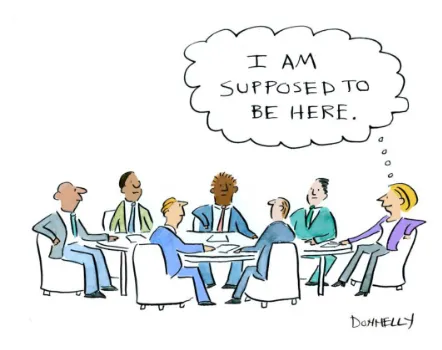
A Doll’s House by Henrik Ibsen Non-literary work: “I am supposed to be here” by Liza Donnelly |
Literary Extract:
1 Helmer. Is it my little squirrel bustling about?
Nora. Yes!
Helmer. When did my squirrel come home?
Nora. Just now. (Puts the bag of macaroons into her pocket and
5 wipes her mouth.) Come in here, Torvald, and see what I have
bought.
Helmer. Don‘t disturb me. (A little later, he opens the door and
looks into the room, pen in hand.) Bought, did you say? All these
things? Has my little spendthrift been wasting money again?
10 Nora. Yes, but, Torvald, this year we really can let ourselves go a
little. This is the first Christmas that we have not needed to
economize.
Helmer. Still, you know, we can‘t spend money recklessly.
Nora. Yes, Torvald, we may be a wee bit more reckless now,
15 mayn‘t we? Just a tiny wee bit! You are going to have a big salary
and earn lots and lots of money.
Helmer. Yes, after the New Year; but then it will be a whole quarter
before the salary is due.
Nora. Pooh! we can borrow till then.
20 Helmer. Nora! (Goes up to her and takes her playfully by the ear.)
The same little featherhead! Suppose, now, that I borrowed fifty
pounds today, and you spent it all in the Christmas week, and then
on New Year‘s Eve a slate fell on my head and killed me, and—
Nora (putting her hands over his mouth). Oh! don‘t say such horrid
25 things.
Helmer. Still, suppose that happened,—what then?
Nora. If that were to happen, I don‘t suppose I should care whether
I owed money or not.
Helmer. Yes, but what about the people who had lent it?
30 Nora. They? Who would bother about them? I should not know
who they were.
Helmer. That is like a woman! But seriously, Nora, you know what
I think about that. No debt, no borrowing. There can be no
freedom or beauty about a home life that depends on borrowing
35 and debt. We two have kept bravely on the straight road so far, and
we will go on the same way for the short time longer that there
need be any struggle.
Nora (moving towards the stove). As you please, Torvald.
Non-literary Extract:
Script
The global issue I will be exploring in this individual oral, centers around the concept of power and more specifically, the effects of gender-based power imbalances on female psychology. Gender inequality has been existing for an extended period of time, and although much improved, we still see this problem in various areas in different forms such as in households and workplaces. The problem of gender inequality and how it affects female psychology can be seen in the two works I’ve chosen for this IO. The literary work I will explore is a 3 Act Norwegian play by Henrik Ibsen titled “A Doll’s House”, which is about a housewife, Nora, who slowly realizes the toxicity of the relationship with her husband, Torvald. The non-literary work I chose is a cartoon called “Supposed to be here” by Liza Donnelly, which presents an individual business woman at a male-dominant workplace. In the two works I’ve chosen, both authors explore how the main female characters are psychologically affected as a result of unequal gender power dynamics.
Starting with the literary extract taken from Act 1 of “A Doll’s House”, where Nora comes back from Christmas shopping and talks with Helmer about issues with saving money, Ibsen explores the global issue through Helmer who metaphorically refers to Nora as “my squirrel” and “my little skylark” which portrays Nora as Helmer’s possession. These small animals not only suggest the insignificance of Nora’s presence in Helmer’s life, but also degrades her worth through dehumanization. Along with these infantilizing nicknames, Helmer treats Nora like his pet as he says “come, come” or “what do you think I have got here?”. Ibsen deliberately makes Helmer resemble the way people talk to their domestic animals by using imperatives to set a condescending tone to convey how he maintains dominance in their conversation. Then, by showing the way Nora agrees and follows Helmer’s words, Ibsen depicts Nora’s conscious submissiveness of depending her decisions on her husband’s commands to directly portray gender imbalance. Through parallel phrases “No debt, No borrowing”, Ibsen exposes how Helmer restricts Nora from spending money, explicitly showing the amount of financial power he holds over his wife as well. He generalizes the act of borrowing money as women-like, revealing a negative stereotypical view on women and how he thinks of them as thoughtless and hopeless. Additionally, Nora’s lack of power is further presented in the stage direction of “putting the bag of macaroons into her pocket and wiping her mouth”. Although it is a small purchase of her favorite snack, Nora is unable to speak up for her choices but instead hides them as Helmer considers this as an unnecessary and wasteful action. Hence, due to her helpless position in this marital relationship, Nora experiences lack of freedom and mental struggle of having to comply with Helmer’s standards in making any decisions. Ibsen portrays Nora as being anxious even when undergoing such frivolous actions like buying a macaroon to vividly portray how gender imbalance negatively affects women’s psychology.
Although more than a 100 years has passed since the first performance of A Doll’s House, this global issue of gender inequality still continues to be evident in contemporary society. Donnelly’s cartoon from 2015 also explores the theme of psychological effects based on gender imbalance through several visual devices and linguistic choices. In the cartoon “Supposed to be here”, a man and woman sitting at each end of the table mirror each other by adopting the same posture. Due to the pressure she feels from being the only female worker in the meeting, the woman imitates the man’s confident attitude and attempts to fit in with the fellow male workers to reassure herself that she belongs there. Although her seat is for the head of the company, and she knows she cannot take that position, she tries to think that she is suitable by reminding herself “I am supposed to be here”. With this thought constantly in her mind, she internally alleviates her insecurities. This behavior represents women’s daily life of having to endure the oppression they experience in patriarchal society which makes them feel insecure. Wearing a purple blazer with pants, Donnelly makes her appearance resemble the male workers. However, the purple color signifies how she attempts to maintain aspects of her femininity with pride in order to avoid fully assimilating into masculinity. Furthermore, this may suggest that even with this effort, she cannot achieve the equal possession of power as there will still be external elements that differentiates her from men. In addition, men of various races are shown by the difference in skin color. By only illustrating one woman, Donnelly depicts that women are below men regardless of ethnicity. Despite the fact that white people normally take on dominant positions in society, in this cartoon, this white woman still feels a barrier against men, indicating the psychological struggle women must undergo coming from a low level of social hierarchy due to the imbalance in power between genders.
Now I will explain how this global issue is further explored in the wider bodies of work by both writers. Following the conversations between Nora and Helmer across the whole play, the power dynamic is most intensely shown towards the end of Act 3, where Helmer opens the letter from Krogstad. Although her intention was to save Helmer, worrying that her actions may degrade his reputation, he rages uncontrollably. In this scene, the contrast in length of each character’s lines is evident, suggesting another aspect of imbalance in power. While Helmer speaks in sets of 7 lines, Nora always remains calm and responds simply with one line. By distributing the lines unequally, Ibsen indirectly suggests that Nora cannot assert her opinion, but instead gives in and accepts her faults as a result of gender imbalance that was prevalent during the play’s time setting. This dialogue thus exemplifies a way men hold more power over women especially in domestic settings. Receiving constant scolding and criticism from Helmer, Nora then acknowledges that “the most wonderful thing” of her husband defending her faults and taking the blame will never come true. The last scene of the play shows Nora’s intellectual awakening where she decides to leave this house after realizing that Helmer, a static character, will never change. Furthermore, the door she walks out from symbolizes an opening to new opportunities and an entrance to a fresh, independent life. While Ibsen mostly highlights how gender imbalance brings about negative psychological impact on women, through this ending, he presents how Nora’s struggle can also turn into a positive outcome, sending a hopeful message that women can overcome this gender imbalance.
Transitioning to the non-literary body of work, Liza Donnelly proposes the idea of how females are psychologically impacted due to unequal possession of power in different settings. One of her cartoons displays a scene where a newly hired female worker questions the head of the company: “Are you hiring me because I’m cheap, I’m qualified, or I’m cheap and qualified?”. Although people normally celebrate when they are accepted to a new job, the way she questions his intention of hiring her indicates how she doubts her self-worth. By using the word “cheap”, Donnelly highlights the reality of unfair distribution of income where women are often paid at a lower price than men. Because this word is located before “qualified”, this suggests that businesses find employing women to be economical, simply because they are considered as cheaper labor than men. Another cartoon by Donnelly that similarly presents this issue features a little girl who asks her dad “Daddy, can I stop being worried now?” after seeing a news reporter on tv possibly talking about one of the unfortunate incidents women experience such as rape, sexual harrassent, or unfair distribution of income. Like this cartoon, Donnelly often selects young children as the main subject of her works to discuss various global issues including the gender-based power imbalance in society. This stylistic choice is significant as it sheds light to the seriousness of the ongoing issues where children, who represent innocence, are already worried for their future. This not only shocks the adult audience but also makes them feel a sense of responsibility to protect children from growing up in a problematic society. Hence the applicability of this global issue to a wide age range highlights the severity of gender imbalance and its impact even on young female’s psychology.
In conclusion, Ibsen and Donnelly both explore and address the timeless global issue of the effects of gender-based power imbalances on female psychology using various literary devices and stylistic techniques in their works. Despite the difference in text types, both authors significantly contribute to the slow but progressive change to overcome the unequal distribution of power between genders in our contemporary society by raising greater awareness about this global issue.
Marking Criteria
Criterion A: Knowledge, Understanding and Interpretation (10 marks)
10 out of 10: The candidate presents a well-defined GI and skillfully employs the two selected texts to connect it meaningfully to this issue. Specific references within both the extract and the broader body of work of various moments showcase the candidate’s thorough understanding of the texts and the GI.
Criterion B: Analysis and evaluation (10 marks)
10 out of 10: The candidate’s observations on the author’s choices are perceptive in both the extract and the larger body of work. The insightful analysis is particularly effective, especially in relation to the diverse context addressed in the discussion fo the non-literary text.
Criterion C: Focus and organisation (10 marks)
10 out of 10: The presentation consistently focuses on the GI while also maintaining an extremely good balance between the literary and non-literary work. Signposts make it easy to follow the ideas during the presentation.
Criterion D: Language (10 marks)
10 out of 10: Overall language was clear with accurate—as well as a wide range—use of terminologies. Although not too advanced, style of language is highly effective in this oral presentation and thus the highest mark fits best.
b. Exemplar 2
Global issue:
How young men feel forced to hide emotions |
Texts chosen Literary work:
The Things They Carried, Tim O’Brien, 1990; pp. 78–79 Non-literary work: The Mask You Live In, Jennifer Siebel Newsom, 2015; 39:50-42:44 |
Literary Extract:
1 After supper Rat Kiley went over and stroked its nose.
2 He opened up a can of C rations, pork and beans, but the baby buffalo
3 wasn't interested.
4 Rat shrugged.
5 He stepped back and shot it through the right front knee. The animal did
6 not make a sound. It went down hard, then got up again, and Rat took careful
7 aim and shot off an ear. He shot it in the hindquarters and in the little hump at
8 its back. He shot it twice in the flanks. It wasn't to kill; it was to hurt. He put
9 the rifle muzzle up against the mouth and shot the mouth away. Nobody said
10 much. The whole platoon stood there watching, feeling all kinds of things,
11 but there wasn't a great deal of pity for the baby water buffalo. Curt Lemon
12 was dead. Rat Kiley had lost his best friend in the world. Later in the week he
13 would write a long personal letter to the guy's sister, who would not write
14 back, but for now it was a question of pain. He shot off the tail. He shot away
15 chunks of meat below the ribs. All around us there was the smell of smoke
16 and filth and deep greenery, and the evening was humid and very hot. Rat
17 went to automatic. He shot randomly, almost casually, quick little spurts in
18 the belly and butt. Then he reloaded, squatted down, and shot it in the left
19 front knee. Again the animal fell hard and tried to get up, but this time it
20 couldn't quite make it. It wobbled and went down sideways. Rat shot it in the
21 nose. He bent forward and whispered something, as if talking to a pet, then he
22 shot it in the throat. All the while the baby buffalo was silent, or almost
23 silent, just a light bubbling sound where the nose had been. It lay very still.
24 Nothing moved except the eyes, which were enormous, the pupils shiny black
25 and dumb.
Non-Literary Extract:
Transcript:
What are some things that you hold up every day when you walk to school that you let people see.
And then on the back, I want you to write what is it that you don't let people see.
Like, what's behind the mask, all right?
So what I want you to do is I want you to take your mask, and I want you to ball it up.
I want you to hit someone across the circle with your mask.
Don't leave your seat, don't leave your seat.
You can't leave your seat.
Open it up.
Okay.
So who wants to reveal what's on the mask they opened.
Read it out loud, just the front.
"Funny, caring and happy."
Okay.
What's behind the mask?
"Sadness and fear."
Sadness and fear.
"Goofy, kindness, happiness, silliness, smile, and fun."
Okay, on the back?
"Anger."
Anger. Okay.
I'll read mine.
The front says "entertainment," that's what I show on the mask, on the back says "pain."
"Energy, frustration, happiness, friendly, heart, smile, outgoing."
And on the back it say "sadness, scared, tears, missing my dad, trying to take care of my brothers and...pain."
Why you think we hold back our pain?
People don't want everybody to know everything.
You got to keep your poker face on, can't let them know what you got.
How hard is that, to walk around every day with a poker face on?
It's not just an activity on paper, it's about real stuff that we are dealing with as young men, that we hide behind because we don't feel safe.
Almost 90% of you had "pain" and "anger" on the back of that paper.
That's not a coincidence.
That is real.
And we're only eight here.
There are hundreds of young men out there that are having the same experience, but they don't have anybody to talk to about it.
They're holding back sadness, they're holding back pain, they're holding back anger, 'cause they have nobody who's even asking them, "What's up with you, man? What's happening? What's going on? How can I support you?"
Script
In this oral, I will be discussing the global issue of “how young men feel forced to hide emotions”. This is a significant global issue as the expression of emotions is fundamental for all human beings to show empathy which helps to build authentic and genuine relationships. However, the harmful standards of masculinity that young men are forced to grow up with inevitably shape their behaviors for the rest of their lives. Hence, this oral will explore the literary extract from the 1990 war novel The Things They Carried by Tim O’Brien and the non-literary extract from the 2015 documentary The Mask You Live In by Jennifer Siebel Newsom to understand how and why young men are forced to conceal their emotions.
In the novel, despite soldiers’ young age and lack of war experience, they all display militarized masculinity due to the pressure of conforming to stereotypes associated with their identities as men and soldiers to be courageous, strong, and stoic. They have internalized these expectations to feel forced to build emotional walls so that they can fit into social norms, as vulnerable emotions can be viewed as a sign of weakness. For example, when Ted Lavender dies, Rat Kiley’s reserved reaction by using an emotionless tone with a mere repetition of “the guy’s dead” reflects an attempt to hide emotions of shock and grief, as it is not the expected reaction after the sighting of a fellow soldier’s death. O’Brien characterizes Rat to be desensitized to death to portray the concealment of his true emotions of sadness. Another soldier, Jimmy Cross, hides his emotions of guilt and shame for his distractions during Lavender’s death by constantly reminding himself that he cannot cry. This is due to the pressure on young men, especially those in positions of authority, to appear composed and strong to conform to societal expectations. However, there are other more inappropriate methods that soldiers resort to to hide their emotions. Dave Jensen conceals his emotions by using dark humor as he casually sings the song “Lemon Tree” as they peel and throw down Lemon’s parts from a tree, which is ironically unfitting with the serious situation. Furthermore, soldiers respond with destructive behavior, burning down the entire village, following Lavender’s death, which can be seen as an outlet for their held-back emotions, an indirect externalization of their anger and grief. It reflects a toxic culture of masculinity where openly expressing emotions is often discouraged or stigmatized, leading to antagonistic behaviors as an alternative release.
A similar use of violence to hide emotions of grief and sadness is depicted in detail in this extract where Rat Kiley hurts a baby buffalo after the death of his best friend Curt Lemon. The lack of dialogue in the scene shows the hiding of emotions as dialogue is a verbal form of directly communicating emotions. It reflects how Rat does not want other soldiers to perceive his vulnerable emotions. Rat’s emotions are also hidden from the readers, as the fast pace of reading created by short sentences engenders a descriptive tone that merely enumerates Rat’s actions rather than his emotions. Through this, O’Brien ensures that the readers are distanced from the real emotional core of the scene, so that they would also be unable to understand Rat’s true hidden emotions.Dialogue is instead replaced with anaphora and vivid visual imagery to emphasize Rat’s violent actions. O’Brien uses the anaphora “he shot” along with the enumeration of hyperspecific body parts such as “right front knee”, “hindquarters”, and “the flanks”. The anaphora suggests Rat’s continuous shooting in a thoughtless manner with each shot alleviating his own sadness and grief. Although he could have easily killed the buffalo, he instead shoots different parts of the body that are less severely affected, simply to hurt rather than to kill as if torturing it. The imagery provides a more full and vivid depiction of how brutally the buffalo is being attacked and therefore clearly highlights the negative consequences of hiding accumulated emotions. This behavior can be explained by the stereotypical attributes of masculinity in which violence and rage are more easily justified than sadness and grief which are considered more “feminine”.
This consequential concealment of emotions can not only be seen through soldiers who are the archetypal icon of masculinity but also by common young boys who are growing up in our contemporary society.
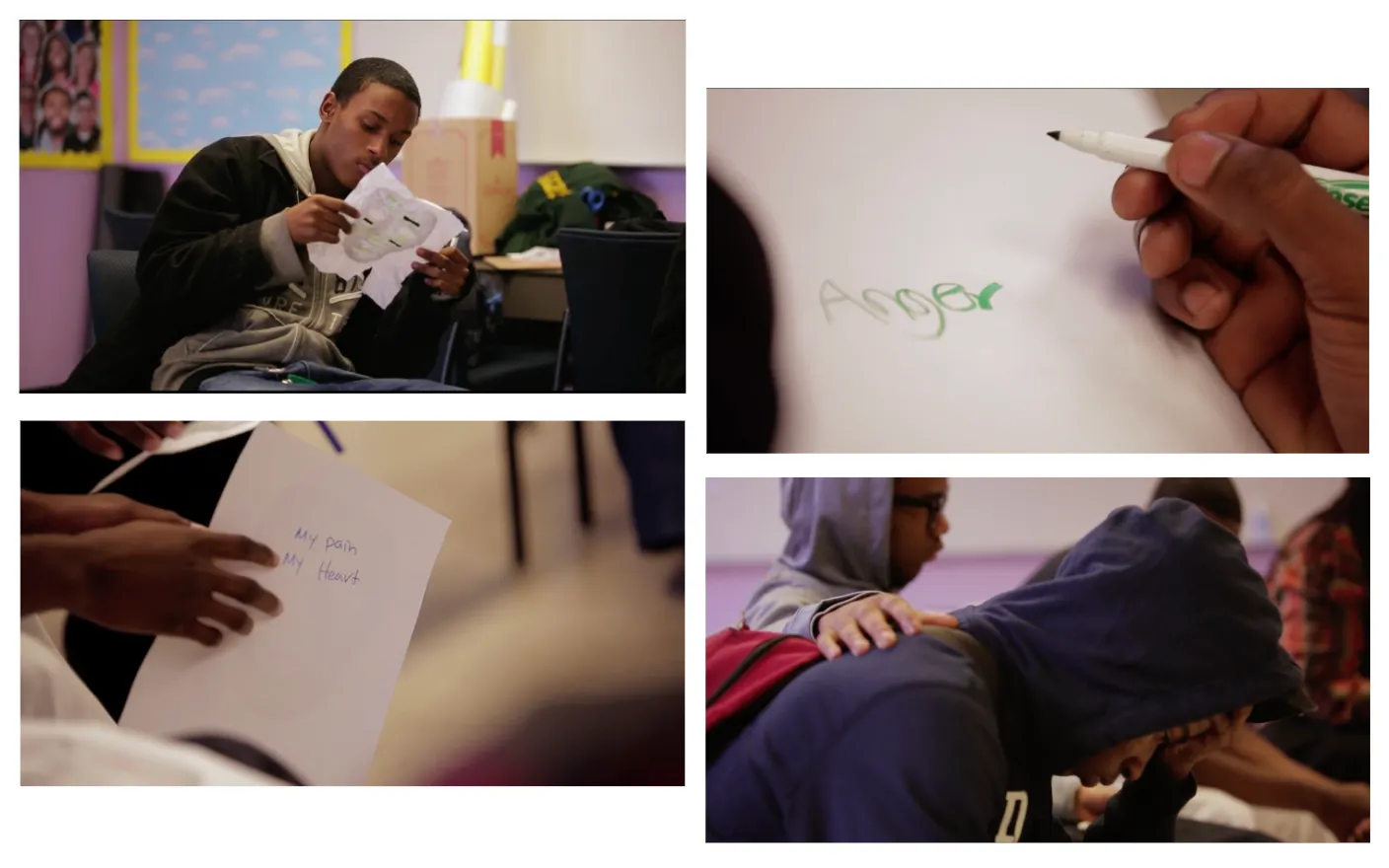
In The Mask You Live In, this scene portrays a classroom of boys writing down hidden emotions on the back side, and the mask they put on the front side of a paper that resembles a mask. The background music with a slow pace and minor tone begins when they start to discuss the differences in the adjectives on the front and back of the paper. This establishes a depressing mood that presents the issue with more severity. The emphasis on why the pressure to hide emotions is problematic is made through the juxtaposition of the adjectives on the front and back, with a semantic field of bright diction such as “outgoing” and “funny” in the front and a semantic cluster of vulnerable emotions such as “fear”, “sadness” and “pain” in the back. Zoom-in shots of each paper mask like in Figure 2 present a repetition of certain emotive words such as “pain” and “anger” on the back, suggesting that the pressure to hide emotions is commonly experienced by many, and the extreme contrast shows the extent to how much effort is needed to completely mask their feelings. While discussing the issue, the teacher uses a repetition of “real” with a confident tone stressing that the boys are merely a microcosm of an entire society of young men feeling pressured to hide emotions. The tricolon of “they’re holding back sadness, they're holding back pain, they're holding back anger” humanizes young boys by stating that they are capable of feeling a range of emotions but are intentionally hiding them. Even more, the pressure to keep a “poker face” metaphorically exemplifies the extent to which young boys have to hide their emotions just like a poker player.
Like in the extract, the idea of a mask is underscored in the title “The mask you live in” in which the mask appears as an extended metaphor symbolizes a fake persona with hidden emotions. And so, the title highlights the global issue of men living in, being born into this pressure of hiding emotions. This pressure conveyed through the gendered diction that associates certain behaviors or traits to specific genders such as “crying, weeping, and slobbering” to a “9-year-old little girl”, appear in b-rolls between interview clips as a form of intertextuality. These scenes from movies depict adult figures telling young boys that crying or expressing any emotion is a problem. In our contemporary society, young boys grow up with easy access to media. The consistent enforcement of masculine ideals of associating expression of emotions with girls and toughness with boys plants a wrong and unrealistic image of a man. In addition, interviews with professionals are inserted to appeal to ethos and add credibility in discussing the global issue. Interviews also include testimonials of laypeople of different backgrounds speaking about their personal, authentic experiences that allow the realization that this is in fact a real issue to which young men are easily susceptible. The documentary ends with providing solutions for the audience to contribute and implement. In the very last scene, an imperative tone is used with written words: “Take the challenge. Exert your influence.” With the direct address and call to action, a sense of urgency and optimism is established to encourage young men and people around them to collaboratively contribute to eliminating the harmful standards of masculinity that prevent the expression of emotions.
To conclude, O’Brien presents the hiding of emotions of young soldiers in the context of war to highlight its severe consequences while Siebel shows the effect of this global issue in young boys’ process of growing up in order to raise awareness about the problem. As both authors bring about the global issue in their work, they utilize their respective mediums to criticize the enforcement of masculine expectations that create pressure on men. Still, its negative impacts are not openly discussed enough. Therefore, it is hoped that with a consistent collective effort to change the societal view on gender, we can create a society devoid of gender expectations that prevent men from expressing emotions and forming meaningful connections.
Marking Criteria
Criterion A: Knowledge, Understanding and Interpretation (10 marks)
10 out of 10: The candidate has a clear global issue and persuasively connects the GI to the extract and to the body of work. Specific references to the text demonstrate accurate understanding of the text as well as the GI.
Criterion B: Analysis and evaluation (10 marks)
9 out of 10: The comments about authorial choices are insightful in both the extract and the wider work/body of work. Perhaps more explicit and nuanced connections to the GI could have been made.
Criterion C: Focus and organisation (10 marks)
10 out of 10: The oral is extremely well-balanced (between the literary work and non-literary work; between the literary extract and the whole novel; and between the non-literary text and the body of work). The transitions make it even more cohesive. Finally, the overall development of ideas is logical and convincing.
Criterion D: Language (10 marks)
9 out of 10: The language is clear, accurate and varied as well. There is a great rhythm and style to the overall oral although a more speech-like style of language could have been more effective.
c. Exemplar 3
Global issue:
The struggle for autonomy and identity against restrictive societal norms |
Texts chosen Literary work:
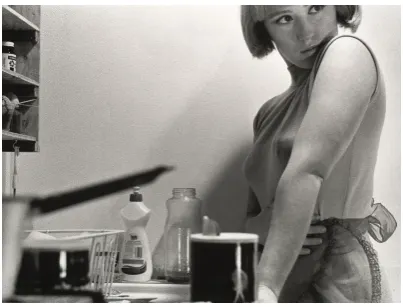
A Doll’s House by Henrik Ibsen Non-literary work: “Untitled Film Still #3” by Cindy Sherman |
Literary Extract:
1.
NORA: Let me go away. You shan’t carry this for my sake. You
2.
shan’t take it upon yourself.
3.
HELMER: No playacting, now. [Locks the front door.] You will
4.
stay and you will stand accountable to me. Do you under-
5.
stand what you’ve done? Answer me! Do you understand?
6.
NORA [looks fixedly at him, her face tensing as she speaks]:
7.
Yes, I am certainly beginning to understand.
8.
HELMER [walks around the room]: Oh, how terribly I’ve been
9.
awakened. All these eight years – the woman who was my
10.
pleasure, my pride – a hypocrite, a liar – worse, worse – a crim
11.
inal! – Oh, the depths of ugliness in all this! Shame, shame!
12.
Nora remains silent and continues to look fixedly at him.
13.
HELMER [stops in front of her]: I should have sensed that
14.
something like this would happen. I should have foreseen
15.
it. All your father’s frivolous attitudes. – Be quiet! You’ve
16.
inherited all your father’s frivolous attitudes: no religion, no
17.
morals, no sense of duty –. Oh, how I’ve been punished for
18.
turning a blind eye to him. I did it for your sake, and this is
19.
how you repay me.
20.
NORA: Yes, this is how.
21.
HELMER: You've wrecked my entire happiness now. You've
22.
gambled away my entire future for me. Oh, it's too terrible
23.
to contemplate. I'm in the power of a man without con
24.
science; he can do whatever he wants with me, demand
25.
anything at all of me, order me about as he pleases - I daren't
26.
breathe a word. And this is how miserably I must sink and
27.
be ruined for the sake of a frivolous woman!
28.
NORA: When I'm out of this world, you'll be free.
29.
HELMER: Oh, spare the gestures. Your father always had such
30.
phrases ready to hand too. What use would it be to me if you
31.
were out of the world, as you put it? It wouldn't be of the
32.
slightest use. He can make it public just the same; and if he
33.
does, I'll perhaps be suspected of having known about your
34.
criminal act. People will perhaps believe that I was behind
35.
it- that I was the one who incited you to it! And all this I can
36.
thank you for, you, whom I've borne in my arms’ through-
37.
out our married life. Do you understand now what you’ve
38.
done against me?
Non-literary Extract:
Script
The struggle for autonomy and identity against restrictive societal norms is a theme that transcends time and medium. Henrik Ibsen’s A Doll’s House, set in late 19th century Norway, and Cindy Sherman’s Untitled Film Stills, capturing America’s perception towards women in the 1950s, serve as critical examinations of this theme in their respective time periods. The selected literary work, A Doll’s House, a three act play, underscores the oppressive gender expectations of its time, culminating in Nora’s awakening and rejection of her domestic role. Parallelly, the selected non-literary work of Sherman’s monochrome photography series portrays women in various isolated domestic settings. Both works uniquely dissect the constraints imposed on women and reveal distinctive perspectives on the global issue of how the struggle for female autonomy and identity beyond domestic roles is neglected and underdeveloped.
The selected extract from A Doll’s House depicts the tense conversation between Nora and Torvald after he finds out about Nora’s secret. One significant authorial choice is the situational irony in the first line. The fact that Nora asks for permission for her new identity beyond the confines of the home with “let me go away” highlights the extent to which patriarchal ideals have infiltrated her sense of self. Here, Nora is unable to make choices for herself due to a lack of development regarding her autonomy and identity. Although has firmly already made up her mind, her past decades of being a subservient wife and child prevent her from following her desires beyond her role inside the domestic sphere. The exclamatory mood is also seen through the repetition and em dash when Torvald describes how Nora has fallen from his “pleasure” and “pride” to a “hypocrite”, “liar”, and “criminal”. This shift, marked by a tricolon, creates an urgent tone through which Torvald reshapes Nora’s identity according to his own emotional state. Consequently, it can be inferred that one of the factors making the struggle for identity invisible is how society defines what women are. Moreover, the exaggeration in “my entire happiness and future” reveals Torvald’s egocentric perception of their relationship. It suggests that his happiness is solely dependent on Nora’s adherence to societal and marital norms, rather than a mutual and empathetic partnership. This diction reflects the broader societal context of the play, where a woman’s individuality is often subsumed under her roles as a wife and mother. Hence, being in a society where the happiness of the husband was the ultimate priority, Nora’s struggle to obtain an identity beyond domestic responsibilities could have seemed selfish.
Considering the work as a whole, the use of a possessive noun in the title is ironic. Conventionally, a doll’s house is under the possession of a human owner rather than a doll. As the doll metaphorically represents Nora, this analogy reflects the reality in which women are bound under the ownership of their husband. The doll is then used as an extended metaphor in the play that reflects women and their deprivation of autonomy and power, similar to a toy doll. In addition, Torvald’s dehumanizing nicknames for Nora characterize him as a misogynistic and self-centered patriarch. For example, “My little songbird” “my little skylark” “little squirrel” are all names of small fragile animals. This selection of nicknames combined with the possessive diction “my” showcases the neglect and even invisibility of Nora’s independent and respectful identity and instead, an extreme reduction of her worth to simply an inferior possession. Moreover, the kenning of “doll-child” and “doll-wife” in the last act emphasizes Nora’s reduced worth which highlights women’s limited role in domesticity and how difficult it is for them to develop a more meaningful identity. Later in the act, Torvald condemns Nora’s decision to leave and equates it to leaving behind her “most sacred duties”. The use of the word “sacred” and superlative of “most” depict Torvald as a metonymy of the general public of the time with the gendered perception that women should be grateful for their given domestic roles. The glorification of the maternal role would have most likely resulted in the difficulty for women to assume a role beyond it due to the guilt of not fulfilling the honor as a wife and mother. This is similarly shown in Krogstad and Mrs.Linde’s relationship as well. Despite Mrs.Linde’s opportunity to work at a bank, she sacrifices this chance in exchange for becoming Krogstad’s wife and caretaker of his children. Hence, Ms.Linde’s belief that her purpose can be fulfilled by taking care of others and Krogstad’s natural acceptance of this suggestion shows both characters’ internalization of prescribed gender roles that consequently prevents women from seeking an identity beyond domestic roles despite their ability to do so.
Moving on to the nonliterary work, Sherman’s photography also portrays women’s inability to escape from the given domestic sphere through the metaphorical significance of a doll-like body posture and symbolic details. In Sherman’s Untitled Film Still #3, the woman’s posture as well as her disinterested way of looking away from the dishwashing counter implies how she has lost interest in her domestic duties. This symbolizes her desire for other pursuits but with her torso still facing the countertop, it shows that in reality, her actions are limited within the expected gender role. With this practical restriction, the woman’s placement among the arrangement of miscellaneous props that seem to enclose her may symbolize the invisibility of her aspirations to others beyond her given role in the kitchen. In addition, the apron tied around her waist and tight frame of the woman cornered to the wall of the kitchen isolates her from the outside world. This angle creates a suffocating atmosphere that reflects the pressure women endure within domesticity. Moreover, just like how Nora was the doll of the house, the woman also has a doll-like presence with her apron and her clean bob cut. The irony of how a woman’s domestic duties include maintaining a high beauty standard highlights the objectification of women in society that restricts them to an inferior position and overall invisibility of their pursuit for individual identity. Also, the absence of any explicit male or secondary figure within the photo may also suggest that women are often blind to their own oppressed states as they complacently internalize the gender roles. This passive effort to fight against given domestic roles and the subconscious distancing from the given task through her outward gaze juxtaposed with the natural draw of domestic roles expressed through her torso and tight apron, convey the everyday struggle of women who aspire a more meaningful identity beyond a wife and mother.
If we zoom out to the entire collection of work, in many photographs by Cindy Sherman, the body posture of female subjects often appears unnatural and doll-like, suggesting discomfort. Such is shown in the image where the subject is seated awkwardly at the edge of an empty bed, or the image where a woman is dressed in an apron with a doll-like hairstyle. This unnatural posing is akin to a doll intentionally arranged by someone else. Hence, this may suggest the subjugation of women under the expected gender role that neglects their struggle to seek an identity beyond their given obligations in domesticity. More specifically, in the photograph where a woman is sitting uncomfortably in a bedroom, the symbolic irony of the bed typically representing a place of comfort underscores how deeply women are domestically manipulated and controlled under a patriarchal framework. By presenting these constrained poses and synthetic scenarios, Sherman’s work resonates with the same themes of identity crisis and societal gender pressure that Ibsen similarly portrays. In addition, there are notable symbolic items placed strategically within the frame of Cindy Sherman’s photographs. In the same photo of the woman in the bedroom, the presence of a man’s photo, likely her husband, suggests his omnipresent surveillance, despite her husband’s absence. This reflects the societal gaze over women, underlining their lack of liberty and autonomy to pursue other identities based on their unique personalities and values due to the pressure and internalization of societal expectations. Another example is seen in an image where a woman is hurriedly packing her suitcase. The small picture of a boat on the wall in this photograph symbolizes the woman’s aspirations for liberation to assume other identities. However, its confinement within a small decorative frame, set against a vast wall, poignantly illustrates the invisibility of her struggle within the expansive constraints of her society. And highlights the crude reality in which a woman's aspirations are seen as an unrealistic fancy.
In summary, both A Doll’s House and Cindy Sherman’s photographs highlight the female struggle for seeking a more meaningful identity beyond the confines of gender expectations.
While A Doll’s House uses diction, irony, and grammatical mood to portray women as dolls of society, Sherman utilizes various film techniques such as posture and visual symbols to highlight the doll-like status of females under a patriarchal society. The purpose of Sherman's photographs picture various women in different yet similar settings to communicate the prevalence of this global issue, Ibsen’s uses Torvald who never fully understands Nora even until the end to convey the invisibility of women’s struggle. However at the same time the narrative structure that eventually reveals Nora's intellectual awakening and boldness to leave the house conveys an empowering message that despite this struggle, women are indeed capable of seeking an identity beyond the expected domestic role.
Marking Criteria
Criterion A: Knowledge, Understanding and Interpretation (10 marks)
10 out of 10: Despite the interpretive demands posed by the non-literary text, the candidate adeptly navigates its nuances to establish a meaningful connection with the GI. Additionally, the references to the literary text are skillfully employed, effectively reinforcing the GI throughout the analysis.
Criterion B: Analysis and evaluation (10 marks)
9 out of 10: While the non-literary extract offers seemingly limited analytical depth due to its simplicity, the candidate succeeded in delivering a remarkably insightful and nuanced analysis of this text, even (and unfortunately) surpassing that of the literary extract. The analysis and evaluation of both texts were executed skillfully, particularly in light of the implications discussed in the conclusion.
Criterion C: Focus and organisation (10 marks)
9 out of 10: The candidate had a clear structure and focus on the GI. However, the time spent on the non-literary text seemed to be relatively longer creating a slight imbalance but a mark below 9 would not be justified.
Criterion D: Language (10 marks)
10 out of 10: The language and syntax were skillfully crafted throughout the oral presentation, effectively enhancing clarity and impact. Terminology was explicitly referenced and applied with precision.