

Overview
Title Employing Mathematical modeling and optimization to minimize the use of plastic material in 1.5L Hanacka Water bottles
Research Question / Aim Minimizing the amount of plastic material needed to hold a fixed volume of water
Context / Personal Engagement Interest in sustainable practices and environmental issues Concerned by high levels of bottled water consumption and resulting waste Optimize bottle design to reduce plastic usage while maintaining functionality
Use of Mathematics Mathematical modeling of the bottle shape for accurate optimization Application of integration to calculate the volume and surface area of solids Constrained optimization using the Lagrange multiplier method
Criteria A Presentation
Level 2 out of 4
“A general description of the student's approach to the investigation should be included.”
Figure 1 shows the Hanacka bottle from the introduction. To reduce the plastic used, I will look at the shape of the bottle calculate its surface area and volume. I will not include the bottle cap in this study because its size stays the same for manufacturing reasons. The important variables for the three sections are shown in Figure 1.
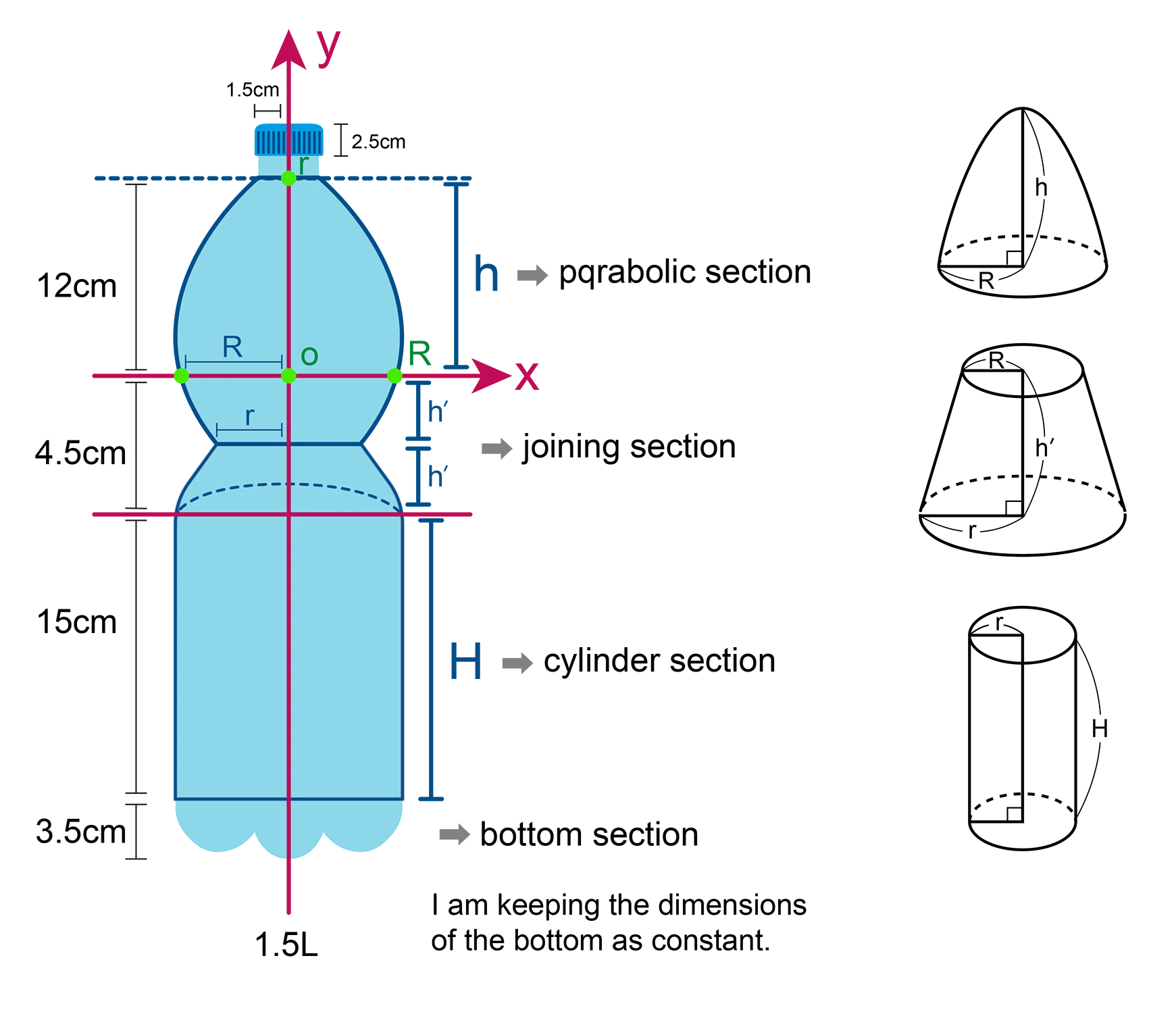
Figure 1. Hanacka water bottle
All figures are presented when appropriate and are properly introduced.
Before each figure, the student states what it contains and what data it presents.
Level 3 out of 4
“A logical approach should subdivide the investigation into clear, distinguishable phases, while focusing on the area of mathematics central to the exploration”
Figure 1 shows the Hanacka bottle mentioned in the introduction. To optimize the surface area, it is important to first construct different mathematical functions to represent the bottle’s shape in regard to the independent variables. Then, we can utilize those functions to calculate the surface area and volume using integration. Therefore, this section mainly focuses on modeling the given shape of the bottle, specifically dividing it into three sections for simplicity: the Parabolic section, Joining section, and the Cylinder section.
As the original shape includes irregular curvatures, dividing the bottle into known shapes greatly simplifies the modeling process. Thus, the main variables were determined in the three divided sections, as shown in Figure 1.
Discuss data collection and the steps to be taken for the calculations.