


 What We Are Building
Help students prepare for real competitions such as:
•
John Locke Essay Competition
•
Cambridge Essay Competitions
•
Other subject-specific competitions
Students should be able to:
•
Understand what high-quality essays look like
•
Learn how to approach unfamiliar and abstract prompts
•
Develop strong arguments under time constraints
•
Receive feedback before submission
The Problem We Are Solving
In reality, most students:
•
Do not know how to approach open-ended essay prompts
•
Lack clear guidance on what examiners are looking for
•
Struggle to structure arguments effectively
•
Have no access to meaningful feedback before submission
As a result, students:
•
Write unfocused essays
•
Misinterpret the question
•
Fail to demonstrate depth of thinking
Our Approach
We treat each competition as a training system, not just a collection of prompts.
Students should go through:
Understand expectations → Analyse prompt → Research → Write → Improve
ibGuru supports each step of this process.
Notes
Layer 1 — Stable (Reusable)
These do NOT change yearly.
1. Subject Essay Guide (e.g. Economics)
This is:
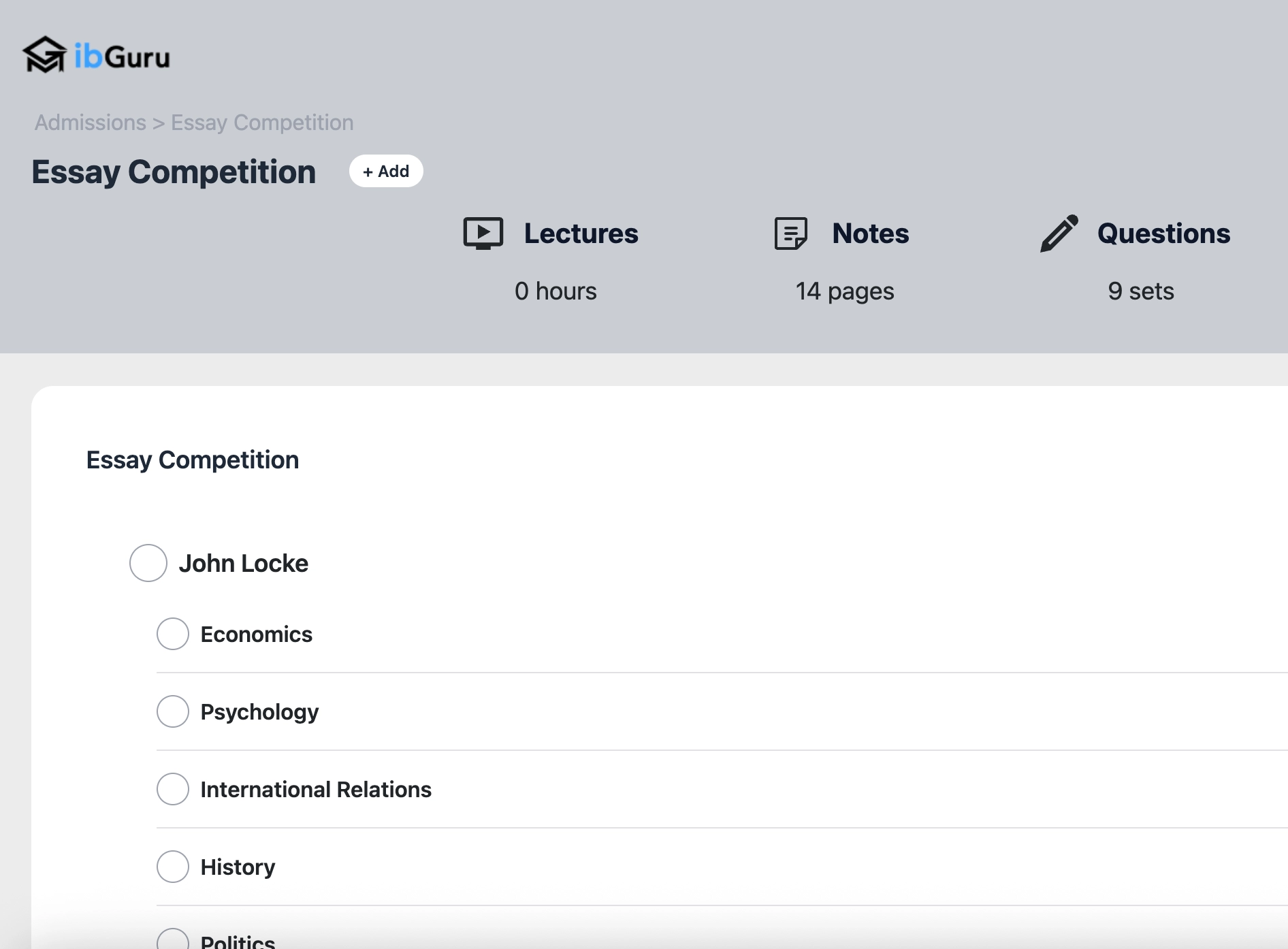
John Locke → Economics → Notes
Plain Text
복사
It should include:
•
How to structure arguments
•
How to evaluate assumptions and limitations
•
Common themes (markets, incentives, rationality, etc.)
•
Writing techniques and essay structure
2. Core Concepts / Research Directions
These are timeless foundations:
•
Key theories
•
Standard examples
•
Foundational thinkers
These remain consistent across years and essay titles Layer 2 — Dynamic (Year-Specific)
These change every year and are tied to specific essay titles.
1. Essay Titles
•
New prompts released each year
2. “Understand the Question”
For each title:
•
What the question is really asking
•
What angle or perspective it is testing
3. Research Direction (Partly Dynamic)
Core concepts remain the same, but emphasis changes depending on the question.
Example:
Same concept:
Rationality
Plain Text
복사
Different essay titles:
•
→ Behavioural economics focus (one year)
•
→ Game theory focus (another year)
Essay Titles (Core Practice)
Students should have access to:
•
All past essay titles (last 10 years)
•
Organised by competition, subject, and year
Each title is treated as a practice task.
Model Answers
We provide model answers for each essay title.
These should:
•
Demonstrate strong structure and argumentation
•
Show how to interpret the question correctly
•
Include evaluation and critical thinking
AI can generate first drafts, but must be reviewed and refined.
Grading Guidelines
Two levels of grading must be provided:
1. Competition-Level Criteria
Applies to all essays within the competition:
•
Clarity of argument
•
Depth of analysis
•
Use of evidence
•
Structure and coherence
2. Title-Specific Expectations
For each essay prompt:
•
What the question is really asking
•
Key angles of approach
•
Common mistakes
Research Guidance (Key Differentiator)
Students need help with where to start.
For each essay title, provide:
•
Suggested research directions
•
Key concepts to explore
•
Relevant thinkers / theories
•
Optional reading suggestions
Role of Mentors
Mentors play a critical role in ensuring quality and realism.
•
Refine AI-generated model answers
•
Define what strong responses look like
•
Help identify key approaches for each essay title
•
Contribute insights on common student mistakes
AI is used for generation and structuring,
but mentor input ensures accuracy and depth.