

Q1
Topic | 5.2 Properties of Curves |
Tag | Differentiation
Stationary Points
Point of Inflection
Concavity
Tangent
Normal
L'Hopital's Rule
Trigonometric Functions
Functions |
Source | N17/5/MATHL/HP1/ENG/TZ0/XX/7 |
Question Text | The folium of Descartes is a curve defined by the equation , shown in the following diagram. |
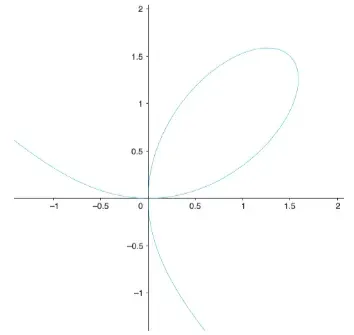
Question Text | The coordinates of the point on the curve where the tangent line is parallel to the -axis can be written in the form where . Find the value of . |
Total Mark | 6 |
Correct Answer | 2 |
Explanation | n/a |
Mark Scheme | Tip 2: Parallel to the -axis means a slope of .
Taking the derivative,
Tip 2: Find a way to use the information found
In this case can be applied to
So,
The coordinates can be written as where , so |
Q2
Topic | 5.2 Properties of Curves |
Tag | Differentiation, Trigonometric functions, Quotient Rule |
Source | N17/5/MATHL/HP1/ENG/TZ0/XX/11 |
Question Text | The function can be written as where
(a)Find an expression for the derivative of with respect to .
(a)
(b)
(c)
(d) |
Total Mark | 3 |
Correct Answer | (a) |
Explanation | n/a |
Mark Scheme | Utilize the quotient rule,
|
Question Text | (b) For , the equation of the tangent to the curve at is , where
Find the value of |
Total Mark | 4 |
Correct Answer | 4 |
Explanation | n/a |
Mark Scheme | The slope of the equation is ,
As , for
So,
|
Q3
Topic | 5.2 Properties of Curves |
Tag | Differentiation
Stationary Points
Point of Inflection
Concavity
Tangent
Normal
L'Hopital's Rule
Trigonometric Functions
Functions
Graphs
Intercepts |
Source | M17/5/MATHL/HP1/ENG/TZ1/XX/12 e |
Question Text | Consider the function .
(i) The graph of is concave up for where is a positive integer. Compute the value of
Total Mark: 3
Correct Answer: 1
Explanation: n/a
Mark Scheme:
(ii) Find the -coordinate of the -intercept of the equation
Total Mark: 3
Correct Answer: 1
Explanation: n/a
Mark Scheme:
by comparing coefficients, -intercept at |
Q4
Topic | 5.2 Properties of Curves |
Tag | Differentiation
Implicit differentiation
Exponential and Logarithmic functions
Differentiation
Tangent
Intercepts
Exponential and Logarithmic functions |
Source | N16-TZ0-P1-9(HL) |
Question Text | A curve has equation .
(a) Which is the correct expression for ?
(a)
(b)
(c)
(d) |
Total Mark | 4 |
Correct Answer | (c) |
Explanation | n/a |
Mark Scheme | Implicit differentiation,
|
Question Text | (b) Select the correct slopes of the equations of tangents to this curve at the points where the curve intersects the line . (select all that apply)
(a)
(b)
(c)
(d)
(e) |
Total Mark | 4 |
Correct Answer | (c), (d) |
Explanation | n/a |
Mark Scheme |
Q5
Topic | 5.2 Properties of Curves |
Tag | Differentiation, Tangent |
Source | M16-TZ1-P1-10(HL) |
Question Text | Select the -coordinates of all the points on the curve at which the tangent to it is parallel to the tangent at the coordinates . (select all that apply)
(a) -2.5
(b) -1
(c) 0.5
(d) 1
(e) 1.5 |
Total Mark | 7 |
Correct Answer | (a), (c) |
Explanation | n/a |
Mark Scheme |
when
Since is a solution to this equation, is one factor
Thus,
|
Q6
Topic | 5.2 Properties of Curves |
Tag | |
Source | N15-TZ0-P1-4(HL) |
Question Text | Consider the curve .
(a) Find .
(a)
(b)
(c)
(d) |
Total Mark | 2 |
Correct Answer | (c) |
Explanation | n/a |
Mark Scheme | |
Question Text | (b) The equation of the normal to the curve at the point can be written in the form where . Find the value of . |
Total Mark | 4 |
Correct Answer | 0 |
Explanation | n/a |
Mark Scheme | Slope of tangent at
Slope of normal is
As the normal passes through the coordinates
|
Q7
Topic | 5.2 Properties of Curves |
Tag | Differentiation, Tangent, Implicit differentiation
Differentiation, Tangent, Implicit differentiation |
Source | N15-TZ0-P1-7(HL) |
Question Text | A curve is defined by .
(a) Find the number of horizontal tangents to the curve.
(a) 0
(b) 1
(c) 2
(d) 4 |
Total Mark | 4 |
Correct Answer | (a) |
Explanation | n/a |
Mark Scheme | Implicit differentiation,
Horizontal tangent occurs when so
Thus,
However, as is not possible there are no horizontal tangents |
Question Text | (b) Select the coordinates of the points where the tangent to the curve is vertical. (select all that apply)
(a)
(b)
(c)
(d)
(e) |
Total Mark | 4 |
Correct Answer | (a), (b) |
Explanation | n/a |
Mark Scheme | The tangent is vertical when
Substitute into the equation,
Coordinates are,
|
Q8
Topic | 5.2 Properties of Curves |
Tag | Differentiation
Stationary Points
Point of Inflection
Concavity
Tangent
Normal
L'Hopital's Rule
Trigonometric Functions
Functions
Graphs
Intercepts |
Source | M15-TZ2-P1-4(HL) |
Question Text | Consider the function defined by .
(a) The values of for which is a decreasing function can be written as where . Find the value of |
Total Mark | 4 |
Correct Answer | 4 |
Explanation | n/a |
Mark Scheme | Differentiate
So decreasing on |
Question Text | (b) There is a point of inflexion, , on the curve .
The coordinates of can be written as . Find the value of . |
Total Mark | 3 |
Correct Answer | 6 |
Explanation | n/a |
Mark Scheme |
To find the point of inflexion set
Coordinate of is |
Q9
Topic | 5.2 Properties of Curves |
Tag | Differentiation
Stationary Points
Point of Inflection
Concavity
Tangent
Normal
L'Hopital's Rule
Trigonometric Functions
Logarithmic Functions
Graphs
Intercepts |
Source | N14/5/MATHL/HP1/ENG/TZ0/XX/11c |
Question Text | The function is defined as . The graph of intersects the -axis at the point .
The equation of the tangent to the graph of at the point can be written as. , where . Find the value of |
Total Mark | 4 |
Correct Answer | 3 |
Explanation | n/a |
Mark Scheme |
-intercept at
|
Q10
Topic | 5.2 Properties of Curves |
Tag | Differentiation
Stationary Points
Point of Inflection
Concavity
Tangent
Normal
L'Hopital's Rule
Trigonometric Functions
Logarithmic Functions
Graphs
Intercepts
Implicit Differentiation |
Source | M14/5/MATHL/HP1/ENG/TZ1/X/9 |
Question Text | A curve has equation . The gradient of the curve at the point where and can be written as where is a positive integer. Find the value of . |
Total Mark | 8 |
Correct Answer | 6 |
Explanation | N/A |
Mark Scheme |
In order to find the coordinate at
So,
Substitution into
|
Q11
Topic | 5.2 Properties of Curves |
Tag | Differentiation, Stationary points, Exponential and Logarithmic functions, Quotient rule |
Source | M14/5/MATHL/HP1/ENG/TZ1/X/11 |
Question Text | Consider the function .
(a) By finding , determine the coordinates at which the curve reaches its maximum value.
(a)
(b)
(c)
(d) |
Total Mark | 3 |
Correct Answer | (a) |
Explanation | n/a |
Mark Scheme |
Consider
Hence maximum at the point |
Question Text | (b) The equation of the tangent at the -intercept of the graph of can be written as where are positive integers. |
Total Mark | 3 |
Correct Answer | 6 |
Explanation | n/a |
Mark Scheme |
-intercept
|
Q12
Topic | 5.2 Properties of Curves |
Tag | Differentiation, Stationary points, Exponential and Logarithmic functions, Quotient rule |
Source | N13-TZ0-P1-10(HL) |
Question Text | The function is given by where .
(a) By considering determine the coordinates of the minimum point.
(a)
(b)
(c)
(d) |
Total Mark | 3 |
Correct Answer | (a) |
Explanation | n/a |
Mark Scheme |
Set
x=1
Minimum point |
Question Text | (b) The graph of the function is obtained from the graph by stretching it horizontally by a scale factor of 3.
(i) State the -coordinate of the minimum for
Total Mark: 2
Correct Answer: 3
Explanation: n/a
Mark Scheme: n/a
(ii) The -coordinate of the point where can be written as where . Determine the value of .
Total Mark: 2
Correct Answer: 27
Explanation: n/a
Mark Scheme:
Equating
|
Q13
Topic | 5.2 Properties of Curves |
Tag | Intercepts, Exponential and Logarithmic functions |
Source | M19/5/MATHL/HP1/ENG/TZ2/XX/11 |
Question Text | Consider the functions and defined by and , where .
The graphs of and intersect at the point .
(a) Find the coordinates of .
(a)
(b)
(c)
(d) |
Total Mark | 2 |
Correct Answer | (c) |
Explanation | n/a |
Mark Scheme | At point , the two functions intersect.
Therefore, the coordinates of point is equal to . |
Question Text | (b) The tangent to at passes through the origin .
The value of can be expressed as . Find the value of . |
Total Mark | 7 |
Correct Answer | 2 |
Explanation | n/a |
Mark Scheme | Attempt to differentiate or ,
When
Since the tangent passes through the origin,
Hence, the value of is equal to . |
Q14
Topic | 5.2 Properties of Curves |
Tag | Differentiation
Stationary Points
Point of Inflection
Concavity
Tangent
Normal
L'Hopital's Rule
Trigonometric Functions
Logarithmic Functions
Graphs
Intercepts |
Source | M18/5/MATHL/HP1/ENG/TZ1/XX/9 |
Question Text | Let
(a) The graph of has a local maximum at . The coordinates of can be expressed as . Find the product of and . |
Total Mark | 5 |
Correct Answer | 5 |
Explanation | n/a |
Mark Scheme | Attempt to differentiate
At the local maximum, the first derivative value is equal to 0 .
Therefore, point is located at and and .
The product of and is equal to 5 . |
Question Text | (b) There is one point of inflection, , on the graph of . The coordinates of can be expressed in the form , where . Find the product of and . |
Total Mark | 8 |
Correct Answer | -2 |
Explanation | n/a |
Mark Scheme | At the point of inflexion, the second derivative value is equal to .
To find the coordinate of ,
Hence, the product of and is equal to . |