
Mathematically Modelling Household Metal Containers: An Investigation into the Most Suitable Container(s) to Store a Hot Beverage
Session: May 2022
Page count: 16
Introduction and Rationale
My family comprises coffee and tea drinkers - myself included - and we enjoy drinking our beverages warm, especially in the cooler months of the year. Often times, we find that the beverage cools quickly after preparation, allowing us to only consume it at a suboptimal, lukewarm temperature. I wanted to figure out a method to both combat the quick cooling of the drinks and ensure that the beverage was as warm as possible during consumption, and I thus decided to mathematically model different metal containers in my house in order to arrive at a conclusion for the most suitable container to keep a drink warm (i.e. one that does not lose heat quickly), by calculating and collating their respective surface area to volume ratios. The surface area to volume ratio is crucial to a multitude of fields - notably Biology – generally in terms of the impact a particular body’s ratio has on its temperature and transfer of heat. For instance, elephants have developed big ears and wrinkled skin in order to increase their surface area to volume ratio1, allowing for greater dissipation of heat during warmer weathers. This is because the larger the surface area to volume ratio, the greater the allowance for heat dissipation, since this allows for greater area for heat energy to escape2. I thus decided to apply the same concept to the metal containers in my exploration. For the purpose of the investigation, the three containers that I chose to explore are the three most common metal containers/cups that are used in my house, which allows me to generalise my findings or conclusion to all other containers of the exact same model in the house. It is important to note the investigation does not condemn any manufacturers, and all chosen containers have been displayed for the purpose of academic and mathematical discourse and exploration.
Aim and Methodology
In this exploration, I have decided to employ calculus to evaluate and compare differently shaped metal (i.e. stainless steel as a metal alloy) containers and their suitability in storing warm beverages. I shall do so by calculating and comparing the ratio of their respective surface areas to their volumes: the lower the ratio, the more suitable the container is for holding warm beverages, as it indicates that there is less surface area per unit volume for which heat can be dissipated, implying that it allows for less heat (per unit time) to escape as compared to the others. I shall use integration in order to calculate the volume and the surface area of the chosen bottle, by plotting functions to model the container’s shape with the help of online tools (such as GeoGebra3). I shall then present a ratio of these values (in cm⎺¹), after which I shall repeat the process for all other chosen containers, before comparing their respective ratios and arriving at a conclusion regarding the ideal container. I shall use whatever function fits best and hence best describes/models the chosen container, as this would guarantee a greater degree of accuracy. The main areas of mathematics that I will be covering in this investigation are functions and calculus: in specific, plotting graphs and calculating the surface area and volume of revolution through integration of the graphs’ respective functions. I shall also be incorporating certain geometric formulae in this investigation. By modelling these household containers, I aim to arrive at a conclusion on which is the most suitable container or cup to hold warm beverages and retain their heat. It is important to note that all container that have been chosen are made of the exact same composition of materials and share roughly the same thickness, so as to ensure uniformity in the investigation and to arrive at the most accurate answer.
Variables and Significance
Before proceeding, it is essential that the reader familiarises themselves with the below symbols and the variables they represent.
Variable (and Symbol) | Denotes |
Volume | |
Surface Area | |
The upper limit of the integral | |
The lower limit of the integral | |
Surface Area to Volume Ratio | |
The first derivative of | |
The height of the container | |
The radius of the circumference at the top of the container | |
The radius of the circumference at the bottom of the container |
Key Formulae Used
The volume of revolution of a solid can be described with the following equation (commonly known as the Disk and Washer Method)
(1)
while the surface area of revolution of a solid can be described with the following equation (the Euler-Lagrange Equation4):
(2)
It is important to note that these equations assume that the plotted equation is (rather than ) and that the axis of rotation is always the -axis (in Euclidean space).
Container 1
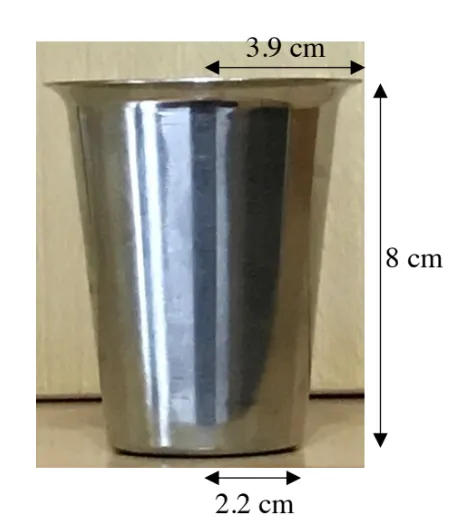
Dimensions (as calculated with a ruler and measuring tape):
Variable | Value (cm) |
8 | |
3.9 | |
2.2 |