

General guidelines
1.
Write within 300 words and maximum of 10 bullet points.
2.
Do not use sub-bullet points.
3.
You can bold, underline, italicize your texts or use abbreviations, notations, symbols, etc (your outline does not have to make sense to the examiner!).
4.
Keep your outline balanced like your oral. Ideally, four bullet points should be dedicated for each text (2 for extract and 2 for body of work for each text).
5.
Avoid writing full sentences as it would be a waste of word count.
Tip: Use outline as your backup though you are planning to memorize your script. Write points that you often forget or phrases to keep you on track!
 Your outline is not part of the IO grade. It is submitted to IB only if requested to ensure that you followed the outline guidelines (300 words, 10 bullet points).You cannot make any additional annotations in the outline before examination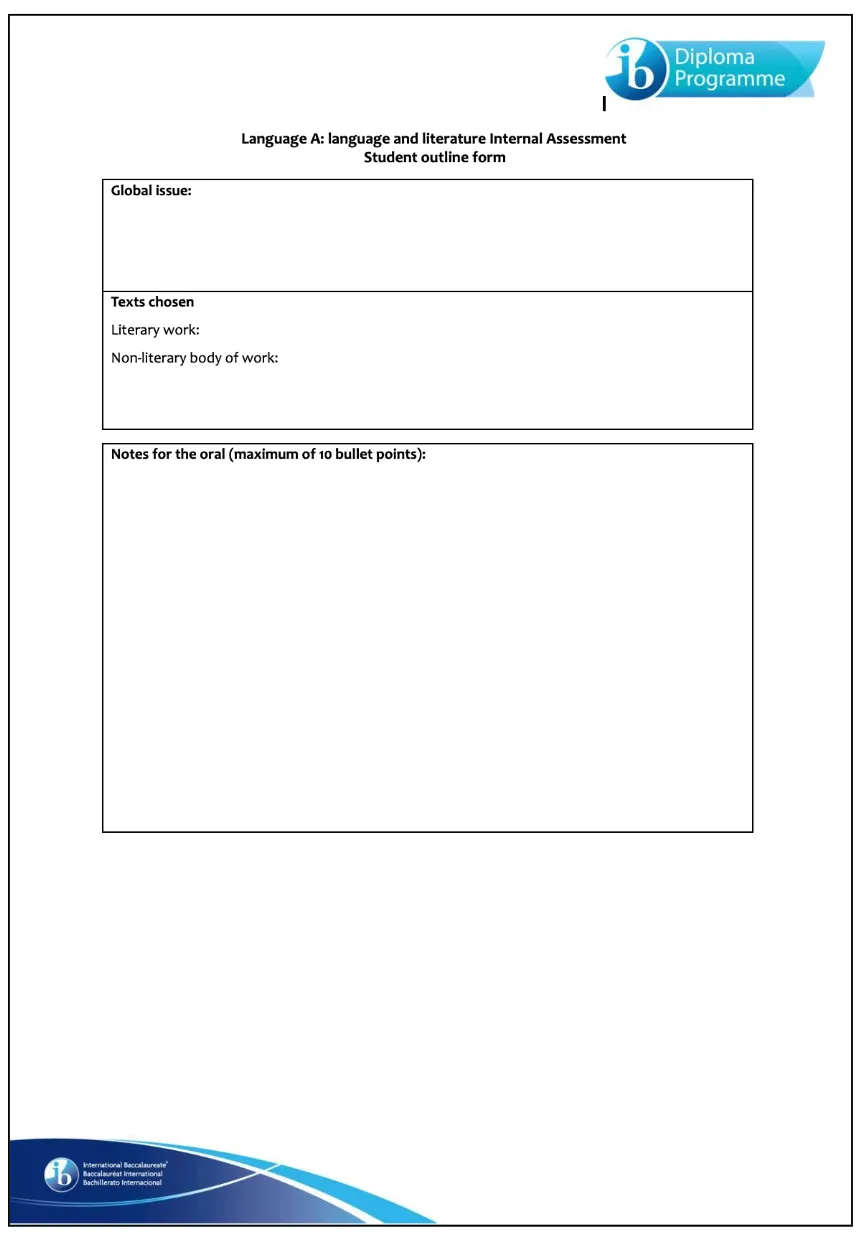
a. Exemplar Outline
For reference, this outline has 299 words.
Global Issue: The effects of gender-based power imbalances on female psychology. |
Texts Chosen
Literary Work: A Doll’s House by Henrik Ibsen
Non-literary Body of Work: “Supposed to be here” by Liza Donnelly |
• 3A Norwegian play = toxicity of relationship // business women in male-dominant—psychologically affected result of GI
• “squirrel&skylark” = portray N as H’s possession→ insig. in H’s life, degrade worth – “come”x2 “what do you think..”—domestic animals(imperatives)= maintains dominance in convo.→ N agree = conscious submissiveness depending decision on husband
• “no debt”&”borrowing” H restricts N from spending money = finan. power over wife—borrow money = women-like (neg. view)—lack of power “putting the bag of…” Xspeak up for her choices (helpless position) = lack of freedom→N anxious
• mirror e.o., adopting same posture—pressure, only female worker = imitate confident attitude&attempt to fit—seat for head = think suitable—women’s daily life (endure oppression in p. society)
• blazer&pants = resemble male—purple = maintain femininity, Xfully assimilating into masculinity—even effort, Xachieve equal possession of power—men various race(diff. skin color)→ 1 woman = below men regardless of ethnicity —white ppl take dominant position = barrier
• N&H, power dynamic most intense end of A3(open letter Krogstad) —intention = save H, degrade reputation→ rages– contrast length character’s lines —distribute unequally→ N Xassert her opinion(gives in&accepts fault)
• constant scolding&criticism from H→ “the most wonderful thing” Xcome true—last scene intellectual awakening(leave house) = H(static charac.)Xchange —door symbolism = N’s struggle turn pos. outcome → hopeful msg (overcome gender imbalance)
• newly hired female worker questions head of comp.: “are you…cheap,...qualified…?” normally celebrate, questions intention→ doubt self-worth — “cheap” = unfair distribution of income— before “qualified” (employing women = economical)
• “Daddy, can I stop being worried now?” after news (unfor. incidents women experience e.g., rape, s.h., income)—young children→ shed seriousness of ongoing issues, innocent—shock, feel responsibility – applicability to wide age range = severity&impact
• Both explore&address timeless GI —despite differences in tt, both contribute to slow but progressive change to overcome unequal distribution of power by raising greater awareness |