

Fiscal policy: changes in the level of government expenditures (G) and taxes (T) to affect AD.
Government expenditures
Capital expenditures | Current expenditures | Transfer payments |
Public investments: spending on infrastructure (roads, airports). | Salaries of public sector employees Expenditures on public school, hospital. | Pensions, unemployment benefits. |
Government revenues
Where government gets its revenue from:
•
Direct tax.
•
Indirect tax.
•
Sale of state owned enterprises (by privatisation).
Goals of fiscal policy
•
Lift an economy from recession: close a large recessionary or inflationary gap.
•
Decrease cyclical unemployment.
◦
Lift an economy from recession → higher demand for employers → lower unemployment.
•
Decrease inflation.
•
Long-term economic growth.
•
Reduce business cycle fluctuations.
•
Decrease income inequality.
•
Decrease trade imbalances.
Expansionary fiscal policy
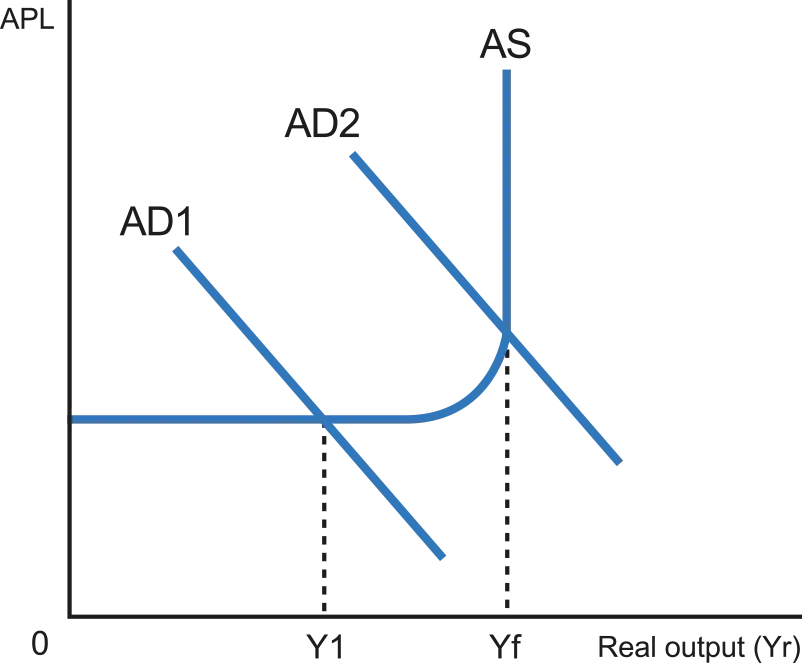
Figure 3.6.1 Expansionary fiscal policy on AD
Increase AD (AD1 → AD2) → close a deflationary gap
•
G ↑ → G is a component of AD → AD ↑ → real GDP ↑.
•
Tax ↓ → disposable income of households ↑ → C ↑ → C is a component of AD → AD ↑ → real GDP ↑.
Contractionary fiscal policy
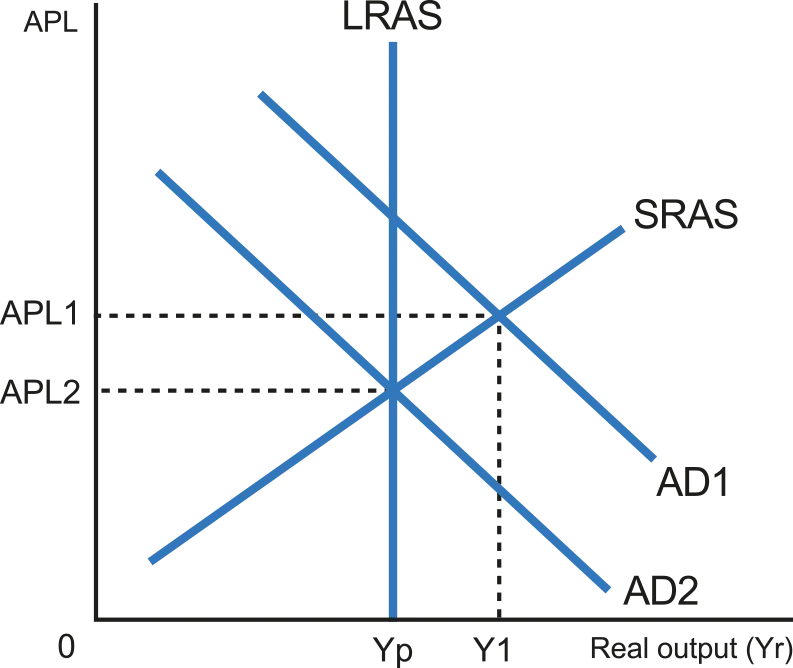
Figure 3.6.2 Contractionary fiscal policy on AD
Decrease AD (AD1 → AD2) → close an inflationary gap
•
G ↓ → G is a component of AD → AD ↓
•
Tax ↑ → disposable income of households ↓ → C ↓ → C is a component of AD → AD ↓
Effectiveness of fiscal policy
Advantages | Disadvantages |
Increased government expenditures
• G is a component of AD → increase G → AD automatically increase.
• Important in a deep recession. | Political issues
• Cutting G and increasing T is not ideal for citizens. |
Can be targeted
• Increased G target specific sectors: infrastructure, R&D, education, healthcare. | Long time lags
• Long administrative lag. |
Tax cuts target the poor
• Decrease income inequality. | Widen a trade deficit
• Increase incomes → higher imports → trade deficit widens. |
Increase in government capital expenditures
• Long term increase potential output → shift AS to the right. | Relies on tax cuts
• If consumer and business confidence is low, tax cuts won’t be effective. |
The Keynesian multiplier (HL only)
Multiplier: ratio of the final change in aggregate demand to the original change in an injection (investment, exports, government expenditures).
•
Increase in injections leads to a larger total change in AD.
•
One’s spending becomes someone else’s income, which leads to more spending.
•
MPC: marginal propensity to consume
◦
Fraction of additional income spent on domestically produced goods and services.
•
MPS: marginal propensity to save
◦
Fraction of additional income saved.
•
MPM: marginal propensity to import
◦
Fraction of additional income spent on imports.
•
MPT: marginal propensity to tax
◦
Fraction of additional income spent on tax.
•
MPW: marginal propensity to withdraw
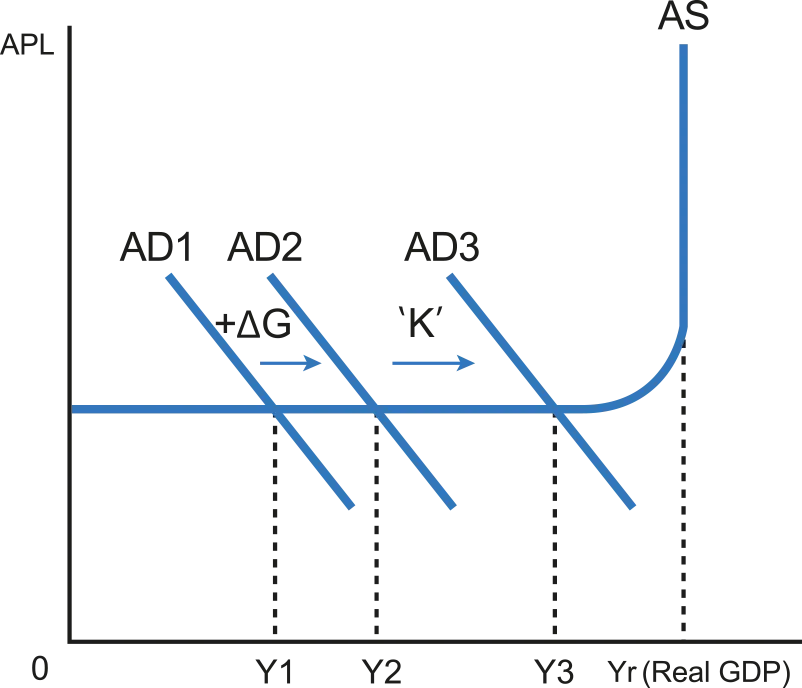
Figure 3.6.3 The multiplier effect
•
Economy is initially at income below the full employment level (Y1) → deflationary gap (Y1Yf) → AD ↑ (AD1 → AD2) → multiplier effect → AD further ↑ (AD2 → AD3) → deflationary gap ↓ (Y1Yf → Y3Yf).
Automatic stabilisers (HL only)
Automatic stabilisers: factors that automatically, without any government action, work towards reducing fluctuations in the business cycle.
In a recession | In a boom |
If the economy enters a recession, then unemployment will increase. Therefore, the government will pay unemployment benefits. This is an increase in government expenditure (G) which is expansionary fiscal policy. | If the economy enters a boom, then unemployment will decrease. Therefore, the government will pay fewer unemployment benefits. This is a decrease in G which is contractionary fiscal policy. |
In a recession, unemployment will increase, therefore fewer people will be paying income tax. This decrease in taxation is expansionary fiscal policy. | In a boom, unemployment will decrease, therefore more people will be paying income tax. This increase in taxation is contractionary fiscal policy. |
Crowding out (HL only)
If the government adopts expansionary fiscal policy by increasing spending without higher taxation then there would be a budget deficit. This deficit will be financed through additional government loans.
This additional borrowing means that the demand for money increases, which increases interest rates.
•
Higher interest rates increase cost of borrowing and reward for saving → reduce consumer spending and investment.
•
Higher government spending has ‘crowded out’ spending from households and firms.
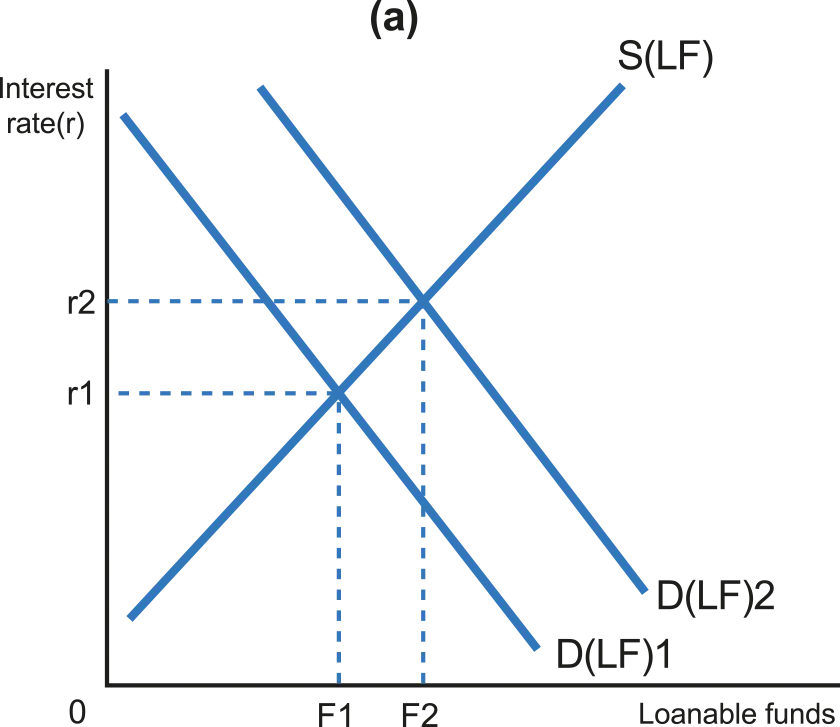
Figure 3.6.4 Impact on market
•
Expansionary fiscal policy → AD↑ (D(LF)1 → D(LF)2) → interest rates ↑ (r1 → r2).
•
Higher interest rates = higher cost of borrowing → ‘crowded out’ spending from firms.
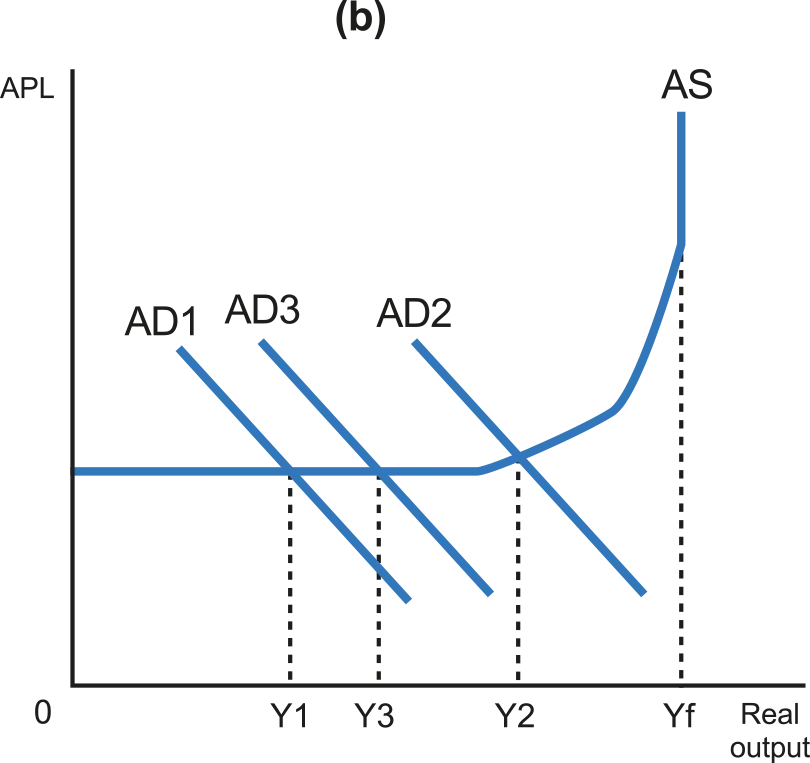
Figure 3.6.5 Impact on the economy
•
Expansionary fiscal policy: government spending(G) ↑ → AD↑ (AD1 → AD2) → crowding out effect → AD may not increase as much as expected (AD1 → AD3).