

Trade protection: policies by a country to reduce imports from other countries and/or increase exports.
Tariffs
Tariff: tax imposed on an imported good.
•
Increases the cost of the imported good → decreases demand for the imported good.
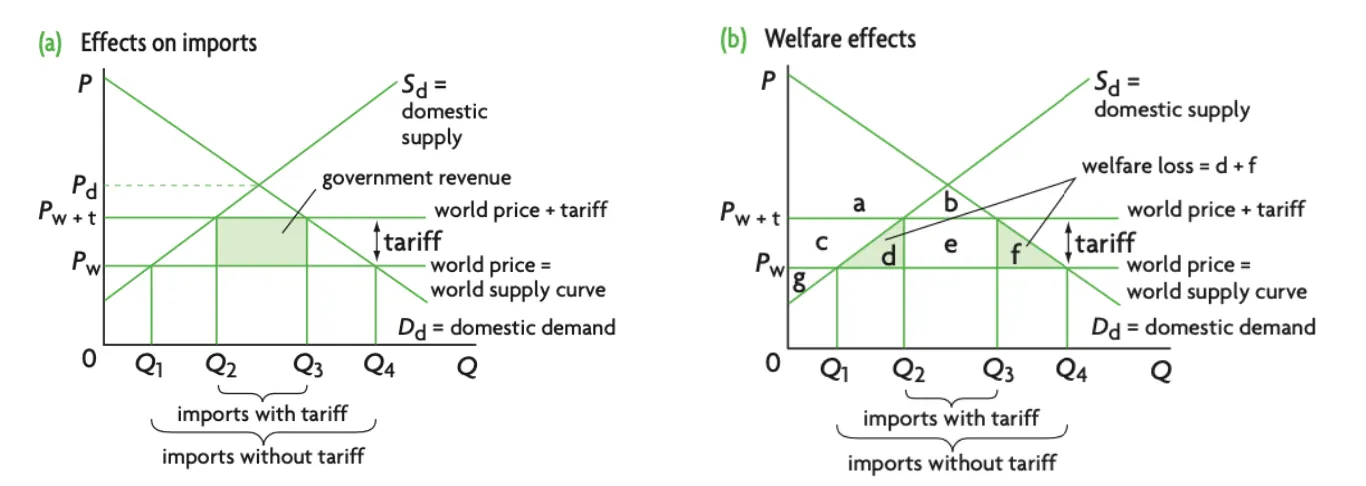
Figure 4.2.1 Tariff
Winners | Losers |
• Domestic producers
• Government revenue
• Domestic employment | • Domestic consumers
• Foreign producers
• Domestic income distribution
• Global allocation of resources |
•
Domestic producers
◦
Before tariff: domestic production (Q1) at Pw and imports (Q2-Q11Q2).
◦
After tariff: domestic production ↑ (Q1 → Q3), and revenue ↑ (H → H + 1 + 2 + F).
•
Domestic consumers
◦
Before tariff: consume Q2 at Pw.
◦
After tariff: consume Q4 at P’, consumer surplus ↓.
•
Foreign producers
◦
Before tariff: foreign production (Q2-Q11Q2) and revenue (F + J + G).
◦
After tariff: foreign production ↓ (Q4-Q3Q3Q4), and revenue ↓ (F + J + G → J).
•
Government revenue
◦
Before tariff: no revenue.
◦
After tariff: revenue of 3 (rectangle area)..
Evaluating Tariff for Import substitution
Advantages
• Decreases the demand for imports.
• Allows domestic producers to be more price competitive in their home market → Increases employment.
• Provides tax revenue for the government.
Disadvantages
• Consumers have to pay more for imported goods.
• Worsens resource allocation: greater inefficiency in production. = DWL on graph (b)
• Foreign governments may retaliate with tariffs of their own.
The impact of a tariff depends upon the elasticity of demand for the import and the size of the tariff
•
Import substitution is a policy strategy aimed at reducing a country's reliance on imported goods by fostering the development and production of domestic alternatives
Export promotion, on the other hand, is a strategy focused on stimulating the growth of a country's economy by encouraging and supporting the exportation of goods and services to international markets.Quotas
Quota: the physical limit on the amount numbers of a particular product that can be imported in a country.
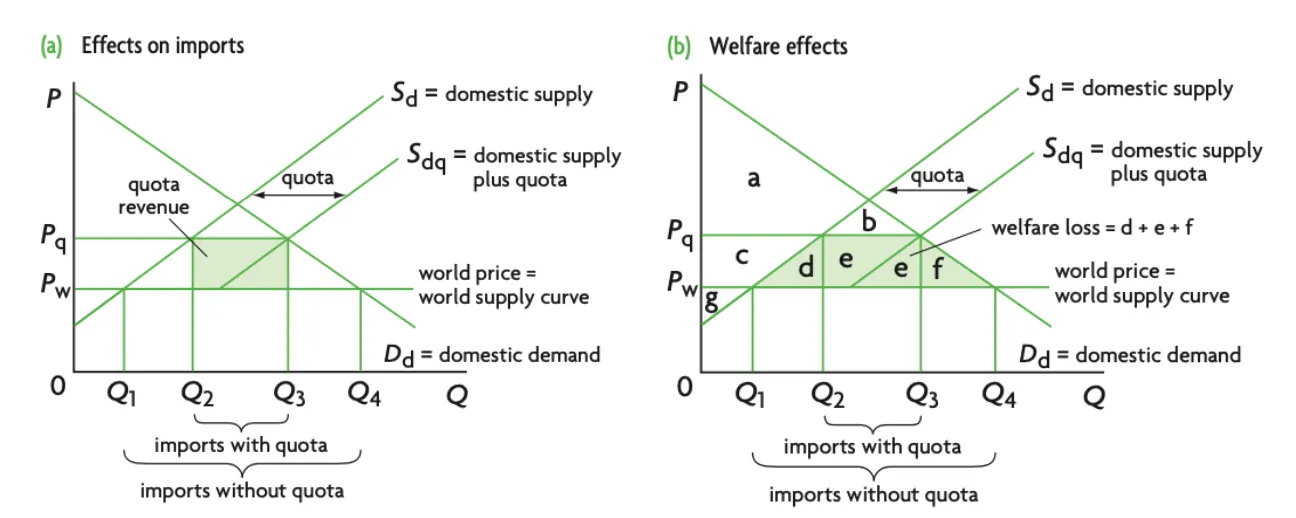
Figure 4.2.2 Quota
Winners | Losers |
• Domestic producers
• Domestic employment | • Domestic consumers
• Domestic income distribution
• Government: no revenue, higher cost
• Foreign producers
• Global allocation of resources |
•
Domestic producer
◦
Before quota: domestic production Q1 at Pw, and imports (Q1Q2-Q1).
◦
After quota: domestic production ↑increase (Q1 → Q3), and revenue ↑increase (H → H + 1 + 2 + F).
•
Domestic consumer
◦
Before quota: consume Q2 at Pw.
◦
After quota: consume Q3 at P’, consumer surplus ↓decrease.
•
Foreign producer
◦
Before quota: foreign production (Q3Q2), and revenue (F + J + G).
◦
After quota: foreign production ↓ decreases (Q3Q2 → Q3Q4) and revenue ↓ decreases (F + J + G → 3 + J).
•
Government revenue
◦
Before quota: no revenue.
◦
After quota: incur expense when enforcing the quota.
Evaluating Quota for Import substitution
Advantages | Disadvantages |
• Protects domestic producers from foreign competitors → increases employment.
• Limits imports → improves the balance of payments. | • Restricted access for domestic consumers to cheaper or better quality foreign products.
• Worsens resource allocation → greater inefficiency in production.
• Foreign governments may retaliate with quotas of their own.
• Quotas provide no revenue for the government. |
Production subsidies
Production subsidies: money given by the government to producers to lower their cost of production and encourage increased output.
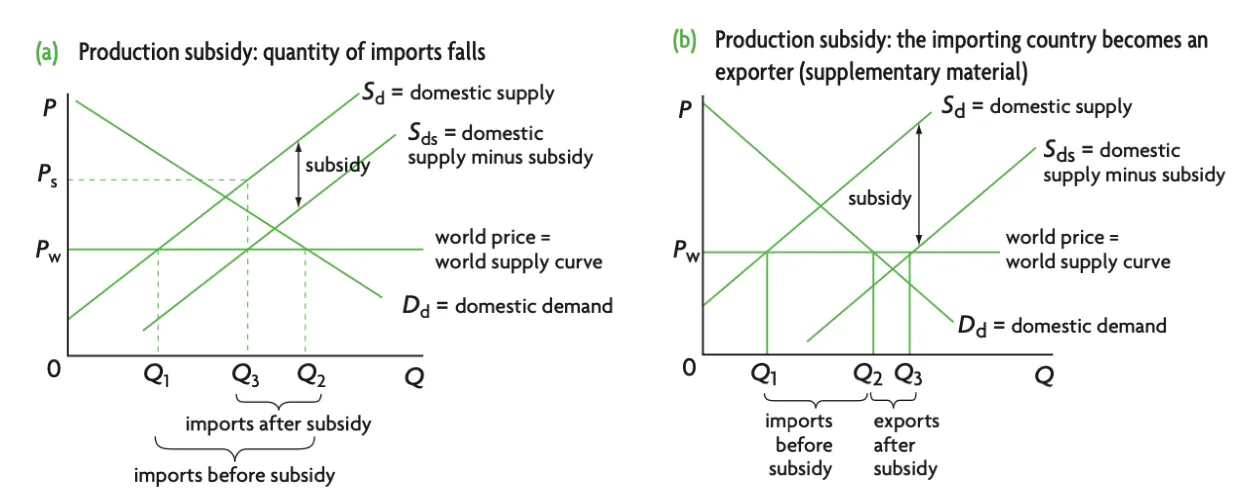
Figure 4.2.3 Production subsidies
Winners | Losers |
• Domestic producers
• Domestic employment | • Government budget
• Tax payers
• Foreign firms
• Efficiency of production
• Global allocation of resources |
•
Domestic producer
◦
Domestic supply ↑increase (Q1 → Q3) and price ↑increase (Pw → Pp).
◦
Revenue ↑increase (A → A + B).
◦
Receive subsidy (F + H).
•
Foreign producer
◦
Supply ↓decrease (Q1Q2 → Q3Q2).
◦
Revenue ↓decrease (B + C → C).
•
Government
◦
Pay subsidy (F + H).
Evaluating Subsidies for Export Promotion
Advantages | Disadvantages |
• Decrease the demand for imports: makes domestically produced products cheaper → improve the balance of payments.
• Protect infant industries until they get the economies of scale to be able to compete internationally. | • Decrease the need for producers to increase efficiency to produce at a lower price.
• Domestic consumers must pay for the subsidy in the form of higher taxes.
• Subsidising exporting firms can lead to dumping which leads to a protective response from foreign governments. |
Export subsidies
Export subsidy: subsidy is paid for each unit of the good that is exported.
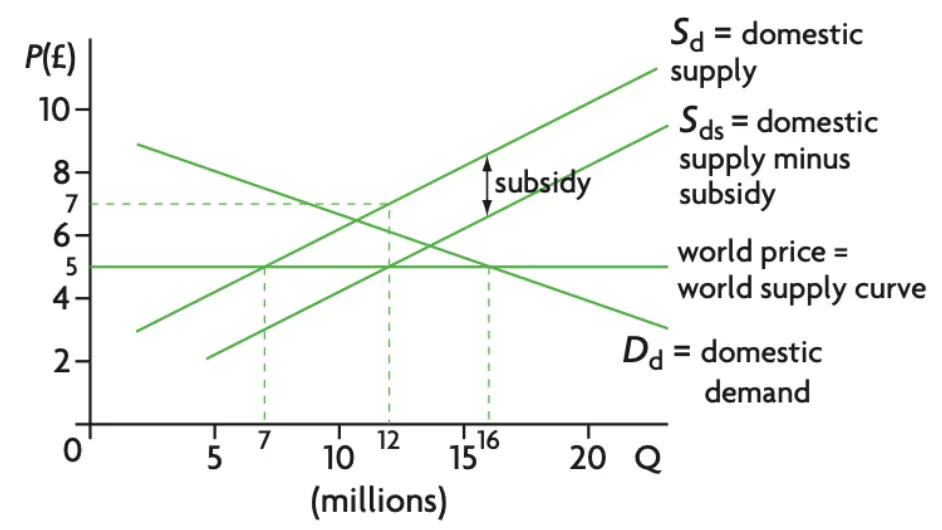
Figure 4.2.4 Export subsidies
Winners | Losers |
• Domestic producers
• Domestic employment | • Domestic consumers
• Government budget
• Tax payers
• Domestic income distribution
• Efficiency of production
• Global allocation of resources |
•
Domestic producer
◦
Receive higher price (Pw → P’), and sell a larger quantity (Q2 → Q4).
•
Domestic consumers
◦
Pay a higher price (Pw → P’), and consume a smaller quantity (Q1 → Q3).
•
Government budget
◦
Pay for the subsidy.
Advantages | Disadvantages |
• Decrease the Price of exports ↓ → increase international demand for goods ↑
• Increase exports ↑ → improve the balance of payments. | • Decrease the need for producers to increase efficiency: subsidy will lower the price of their products anyway.
• Domestic consumers must pay for the subsidy in the form of higher taxes. |
Administrative barriers
Administrative barriers are obstacles imposed by governments on imports through customs procedures, inspections, and regulatory requirements. These barriers, including specific packaging and technical standards, often serve as trade protection measures to reduce the quantity of imports.
•
Customs procedures: inspections, valuation.
•
Increased red-tape: time-consuming, difficult procedures.
•
Packaging requirements: specific ways; non-compliance reduces imports.
•
Technical standards: health, safety, environmental conditions.
•
Testing and inspections: costly, time-consuming; reduce imports.
Reasons for Standards:
•
Health and safety of the domestic population.
•
Environmental protection.
•
Often seen as disguised trade protection to limit imports.
Stakeholder | Tariffs | Quotas | Production subsidies | Export subsidies | Administrative barriers |
Domestic producers | Gain | Gain | Gain | Gain | Gain |
Workers | Gain | Gain | Gain | Gain | Gain |
Government | Gain | Neutral | Lose | Lose | Neutral |
Taxpayers | Gain | Neutral | Lose | Lose | Neutral |
Consumers | Lose | Lose | Neutral | Lose | Lose |
Domestic society
Producer efficiency | Lose | Lose | Lose | Lose | Lose |
Domestic society Income distribution | Lose | Lose | Neutral | Lose | Lose |
Domestic society Resource allocation | Lose | Lose | Lose | Lose | Lose |
Foreign producers | Lose | Lose | Lose | Lose | Lose |
Global society
Resource allocation | Lose | Lose | Lose | Lose | Lose |