

Gallery view
Search
International trade: exchange of goods and services between countries.
•
Mechanism: It involves both exports (selling domestically produced goods and services to foreign markets) and imports (buying goods and services produced in foreign markets).
•
Freedom: International trade is considered "free" when there is no government intervention such as quotas, tariffs, or other restrictions imposed to reduce or limit trade.
Benefits of free trade
The benefits of free trade can be seen for a country where the world price for a good/service is above the domestic price thus allowing for exports
To consumers
•
Lower prices
◦
Consumers can buy goods and services below the domestic price level.
◦
Free trade allows countries that produce goods at a high unit cost to discontinue producing these goods and import them.
◦
Countries can concentrate on the goods they produce relatively cheaply.
•
Greater choice
◦
Citizens have access to goods produced by other countries → increase their choice.
•
Increased competition
◦
Domestic firms have to compete with firms from other countries.
◦
Competition forces firms to keep costs low and to innovate.
To firms
•
Economies of scale due to access to larger markets
◦
Free trade allows firms to increase the amount they produce and therefore gain greater economies of scale.
◦
Firms can benefit from the decreased unit cost by increasing their profit or reducing their price to the consumer.
•
Access to different resources
◦
Free trade allows a firm to gain access to resources they don’t have.
To the economy
•
Increased economic efficiency
◦
Increase in economic welfare: countries produce the goods and services they are most suited to.
◦
Trade enables countries to specialise: theory of comparative advantage.
•
Source of foreign exchange
◦
To buy imports, foreign exchange is needed - exports generate this.
4.1 Benefits of international trade
Trade protection: policies by a country to reduce imports from other countries and/or increase exports.
Tariffs
Tariff: tax imposed on an imported good.
•
Increases the cost of the imported good → decreases demand for the imported good.
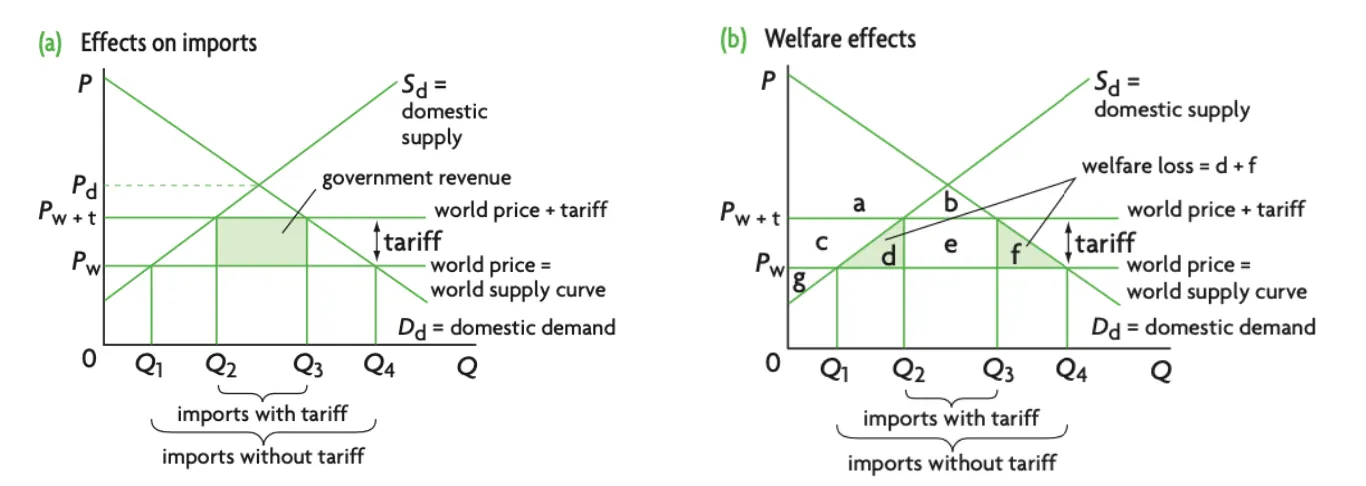
Figure 4.2.1 Tariff
Winners | Losers |
• Domestic producers
• Government revenue
• Domestic employment | • Domestic consumers
• Foreign producers
• Domestic income distribution
• Global allocation of resources |
•
Domestic producers
◦
Before tariff: domestic production (Q1) at Pw and imports (Q2-Q11Q2).
◦
After tariff: domestic production ↑ (Q1 → Q3), and revenue ↑ (H → H + 1 + 2 + F).
•
Domestic consumers
◦
Before tariff: consume Q2 at Pw.
◦
After tariff: consume Q4 at P’, consumer surplus ↓.
4.2 Types of trade protection
Arguments in favour of protection
Infant industry argument
Infant industry: a new domestic industry that has not yet established itself to compete with more ‘mature’ foreign rivals.
•
Infant firms have a higher unit cost than existing firms (since they gain fewer economies of scale), thus they are higher up on the LRAS curve. Thus, an infant industry might struggle to compete with a mature industry.
•
If an infant industry is protected from foreign competitors,competition then it will be able to grow, gain economies of scale, and be able to compete with foreign rivals.
Evaluation
•
It’s difficult for the government to identify which industries have the potential to grow and compete in global markets.
•
Protection can disincentivise infant industries to operate efficiently (since they are provided with production subsidies already) which disables them to compete internationally.
•
It’s difficult for the government to know when it’s appropriate to remove the protection.
National security
Certain industries (e.g. aircraft, weapons) are essential for national security. These industries should be protected.
Evaluation
•
It is difficult to decide which industries are essential to national security.
Health, safety and environmental standards
Many countries wish products to conform to certain minimum standards and thus impose regulations to ensure that all imported products meet these standards. These minimum standards can help protect the public.
4.3 Arguments for and against trade control and protection
Economic integration: economic interdependence between countries is usually achieved by agreement between countries to reduce or eliminate trade barriers between them.
Preferential trade agreements
•
Preferential trade agreements: the agreement between 2 or more counties to lower trade barriers between them on particular products.
•
Bilateral trade agreement: the agreement to lower trade barriers between 2 trading partners.
•
Regional trade agreement: the agreement to lower trade barriers between countries within a region.
•
Multilateral trade agreement: the agreement to lower trade barriers between many countries.
Trading blocs
•
Free trade area (FTA): members of the trading bloc agree to free trade between themselves.
◦
Countries are allowed to set their own trade policies with countries outside the bloc.
◦
e.g. the ASEAN Free Trade Area (1992): Brunei Darussalam, Indonesia, Malaysia, the Philippines, Singapore, Thailand (added Cambodia, Laos, Myanmar and Vietnam in 1999).
•
Customs union: free trade amongst bloc members and they agree to set the same tariffs against non-bloc in bloc member countries.
◦
Common external tariff.
◦
e.g. the European Union (1968): Belgium, Germany, France, Italy, Luxembourg and, the Netherlands.
•
Common market: free trade between bloc members.
◦
Common external tariff.
◦
Common product standards: products produced in bloc meet the same standards.
◦
Free movement of factors of production: labour and capital can move freely throughout the bloc.
Advantages and disadvantages of trading blocs
Advantages | Disadvantages |
Trade creation
• By joining a customs union: production of goods and services are transferred from high-cost high cost domestic producers to lower-cost lower cost countries within the customs union.
• Consumers benefit from access to lower-cost lower cost goods.
Increased competition
• Leads to increased efficiency of firms thus the lower price for consumers.
Lower prices and greater choice for consumers.
Economies of scale
• Decreased unit cost may lead to lower prices of products for consumers.
Increased investment
• Investment expenditure is a component of AD → AD increase → economic growth.
Improved efficiency
• Free movement of factors of production: workers move from areas of high unemployment to areas of low unemployment. | Trade diversion (HL only)
• The pProduction of a good is transferred from a low cost producer (outside the customs union) to a higher cost producer (within the customs union).
• More of the world’s scarce resources are used to produce the same amount of goods and services.
The challengeChallenge to WTO trade negotiations
• Might impose high trade barriers to countries outside the trading bloc
Loss of sovereignty
• Countries should give up some powers to the authority in charge of joining a trading bloc.
• The deeper the integration, the greater the loss of sovereignty. |
Monetary union
Monetary union: free trade between bloc members.
•
Common external tariff and common product standards.
4.4 Economic integration
Exchange rate: the value of one currency expressed in terms of another currency.
Exchange rate systems
•
Free floating exchange rate system: the value of a currency is determined by market forces.
•
Fixed exchange rate system: exchange rate set by the government and is maintained through appropriate central bank intervention.
•
Managed exchange rate system: exchange rate is allowed to float but there is periodic intervention by the central bank
Evaluating free floating exchange rate system
Advantages | Disadvantages |
Adjust to correct the current account deficit.
• Current account deficit → depreciation → help decrease current account deficit.
Doesn’t need to be manipulated by interest rates.
• Leaves monetary policy free to pursue other macroeconomic objectives (e.g. low inflation).
Doesn’t need to be manipulated by the buying and selling of foreign reserves. | Increased uncertainty → more difficult to trade.
• Firms have more uncertainty when calculating the costs of their imported raw materials.
May not readjust to eliminate a current account deficit.
Increase inflation.
• Depreciating currency → increase cost of imports → inflationary pressures. |
Appreciation, depreciation, revaluation, devaluation
•
Appreciation: increase in the value of a currency in terms of another currency in a floating exchange rate system.
•
Depreciation: fall in the value of a currency in terms of another currency due to market forces in a floating exchange rate system.
•
Revaluation: increase in the value of a currency (fixed exchange rate system).
•
Devaluation: decrease in the value of a currency (fixed exchange rate system).
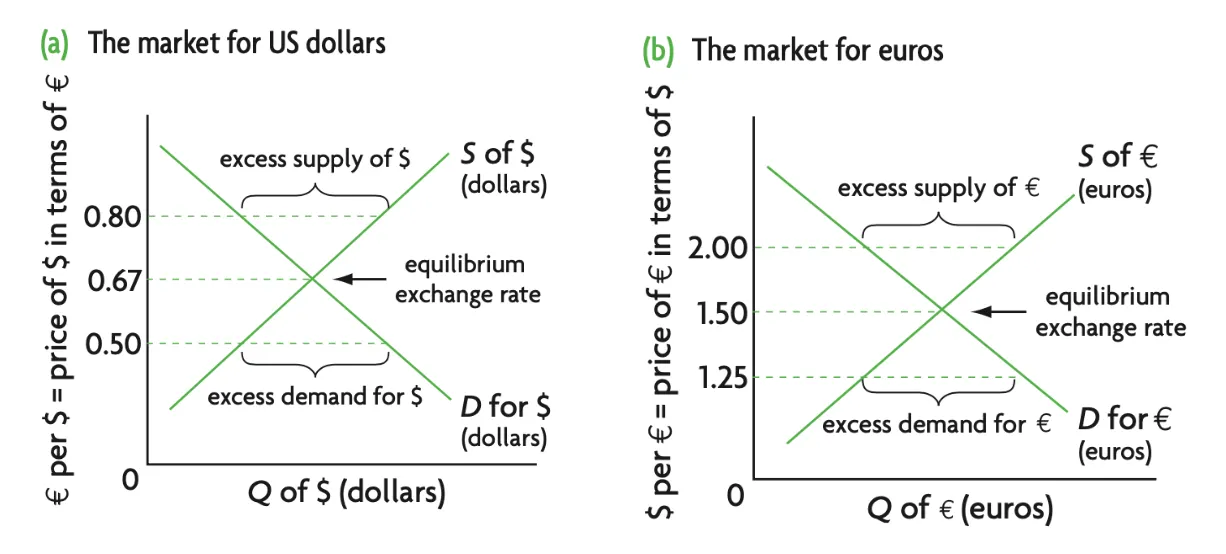
Figure 4.5.1 Free Floating Exchange rateMarket for pounds (in USD)
Diagram Analysis
Currency Pricing:
◦
Prices of currencies are expressed in terms of another currency (e.g., dollar in euros).
◦
No independent unit to measure the value of currencies.
Equilibrium Exchange Rate:
◦
Intersection of demand and supply curves.
◦
Example equilibrium rate: 0.67 euro per dollar.
◦
Higher rate (e.g., 0.8 euro per dollar) → excess supply of dollars.
◦
Lower rate (e.g., 0.5 euro per dollar) → excess demand for dollars.
◦
Forces of demand and supply balance the quantity demanded and supplied.
Market for Euros:
◦
Similar principles as the dollar market.
◦
Equilibrium rate: 1 euro = 1.5 dollars.
◦
Higher euro price → excess supply of euros.
◦
Lower euro price → excess demand for euros.
Causes of changes in the exchange rate of a currency
Factors that affect the demand for a currency
Exports and factors affecting exports
◦
Demand for exported goods.
◦
Demand for exported services.
◦
Inflation rate.
◦
Higher inflation rates in Indonesia will decrease demand for the rupiah (D1 for Rp → D2 for Rp) since its exports will become less competitive. Therefore, the rupiah will depreciate (e1 → e2).
◦
Relative growth rates.
◦
Indonesian economic growth increases → incomes increase → Indonesian purchase more imports → supply of rupiahs increases (S1 of Rp → S2 of Rp) → the rupiah will depreciate (e1 → e2).
Investment and factors affecting investment
•
Inward foreign direct investment (FDI).
◦
FDI: investment by a multinational corporation based in one country in productive assets in another country.
◦
e.g. Samsung builds factories in Vietnam - in order for Samsung to invest in Vietnam, they need to purchase VND, thus increasing the demand for VND.
•
Inward portfolio investment.
◦
Portfolio investment: financial investments in stocks and bonds.
◦
In order for foreign investors to purchase stocks or bonds they first need to purchase the relevant currency.
4.5 Exchange rates
Balance of payments: the record of all financial transactions between one country and the rest of the world in one year.
Accounting in BoP
•
Credits (+): Money flowing into an account.
•
Debits (-): Money flowing out of an account.
•
Surplus: More money flows in than out.
•
Deficit: More money flows out than in.
The Current Account
•
The Current Account is often considered to be the most important account in the BoP
•
This account records the net income that an economy gains from international transactions
The Capital Account
The Capital Account records small capital flows between countries and is relatively inconsequential
1.
Capital transfers
•
Smaller flows of money between countries
•
E.g. Debt forgiveness payments by the government toward developing countries
4.6 Balance of payments
Sustainable development
Sustainable development: development involving the use of resources in the present to meet present needs and wants in ways that do not deplete or degrade them, so that future generations will have enough resources to meet their own needs.
Sustainable development goals
Sustainable development goals: 17 goals developed by the United Nations in 2012
•
Measure progress towards poverty reduction and sustainable development.
1. No poverty
2. Zero hunger
3. Good health and well-being
4. Quality education
5. Gender equality
6. Clean water and sanitation
7. Affordable and clean energy
8. Decent work and economic growth
9. Industry, innovation and infrastructure
10. Reducing inequality
4.7 Sustainable development
Single indicators
GDP / GNI per capita at purchasing power parity (PPP)
PPP exchange rates are used to resolve the issue of different countries having different purchasing powers of the same amount of money.
•
Eliminate the effect of differing price levels.
Health indicators
•
Infant mortality rate: number of deaths before age 1 per 1,000 live births.
•
Maternal mortality rate: number of women who die per year as a result of pregnancy-related related causes, per 100,000 births.
Composite indicators
Human development index (HDI)
Composite indicator of development that includes 3 indicators that measure 3 dimensions of development equally to give a score between 0 and 1.
•
Income per capita: measured by GNI per capita at PPP.
•
Healthcare: measured by life expectancy at birth.
•
Education: measured by mean and expected years of schooling.
Inequality adjusted HDI (IHDI)
Measures development in the same way as HDI but each of the 3 dimensions are adjusted to take into account inequality.
4.8 Measuring development
Poverty cycle / trap
Poverty cycle / trap: circular chain trapping individuals / societies in poverty.
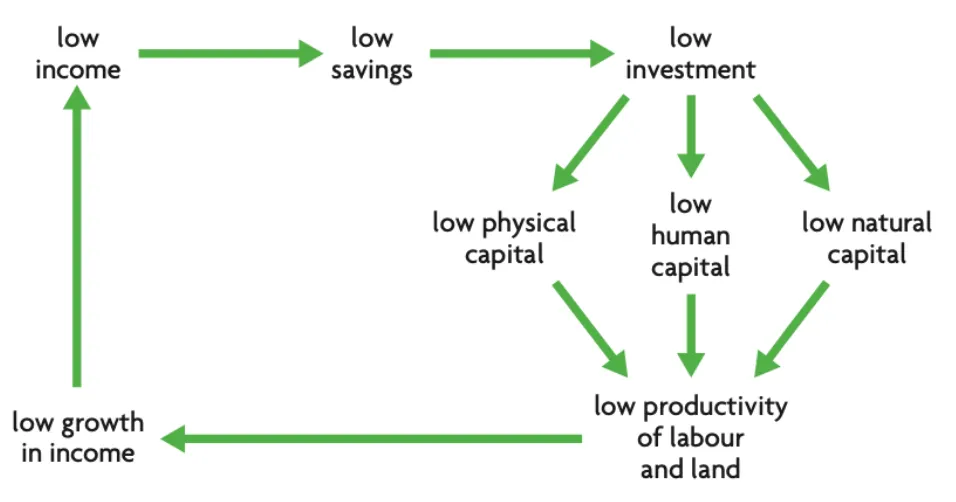
Fig 4.9.1 The poverty cycle
Economic barriers
Rising income inequality
Decrease in access to education, healthcare, and nutrition → decreases the ability of the country to develop.
•
Higher income inequality → disincentivise workers → lower productive efficiency → lower production → misallocation of resources.
•
Higher income inequality → higher relative poverty → lower access to quality education → lower access to future jobs = barrier to development.
4.9 Barriers to economic growth and / or economic development
Trade strategies
Import substitution industrialisation (ISI)
Import substitution industrialisation (ISI): a strategy to reduce imports using protectionism to allow domestic industry to grow.
Advantages | Disadvantages |
• Protects domestic employment.
• Improves current account.
• Protects local culture and way of life.
• Protects the economy fromform powerful of foreign multinational corporations (MNCs).
• Creates national champions - gain economies of scale. | • Country doesn’t benefit from international trade: goods could be sourced at a lower cost from abroad.
• Domestic industry may become inefficient: the domestic industry is protected from international competition.
• Inflation: domestic supply constraints.
• Retaliation by trade partners. |
Export led growth
Outward looking growth strategy based on increased international trade.
Growth achieved by focusing on exports and increasing export revenue → increase AD.
Advantages | Disadvantages |
• Increases exports → improves current account.
• Requires trade liberalisation → countries are forced to be competitive. | • Increases income inequality → social problems.
• Over reliance on MNCs → MNCs become too powerful and dictate.
• Dependent on overseas demand.
• Disgruntles developed trading partner countries.
⸰ Stop country from developing: produce higher value-added products for export |
Economic integration
Economic integration: economic interdependence between countries usually achieved by agreement between countries to reduce or eliminate trade barriers between them.
Advantages | Disadvantages |
• Increased competition.
• Greater economies of scale.
• Lower price, greater choice for consumers.
• Increased FDI. | • Leads to the loss of sovereignty.
• Trade diversion |
Diversification
Diversification: reallocation of resources into new activities that broaden the range of goods or services produced by a country.
•
Sustained increase in exports.
•
Development of technological capabilities and skills.
4.10 Economic growth and / or economic development strategies