

Balance of payments: the record of all financial transactions between one country and the rest of the world in one year.
Accounting in BoP
•
Credits (+): Money flowing into an account.
•
Debits (-): Money flowing out of an account.
•
Surplus: More money flows in than out.
•
Deficit: More money flows out than in.
The Current Account
•
The Current Account is often considered to be the most important account in the BoP
•
This account records the net income that an economy gains from international transactions
Consists of:
1. Net exports of good
2. Net exports of services
3. Net income from investment
4. Net current transfer
5. Balance on current account
Goods: Visible exports/imports.
Services: Invisible exports/imports.
Net Income: Income transfers by citizens and corporations.
Credits: Remittances sent home by citizens abroad.
Debits: Remittances sent by foreigners
Current Transfers: Government-level payments between countries (e.g., contributions to the World Bank).
The Capital Account
The Capital Account records small capital flows between countries and is relatively inconsequential
1.
Capital transfers
•
Smaller flows of money between countries
•
E.g. Debt forgiveness payments by the government toward developing countries
•
E.g. Capital transfers by migrants as they emigrate and immigrate
2.
Transactions in non-produced, non-financial assets
•
Small payments are usually associated with royalties or copyright e.g. royalty payments by record labels to foreign artists
The Financial Account
Records transactions related to changes of ownership of the country’s foreign financial assets and liabilities.
1.
Foreign Direct Investment (FDI):
•
Purchase of a controlling interest (10% or more) in a foreign firm.
•
Money inflow is recorded as a credit (+), outflow as a debit (-).
2.
Portfolio Investment:
•
Purchase of foreign company shares and debt securities (government and corporate bonds).
•
Money inflow is recorded as a credit (+), outflow as a debit (-).
3.
Official Borrowing:
•
Government borrowing from foreign countries or institutions.
•
Money received is recorded as a credit (+), repayment or interest payments as a debit (-).
4.
Reserve Assets:
•
Assets controlled by the Central Bank for monetary policy goals.
◦
Gold, foreign currency at IMF, foreign exchange held by the Central Bank.
•
Included in the Financial Account.
Interdependence between the accounts
•
Current account deficit → financial account surplus.
◦
Incomes from portfolio investment and direct investment are repatriated to the home country through the income part of the current account.
The Relationship Between the Current Account & the Exchange Rate
Current account | Exchange rate | Explanation |
Current account deficit. | Currency depreciation. | More of a country’s currency is being supplied to purchase imports than is being demanded to pay for export → depreciation. |
Current account surplus. | Currency appreciation. | Less of a country’s currency is being supplied to purchase imports than is being demanded to pay for export → appreciation. |
Why the current account and financial account are interdependent
Trade Imbalance:
•
When a country's imports exceed its exports, it faces a trade deficit, likely leading to a current account deficit.
◦
Operating beyond its PPC, such as point C in Figure (a).
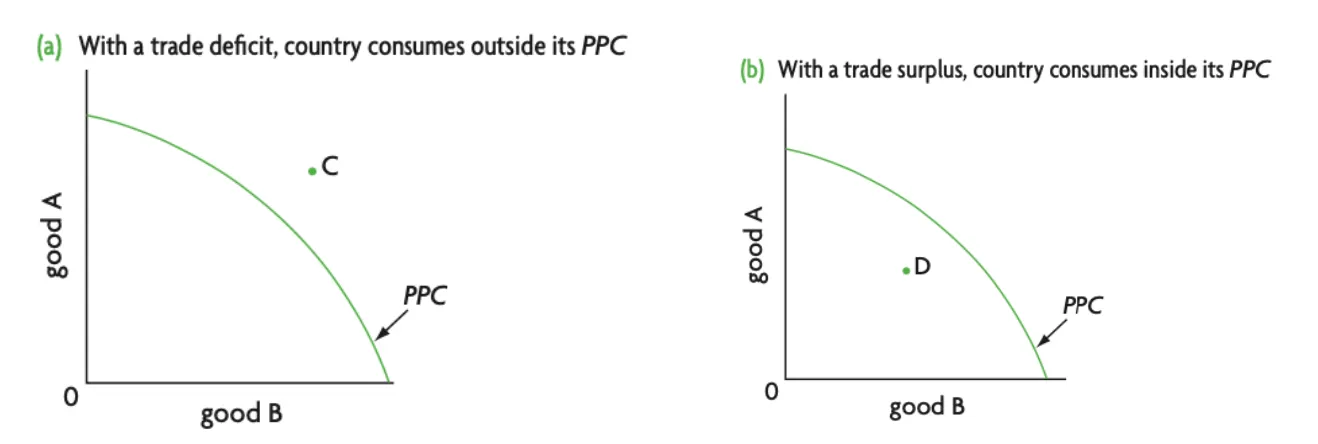
4.6.1 Trade deficit and Trade surplus
Diagram Analysis
Relation to Financial Account:
•
A current account deficit necessitates a financial account surplus, providing foreign exchange to cover the excess imports.
•
This surplus arises from foreign investments or loans, compensating for the trade shortfall.
Surplus Scenario:
•
Conversely, if exports surpass imports, indicating a current account surplus, the country consumes less than its potential (point D in Figure b).
•
This surplus allows the country to accumulate foreign exchange, facilitating investments or loans abroad, leading to a financial account deficit.
Stronger Exchange Rate:
•
Reduces export competitiveness but makes imports cheaper.
•
Can lead to decreased export volumes and increased import volumes.
Weaker Exchange Rate:
•
Enhances export competitiveness but makes imports more expensive.
•
May result in increased export volumes and decreased import volumes.
Implications of a persistent current account deficit
•
Negative (X-M) → lower AD
◦
Less economic growth, higher unemployment
•
Negative (X-M) → depreciation
•
Deficit needs to be financed
◦
Borrow from abroad
◦
Sell domestically owned assets to foreigners
◦
Attract foreign direct investment (FDI)
Correcting a persistent current account deficit
Policy | Expenditure switching policy | Expenditure reducing policy | Supply-side policy |
Definition | Switch spending from foreign goods to domestic goods. | Decrease expenditure using contractionary fiscal and monetary policy.
• Decrease demand for imports → increase export competitiveness. | Refer to section 3.7. |
Methods and evaluation | Protectionism
• Retaliation.
• Higher prices for domestic consumers.
• Loss of economic efficiency. | Higher unemployment, lower economic growth. | Interventionist supply-side policy
• Difficult to implement.
• Very long time lags. |
Depreciation
• Inflation.
• Retaliation from foreign governments. | Higher interest rates → decrease investment → undermine the competitiveness of the economy in the long run. | Market-based supply-side policy Very long time lags. |
Marshall-Lerner condition and the J-curve effect (HL)
Marshall-Lerner condition: depreciation/devaluation will have a positive effect on the current account if the sum of the price elasticity of demand for imports and exports is greater than 1.
If demand for imports and exports is elastic | If demand for imports and exports are inelastic |
% increase in the price of imports caused by depreciation would cause a greater % decrease in the demand for imports. Import expenditure would decrease. | % decrease in the price of imports caused by depreciation would cause a smaller % decrease in the demand for imports. Import expenditure would increase. |
% decrease in the price of exports caused by depreciation would cause a greater % increase in the demand for exports. Export expenditure would increase. | % decrease in the price of exports caused by depreciation would cause a smaller % increase in the demand for exports. Overall expenditure on exports would decrease. |
Depreciation would lead to an improvement in the current account. | Depreciation would lead to a worsening in the current account. |
The J-curve Effect
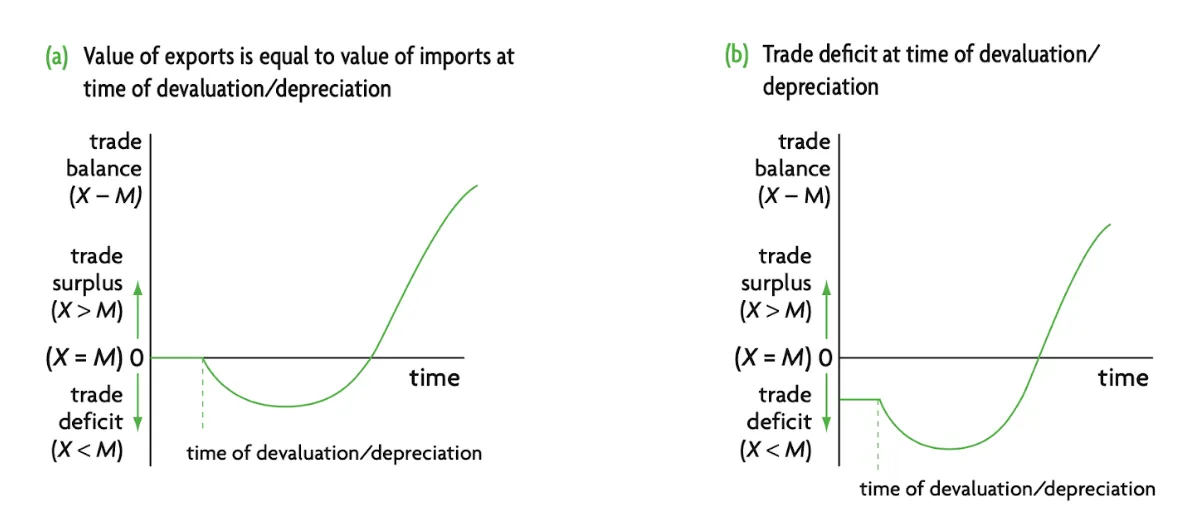
Figure 4.6.2 J-curve effect
Diagram Analysis
J-Curve shape: Occurs after currency devaluation/depreciation.
•
Initially worsens trade balance, then improves over time.
Fig (a) Initial Equilibrium with Balanced Trade: | (b) Initial Trade Deficit: |
Scenario: Initially, exports equal imports, resulting in no trade deficit or surplus. Effect of Devaluation/Depreciation: Following the devaluation/depreciation, a trade deficit emerges. Over time, this deficit decreases, eventually leading to a trade surplus. | Scenario: Begins with a trade deficit before the devaluation/depreciation. Effect of Devaluation/Depreciation: Trade deficit worsens immediately post-devaluation/depreciation. However, it gradually improves, eventually resulting in a trade surplus. |
Marshall–Lerner Condition:
•
Initially not satisfied due to low price elasticities of demand (PED).
•
As time passes, PEDs increase, leading to an improvement in the trade balance.
◦
Over time, consumers and producers adapt to price changes.
◦
PEDs increase, leading to decreased import demand and increased export demand.
◦
Trade balance begins to improve.
Short Run:
Impact on Imports:
•
Prices rise, but demand remains relatively unchanged (inelastic).
•
Import revenue increases, worsening the current account position.
Impact on Exports:
•
Prices fall, yet demand remains steady (inelastic).
•
Export revenue decreases, worsening the current account position.
Long Run:
Impact on Imports:
•
Increased consumer awareness leads to decreased spending on imports (elastic).
•
Current account position improves as import spending decreases.
Impact on Exports:
•
Increased consumer awareness results in higher spending on exports (elastic).
•
Current account position improves as export revenue increases.
Persistent Current Account Surpluses
1.
Rising Consumption and Investment:
•
Exporting firms experience increased profits, leading to higher investment.
•
Increased profits contribute to rising domestic income, driving up consumption.
2.
Appreciating Exchange Rates:
•
Foreign demand for the local currency rises due to higher exports, causing currency appreciation.
•
Appreciation makes the economy less attractive for foreign direct investment.
3.
Inflationary and Deflationary Effects on Prices:
•
Impact on inflation depends on the reliance of domestic firms on imported raw materials.
4.
Employment:
•
Export-driven industries experience increased demand, leading to reduced unemployment.
•
Rising profits spur further investment, potentially creating more jobs.
•
Increased domestic spending may also boost employment in non-exporting industries.
5.
Export Competitiveness:
•
Persistent surplus leads to currency appreciation, gradually reducing export competitiveness.
•
Impact varies based on the price elasticity of demand for exports:
◦
Inelastic demand mitigates the impact of currency appreciation on competitiveness.
◦
Elastic demand results in a greater erosion of competitiveness over time.