

Trade strategies
Import substitution industrialisation (ISI)
Import substitution industrialisation (ISI): a strategy to reduce imports using protectionism to allow domestic industry to grow.
Advantages | Disadvantages |
• Protects domestic employment.
• Improves current account.
• Protects local culture and way of life.
• Protects the economy fromform powerful of foreign multinational corporations (MNCs).
• Creates national champions - gain economies of scale. | • Country doesn’t benefit from international trade: goods could be sourced at a lower cost from abroad.
• Domestic industry may become inefficient: the domestic industry is protected from international competition.
• Inflation: domestic supply constraints.
• Retaliation by trade partners. |
Export led growth
Outward looking growth strategy based on increased international trade.
Growth achieved by focusing on exports and increasing export revenue → increase AD.
Advantages | Disadvantages |
• Increases exports → improves current account.
• Requires trade liberalisation → countries are forced to be competitive. | • Increases income inequality → social problems.
• Over reliance on MNCs → MNCs become too powerful and dictate.
• Dependent on overseas demand.
• Disgruntles developed trading partner countries.
⸰ Stop country from developing: produce higher value-added products for export |
Economic integration
Economic integration: economic interdependence between countries usually achieved by agreement between countries to reduce or eliminate trade barriers between them.
Advantages | Disadvantages |
• Increased competition.
• Greater economies of scale.
• Lower price, greater choice for consumers.
• Increased FDI. | • Leads to the loss of sovereignty.
• Trade diversion |
Diversification
Diversification: reallocation of resources into new activities that broaden the range of goods or services produced by a country.
•
Sustained increase in exports.
•
Development of technological capabilities and skills.
•
Reduced vulnerability to short-term price volatility.
•
Use of domestic primary commodities.
Social enterprise
Social enterprise: a type of commercial organisation that aims to achieve certainparticular social goals to improve people’s well-being and promote social change.
Market based policies
Trade liberalisation
Trade liberalisation: removal of trade barriers (e.g. tariffs, quotas).
•
Opposite of ISI and export promotion: they rely on trade barriers to promote domestic industries.
Privatisation
Privatisation: transfer of state-owned companies to the private sector.
Advantages | Disadvantages |
• Improved efficiency as the private sector is more efficient.
• Increased competition: if a state-owned monopoly is broken up when sold to the private sector.
• Government will raise revenue from the sale. | The problemProblem of regulating private monopolies: stop monopoly abusing power. |
Deregulation
Deregulation: removal of regulations or restrictions (in a particular industry).
•
Adopt market-based supply-side policies for labour.
•
Remove barriers of entry toto enter product markets.
Interventionist policies
Redistribution policies including tax policies, transfer payments and minimum wages
•
Tax policies:
◦
Progressive income tax.
◦
Indirect tax on luxury goods.
◦
Progressive corporation tax on company profits.
◦
Wealth tax.
•
Transfer payments:
◦
Pensions.
◦
Unemployment benefits.
◦
Free education and, healthcare.
Advantages of transfer payments |
• Provide basic income for the vulnerable in society → decrease poverty.
• Increase human capital → help drive development. |
•
Minimum wage: the amount of pay set by the government below which an employer cannot pay an employee
Advantages | Disadvantages |
• Reduces poverty by raising the living standard of the lowest-paidlowest paid workers.
• Prevents exploitation of workers who have poor bargaining strength in the labour market. | • Causes unemployment: increases the cost of employing workers → demand for these type of workers decrease.
• Raises business cost → businesses increase the price of their products → reduces their international competitiveness. |
Provision of merit goods
Health and education programmes
Healthcare | Education |
• People suffering from diseases are less productive.
• Decrease infant mortality: less likely that families will be bigger to ensure a male heir.
• Increase life expectancy: increase the payoffpay off from education → individuals will choose a higher amount of education → increase productivity. | • Decrease unemployment → increase real GDP.
• Increase income for individuals → more savings for entrepreneurs to borrow to invest in capital.
• Increase human capital. Increase developing countries’ ability to absorb modern technology.
• Attractive to foreign direct investment (FDI).
• Increase political participation / social justice. |
Infrastructure
Government builds capital equipment which includes energy, transport, telecommunications, clean water, etc.
•
Increase productivity.
•
Lowers cost of production for firms.
Inward foreign direct investment
Foreign direct investment (FDI): purchase of productive assets (factories, machinery) by a multinational corporation (MNC) in another country.
Advantages | Disadvantages |
• Provides funds for investment.
• Provide employment.
• Brings business knowledge, skills and technology into the country that may transfer to domestic firms.
• Increased tax revenue → increased government expenditure on health and education.
• MNCsMNC may improve infrastructure.
• Lower price and increased choice for domestic citizens. | • Employed created is low paid and low skilled.
• MNCs may lead to the closure of domestic firms thatwho cannot compete.
• MNCs may have too much power → secure large tax concessions or subsidies → reduce tax revenue.
• Lax regulation → firms reduce private costs (e.g. MNCs may pollute the local environment due to weak environmental legislation).
• MNCs may use inappropriate technology.
• MNCs may repatriate their profits. |
Foreign aid
Foreign aid: concessional and non-commercial transfer of funds or goods and services to developing countries with the main objective to bring about improvements in their economic, social or political conditions.
Concessional | Non-commercial |
Transfers involve more favourable conditions than could be achieved in the market. | Must not involve buying and selling (or other activities concerned with making a profit). |
Aid is distributed as either:
Humanitarian aid | Development aid |
Food, medical and emergency relief aid.
• Doesn’t have to be repaid. | Help developing countries achieve their economic growth and development objectives.
• Financial support for specific projects (e.g. building schools). |
Official development assistance (ODA)
Funded by governments and forms the largest part of overall foreign aid.
ODA funds reach developing countries in 3 ways:
Bilaterally | Multilaterally | Through non-governmental organisations (NGOs) |
ODA goes directly from the donor government to the developing country recipient.
• From one country to another. | ODA goes from the donor country to an international organisation (e.g. United Nations) to the recipient country. | ODA goes from donor country to NGO to recipient country. |
Advantages | Disadvantages |
• Moral argument.
• Breaks the poverty cycle.
• Increases economic growth: used to provide infrastructure. | • Tied aid: specific conditions are tied to the offer of aid assistance.
• Conditional aid.
• Aid volatility and unpredictability.
• Aid may not reach where it is needed. |
Non-governmental organisations (NGOs)
Non-governmental organisations (NGOs): private organisations that pursue activities to relieve suffering, provide basic social services or undertake community.
Advantages | Disadvantages |
• Strong anti-poverty orientation of activities: reach poor people and help them emerge from their poverty.
• Work closely with project beneficiaries.
⸰ Improve local people in the design and implementation of development projects.
• Enjoy the trust of beneficiaries. | • NGOs are small in size and have limited resources.
• NGOs may not be fully aided by the host government → difficult to bring meaningful change. |
Debt relief
Debt: money owed by one country to another country.
•
Opportunity cost of repayments
◦
Funds used to repay debt are not available to spend pursuing development objectives.
◦
High interest payments: countries will never be able to pay off their debt.
•
Odious debt
◦
Often the money lent by western banks werewas not used for development projects.
Multilateral development assistance
Lending to developing countries on non-concessional terms by:
•
World Bank.
•
International Monetary Fund (IMF).
World Bank
Extends long-term loans to developing country governments for the purpose of promoting economic development and structural change.
Evaluating the role of the World Bank |
• Conditional assistance (lending)
⸰ Conditions must be met by borrowing countries to qualify for a loan.
⸰ Deprives countries of control over their domestic economic activities.
• Inadequate attention for poverty alleviation
⸰ World Bank is not doing enough to meet the challenges of extreme poverty.
• Social and environmental concerns
⸰ Lent for socially unsound projects, as well as environmentally unsustainable projects. |
International Monetary Fund (IMF)
International Monetary Fund (IMF): a multilateral financial institution that leads to countries experiencing balance of payments deficits under the system of fixed exchange rates that existed at the time.
•
Helps countries who are having difficulties by lending them funds to repay international debt.
•
Oversees the global financial system.
•
Advises on the macroeconomic policies of its member countries.
•
Stabilises exchange rates.
*Evaluating the role of the IMF
Advantages | Disadvantages |
• Crisis Mitigation: Helps stabilize economies by providing emergency loans and support.
• Global Stability: Promotes international monetary cooperation and reduces risks of economic contagion.
• Structural Reforms: Encourages policies for long-term economic resilience.
• Technical Assistance: Offers expertise to improve financial systems in developing nations. | • Austerity Costs: Required reforms can lead to social unrest, poverty, and unemployment.
• Loss of Sovereignty: Borrowing nations may feel pressured to follow IMF-prescribed policies. • Generic Solutions: Often criticized for failing to adapt to local contexts.
• Dependency Risk: Programs can foster reliance instead of sustainable growth. |
Institutional change
Improved access to banking, including microfinance and mobile banking
Microfinance:
small loansloan given to poor people without collateral to start a business at a low interest rate.
Advantages | Disadvantages |
• Solves savings gap problem.
• Empowers women.
• Limited seed capital required.
• Successful entrepreneurial projectsproject will increase employment in a deprived area. | • Microfinance institutions do charge interest.
• Often prefers to lend to those who are not the poorest in society. |
Mobile banking: use of mobile telephones to receive or send money and to pay bills.
•
Easy to make Ease of making payments to family and businesses with instant access.
•
AvoidsAvoidance of having to travel long distances holding cash which may be stolen.
•
Reduced costs of transferring money.
•
Easier to get loans and, insurance.
•
Helps women expand their range of activities.
Empowerment of women
Educated women:
•
Are lLikely to be employed and add to the country’s GDP.
•
Improves the well-being of familiesfamily’s wellbeing.
•
Likely to marry later and have fewer children.
Reducing corruption
•
Eliminates inefficient regulations.
•
Make public expenditures more transparent.
•
Promote competition: avoid too much power concentrated in large monopolies.
Property rights and land rights
•
The poor will be able to unlock their entrepreneurial potential → generate income → reduce inequality.
•
Legal recognition and protection of land rights → boost growth → reduce poverty.
Important diagrams to remember
International Trade

Absolute and comparative advantage
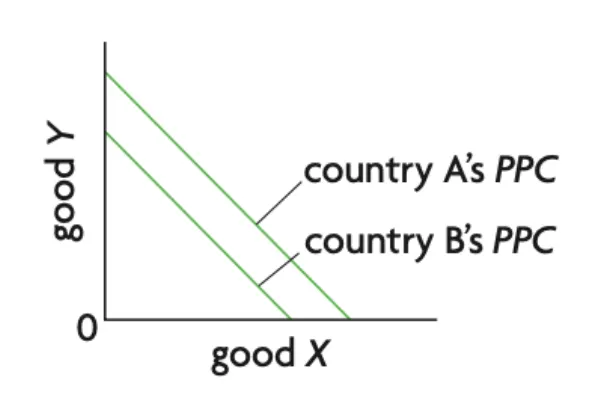
Identical opportunity costs: no gains from trade

Comparative advantage
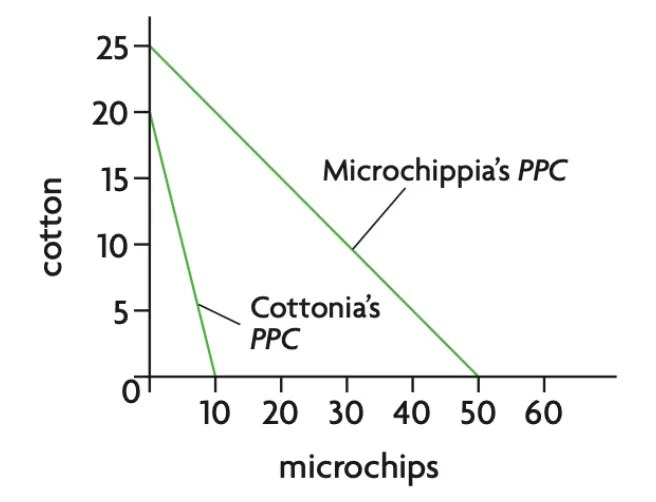
Comparative advantage
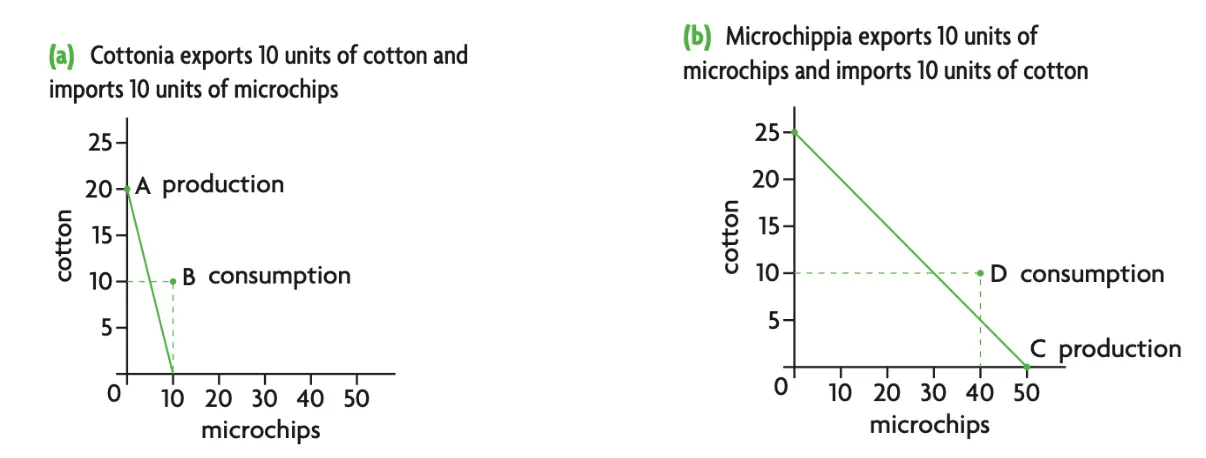
Benefits of Specialization & Trade: Beyond PPC
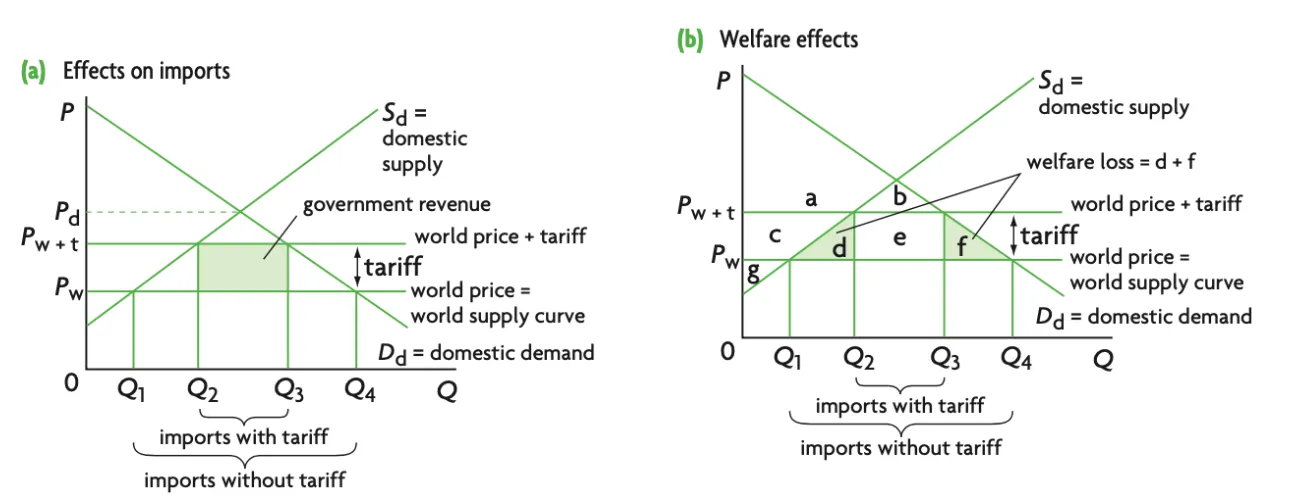
Effects of Tariff

Effects of Quota
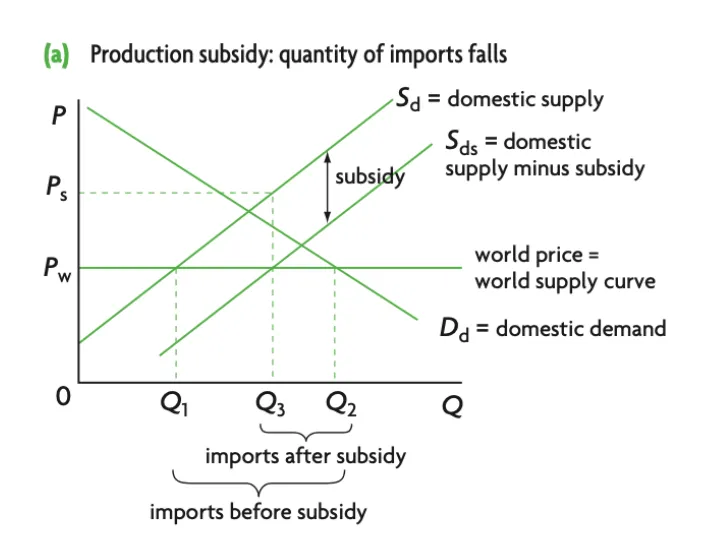
Effects of Export Subsidies
Exchange rates and the balance of payments

Freely Floating Exchange Rate System
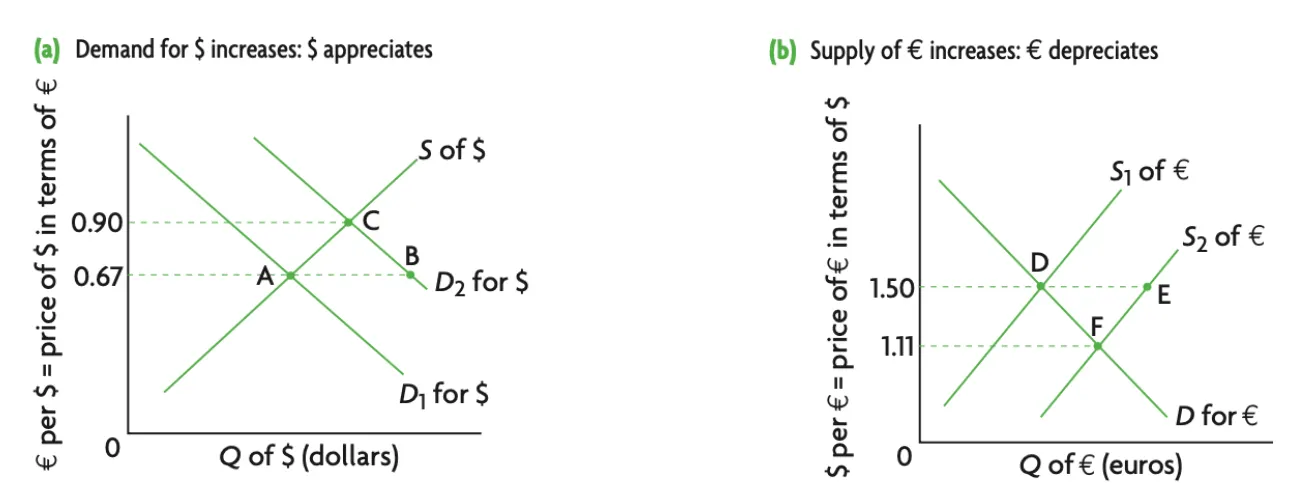
Exchange rate changes in a freely floating exchange rate system
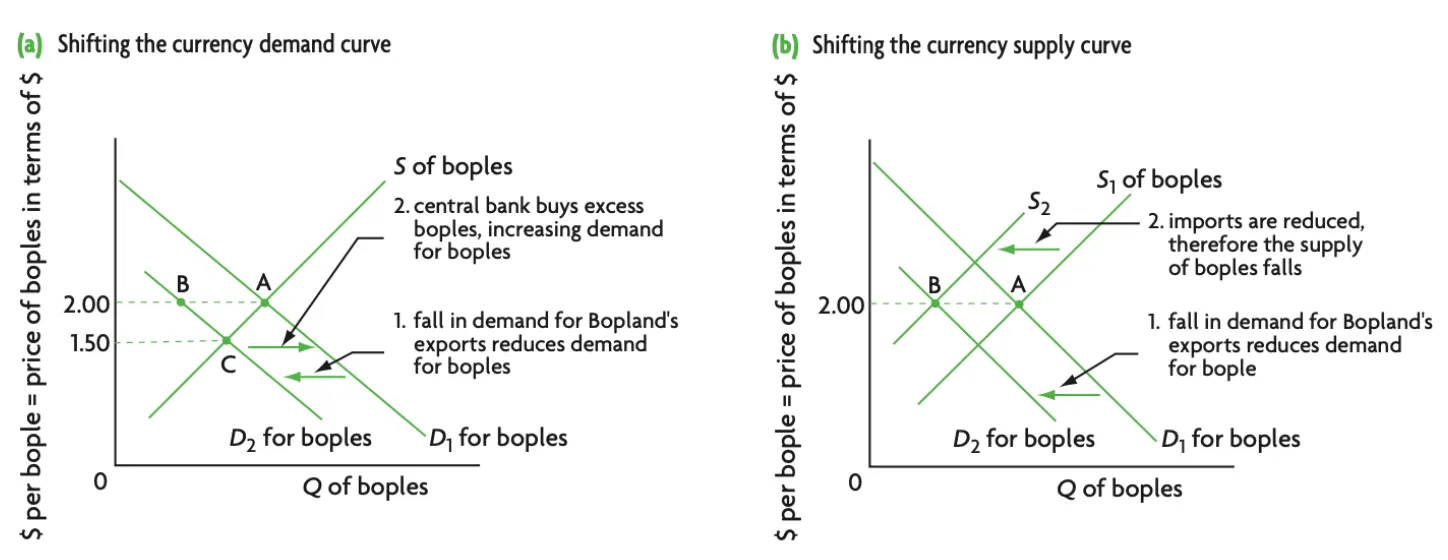
Fixed exchange rates

PPC: Trade deficit and a trade surplus
Economic integration and the terms of trade (HL)
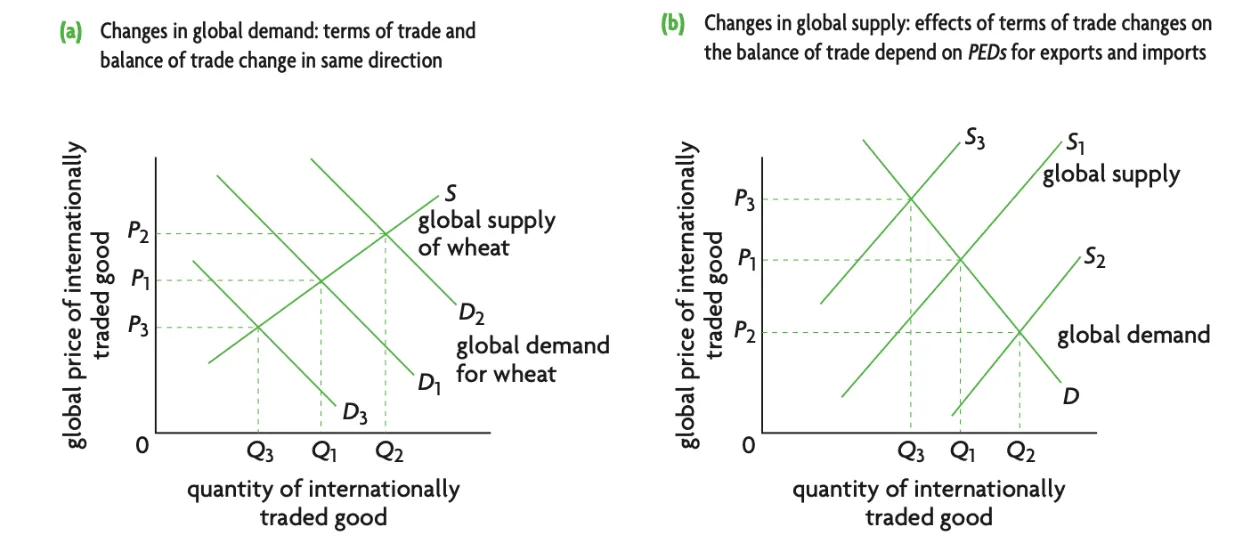
Changes in global demand or supply: terms of trade impacts on the balance of trade
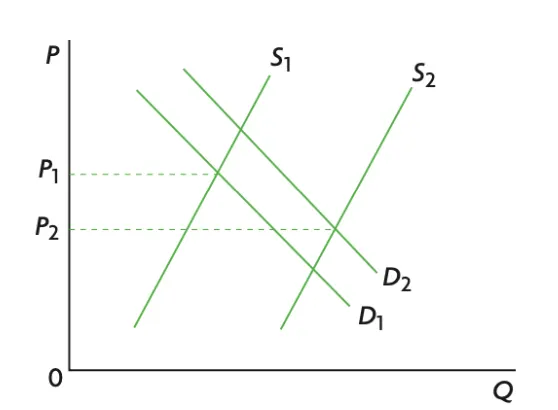
Long-term primary product price declines: low demand growth (low YED) and high supply growth (tech advances)
Understanding economic development
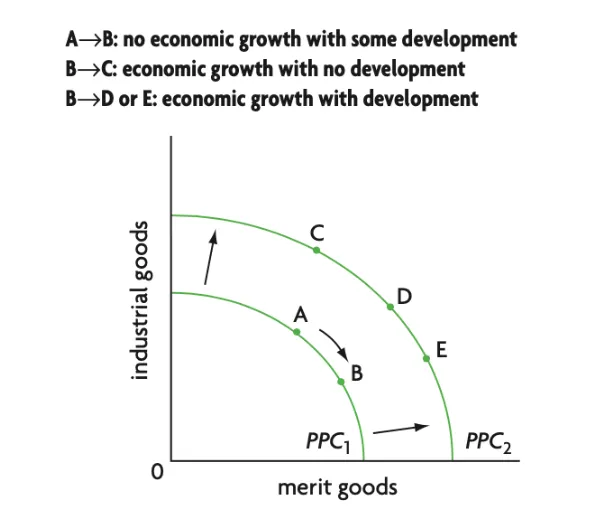
Economic growth and economic development