

Poverty cycle / trap
Poverty cycle / trap: circular chain trapping individuals / societies in poverty.
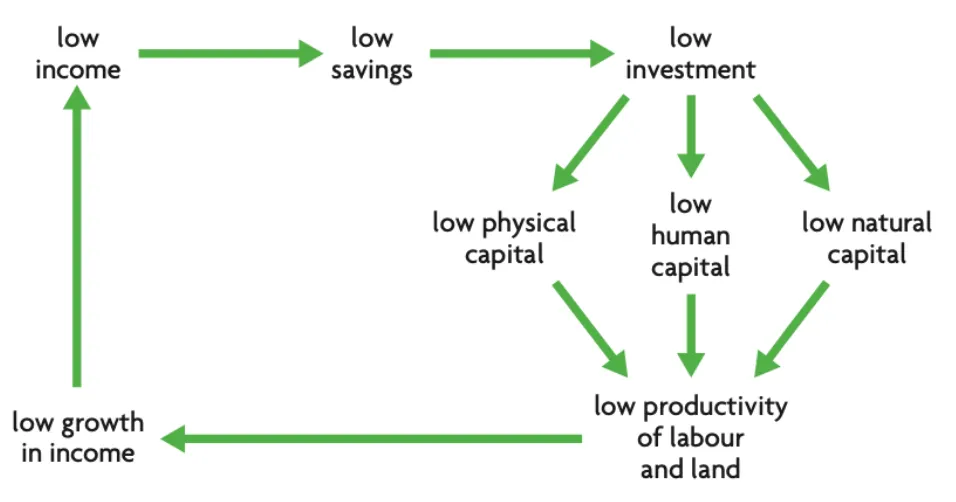
Fig 4.9.1 The poverty cycle
Economic barriers
Rising income inequality
Decrease in access to education, healthcare, and nutrition → decreases the ability of the country to develop.
•
Higher income inequality → disincentivise workers → lower productive efficiency → lower production → misallocation of resources.
•
Higher income inequality → higher relative poverty → lower access to quality education → lower access to future jobs = barrier to development.
Lack of access to infrastructure and appropriate technology
Poor provision of infrastructure | Limited access to appropriate technology |
• Problems of financing
⸰ Insufficient revenue for state enterprises.
• Inadequate maintenance and poor quality
⸰ Low quality and unreliable service.
• Limited access by the poor
• Misallocation of resources
⸰ Inappropriate infrastructure provided.
• Neglect by the government
⸰ Failure to control unnecessary emissions, wasteful consumption of water in poor irrigation facilities. | • Different factor supplies (labour and physical capital)
⸰ No technologically advanced equipment.
⸰ Lack of machinery.
• Developing countries don’t develop their own technology - import capital machinery from developed countries - not suitable for their needs. |
Low levels of human capital - lack of access to healthcare and education
Human capital: skills, abilities, knowledge acquired by people and good health
Low-qualityLow quality human capital → low productivity → low incomes → low tax revenue / corrupt government → minimal spending on public goods → poor education and healthcare system.
Barriers to adequate healthcare | Barriers to adequate healthcare |
• Insufficient funding
• Lack of teachers
• Insufficient facilities
• Remote communities far from schools
• Ethnic / gender discrimination | • Insufficient funding
• Lack of teachers
• Insufficient facilities
• Remote communities far from schools
• Ethnic discrimination |
Dependence on primary sector production
•
Primary sector commodities have little value added → don’t add much to GDP.
•
Primary product prices decrease over time compared to secondary and tertiary products.
•
Primary products are price volatile → uncertain incomes and limited ability to invest in capital equipment.
Lack of access to international markets
•
Landlocked countries (e.g. Malawi, Chad, Zambia and, Botswana).
◦
Landlocked: relianty on neighbouring countries with access to the sea for trade.
•
Tariff barriers set by developed countries.
◦
Tax barriers: hinder imports from entering the country.
•
Developed countries subsidise their agricultural sector which makes it difficult for developing countriesdevelopment to compete in their markets.
Informal economy
Economic activities that are unregistered and legally unregulated.
•
Unregistered work → tax evasion.
•
Corruption or crime.
Countries with high levels of informal employment have a lower HDI value.
Low HDI → low education levels → more informal labour.
•
Government gains no income taxes from those who are informally employed.
•
Informal employees have no legal protection.
•
Informal employees are vulnerable to exploitation (e.g. low levels of health, safety).
Indebtedness
Occurs whenwhere developing countries owe a large amount of money to developed countries / International Monetary Fund / World Bank.
•
Specialisation in primary sector products.
◦
Fall in price of secondary, tertiary sector products over time.
◦
Exporting primary and importing secondary, tertiary sector products will guarantee that a country will run out of money.
•
Low saving rates in developing countries → government has to borrow from abroad to finance infrastructure.
•
Poor governance in developing countries → money borrowed was often not put to the best use.
•
High repayment rates → opportunity cost.
•
Money will only be lent at a higher percentage rate → more money has to be repaid.
•
Taxes will have to be increased → produce funds to finance debt: contractionary.
•
Debt trap: government borrows more funds to repay previously borrowed money.
Geography - including being landlocked
•
Landlocked countries have poor relations with the country with the nearest port → limit their access to sea markets.
•
Extra costs / time delays / admin associated with routing exports through another country.
Tropical climates and endemic diseases
•
Temperate climates: richer soil are, more productive
•
Infectious disease: hinders development as it erodes human capital.
•
Many sub-Saharan economies are severely affected by droughts followed by flooding → difficult to establish an industry.
Political and social barriers
Weak institutional frameworks
•
Legal systems
◦
Eliminate discrimination, exclusion, and disempowerment of the individual.
◦
Decrease monopoly and reduce allocative inefficiency.
•
Ineffective taxation structures
◦
Weak tax collection systems: corruption.
◦
Bureaucratic tax system: complicated and, time-consumingtime consuming.
◦
High levels of indirect tax.
•
Banking system
◦
Provides a safe place for individuals to save money and accumulate wealth.
◦
Allows entrepreneurs to borrow saved funds to invest in capital equipment and drive growth.
◦
Allows individuals to borrow to increase their human capital and boost growth.
•
Property rights
◦
Allows for wealth accumulation and increase investment.
Gender inequality
•
Inequality in education: girls are not as well educated.
•
Labour market inequality: women don’t get the jobs they deserve → lower productivity.
•
Access to credit: females are less likely to start businesses → less investment in capital equipment.
Poor governance and prevalent corruption
•
Good governance: fairness, accountability, transparency, and efficiency in how the government deals with the running of society.
•
Corruption hinders development.
◦
Bribes: tax on getting a government service performed → decrease investment.
◦
Hinder transparency.
◦
Misallocation of resources.
◦
Barrier to entry to markets → less competition → higher prices.