

Supply-side policies: attempt to shift LRAS to the right and achieve long-run economic growth.
Goals of supply-side policies
Goal | Explanation |
Increase the productive capacity. | Increase potential output by rightward shift of the LRAS curve. |
Improve competition and efficiency. | Make the economy more responsive to the forces of demand and supply so as to increase efficiency in production. |
Reduce labour costs and unemployment through labour market flexibility. | Make labour market more responsive to the forces of demand and supply so as to reduce unemployment as well as labour costs. |
Increase incentive of firms to invest in innovation. | Lower cost of production provide firms with incentives to engage in research and development (R&D) which increases the productive capacity of the economy. |
Reduce inflation to improve international competitiveness. | Reduce inflationary pressure in the economy, which makes exports more competitive in global markets. |
Market-based policies
Product market related policies
Anti-monopoly regulation | Deregulation | Privatisation | Trade liberalisation |
Establish competition commissions, pass antitrust laws. | Relax inappropriate rules, restrictions, and laws in the operation of firms / markets.
• Airline, banking, and electricity industries. | Transfer of state-owned assets to the private sector.
• Utilities: water, electricity.
• Privately owned firms pursue profit maximisation → operate more efficiently. | Elimination of policies that protect domestic firms from foreign competition.
• Tariff
• Quotas
• Subsidies
• Health & safety barriers |
Labour market related policies
Reduce power of labour unions | Decrease or abolish minimum wage | Reduce non-wage labour costs |
Decrease money wages and production costs.
• Firms reduce prices and increase output. | Decrease production costs → lower prices → increase output → increase investment. | Employer contributions to national insurance, pension schemes. |
Incentive-related policies
Cut personal income tax | Cut business tax and capital gains tax |
Increase labour supply: more individuals join the labour force → shift LRAS curve to the right. | Increase profitability of investments → increase potential output → shift LRAS curve to the right. |
Interventionist supply-side policies
Increase public investments in education, training, healthcare | Public investment in infrastructure | Public investment in research and development (R&D) |
Increase stock and quality of human capital: education, training, skills, experience | Infrastructure: physical capital that decreases the overall cost of economic activity.
• Better transportation network.
• Electrification → access to information. | Spillover benefits
• Invest R&D in the form of subsidies, tax allowances, and patents. |
Industrial policies
•
Direct, and indirect subsidies.
•
Tax cuts, and allowances.
Analysing impact of supply-side policies using a diagram

Figure 3.7.1 Monetarist / New classical diagram
•
LRAS ↑ (LRAS 1 → LRAS 2) → real output ↑ (Yp → Y’p).
•
SRAS ↑ (SRAS 1 → SRAS 2) → real output ↑ (Yp → Y’p).
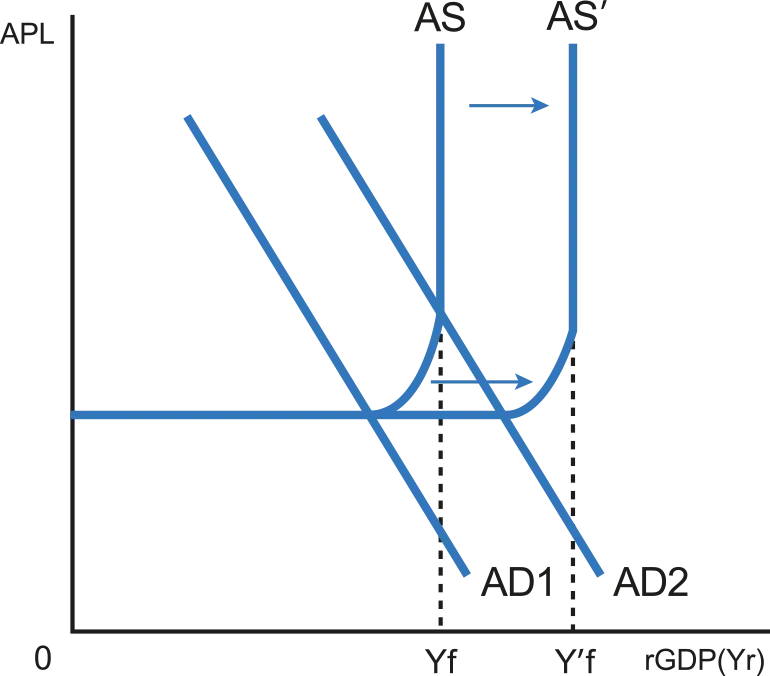
Figure 3.7.2 Keynesian diagram
•
IAD ↑ (AD1 → AD2) → real output ↑ (Yf → Y’f).
Demand-side effects of supply-side policies
•
Interventionist supply-side policies: increase AD in the short term.
•
Market-based supply-side policies (e.g., tax cuts): increase AD.
◦
Personal income tax ↓: disposable household incomes ↑ → C ↑ → C is a component of AD → AD ↑.
◦
Corporate tax ↓: I↑ → AD↑.
Supply-side policies of fiscal and monetary policies
•
Fiscal policies: increase government expenditures on infrastructure, healthcare → increase aggregate supply (AS)
◦
Income tax cuts → incentive to work ↑ → quantity of labour (factor of production) ↑ → AS ↑
•
Monetary policies: maintain low and stable inflation → I ↑due to lower economic uncertainty → AS ↑ in the long term.
Effectiveness of supply-side policies
Market-based supply-side policies
Strengths
Improve resource allocation
Decrease involvement of government
Weaknesses
Increased income inequality
•
Deregulation, privatisation → increased monopoly power and concentration
Long time lags
•
Environmental harm
Relax environmental rules → firms are more likely to cause harm to the environment (e.g. air pollution).
Interventionist supply-side policies
Strengths
Directly target specific areas
•
Public investments in education and healthcare → quality education and healthcare services
Weaknesses
Monetary cost
•
Huge government expenditure
Long time lags
•
Infrastructure: long time to build
•
Public investment in education: long time lag to show clear results