

D.3.1 Magnetic fields
Magnetic and Electric Fields
Electric field | Magnetic field | |
Symbol | E | B |
Caused by | Charges | Magnets (or electric currents) |
Affects | Charges | Magnets (or electric currents) |
Two types of | Charge: Positive and negative | Pole: North and South |
Simple force rule | Like charges repel, unlike charges attract | Like poles repel, unlike poles attract |
•
In order to visualize a magnetic field, we should once again use the concept of field lines
•
This time the field lines are lines of magnetic field- also called flux lines
◦
If a test magnetic north pole is placed in a magnetic field, it will feel a force
◦
The direction of the force is shown by the direction of the field lines
◦
The strength of the force is shown by how close the lines are to one another

D.3.1-1 Magnetic Field around magnets
•
An electric current can also cause a magnetic field

D.3.1-2 Magnetic Field around right hand grip rule
•
The field lines are circular around the current

D.3.1-3 Magnetic Field around the circular magnet
•
The direction of the field lines can be remembered with the right-hand grip rule as shown in the figure above
D.3.2 Magnetic force on a current
Flemming’s Left Hand Rule
•
When a current carrying wire is placed in a magnetic field the magnetic interaction between the two results in a force
◦
This is known as motor effect
◦
The direction of this force is at right angles to the plane that contains the field and the current

D.3.2-1 Diagram of Magnetic field with FLH Rule effect
•
The direction of force, field and current could be determined by using Fleming’s left-hand rule

D.3.2-2 Diagram of FLH Rule
•
The experiments has show that the force is proportional to the :
◦
The magnitude of the magnetic field B
◦
The magnitude of the current I
◦
The length of the current L that is in the magnetic field
◦
The sine of the angle, theta, between the field and current
◦
The magnetic field strength, B is defined as follows :
◦
Where the unit of B is the tesla
D.3.3 Magnetic force on a moving charge
Charge and Magnetic Field
•
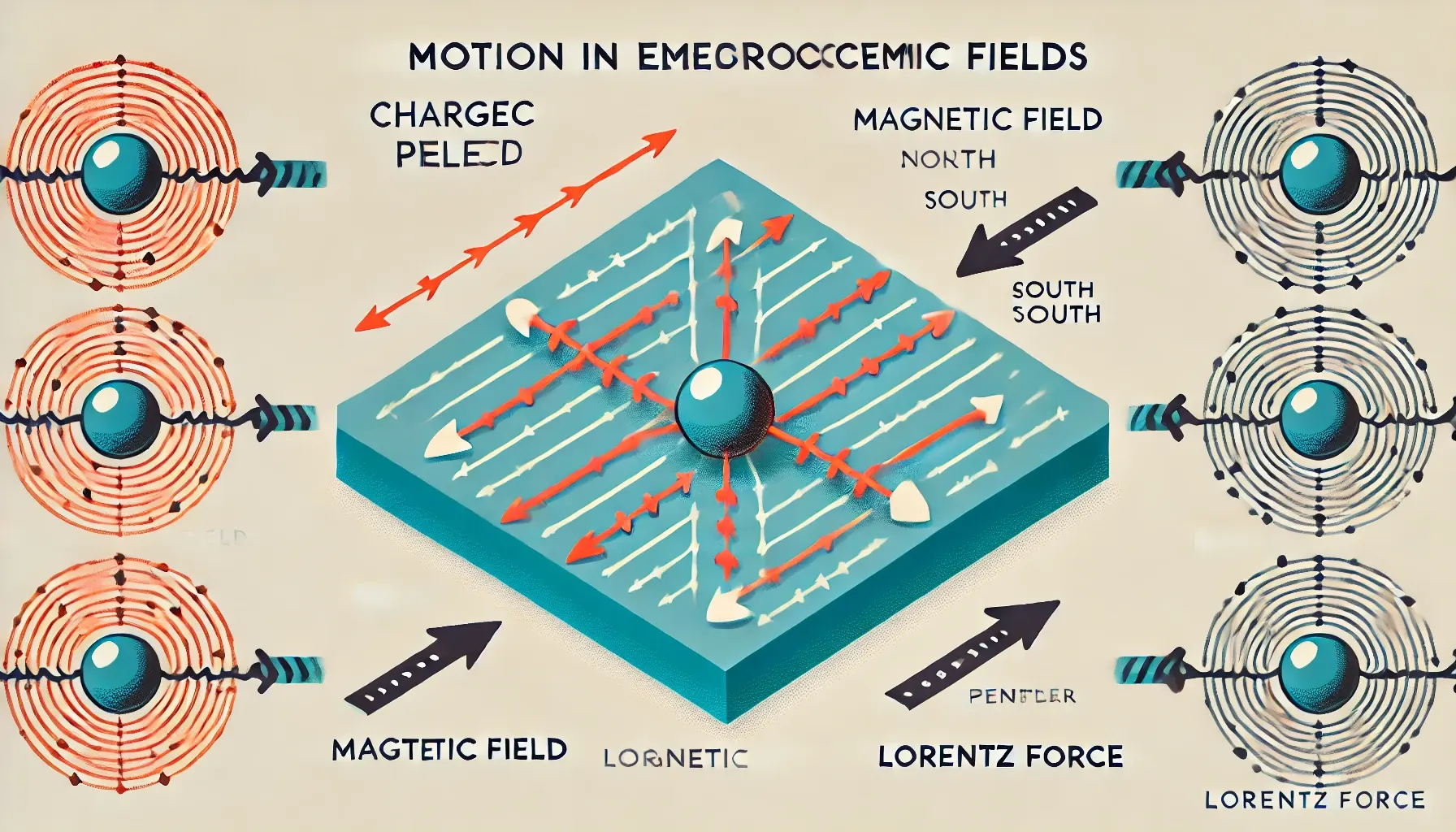
A single charge moving through a magnetic field also feels a force in exactly the same way that a current feels a force
•
In this case the force on a moving charge is proportional to :
◦
The magnitude of the magnetic field, B
◦
The magnitude of the charge, q
◦
The velocity of the charge, v
◦
The sine of the angle, theta, between the velocity of the charge and the field
•
Using these information and relationship, we can give an alternative definition of the magnetic field strength B
◦
Which is mathematically :