

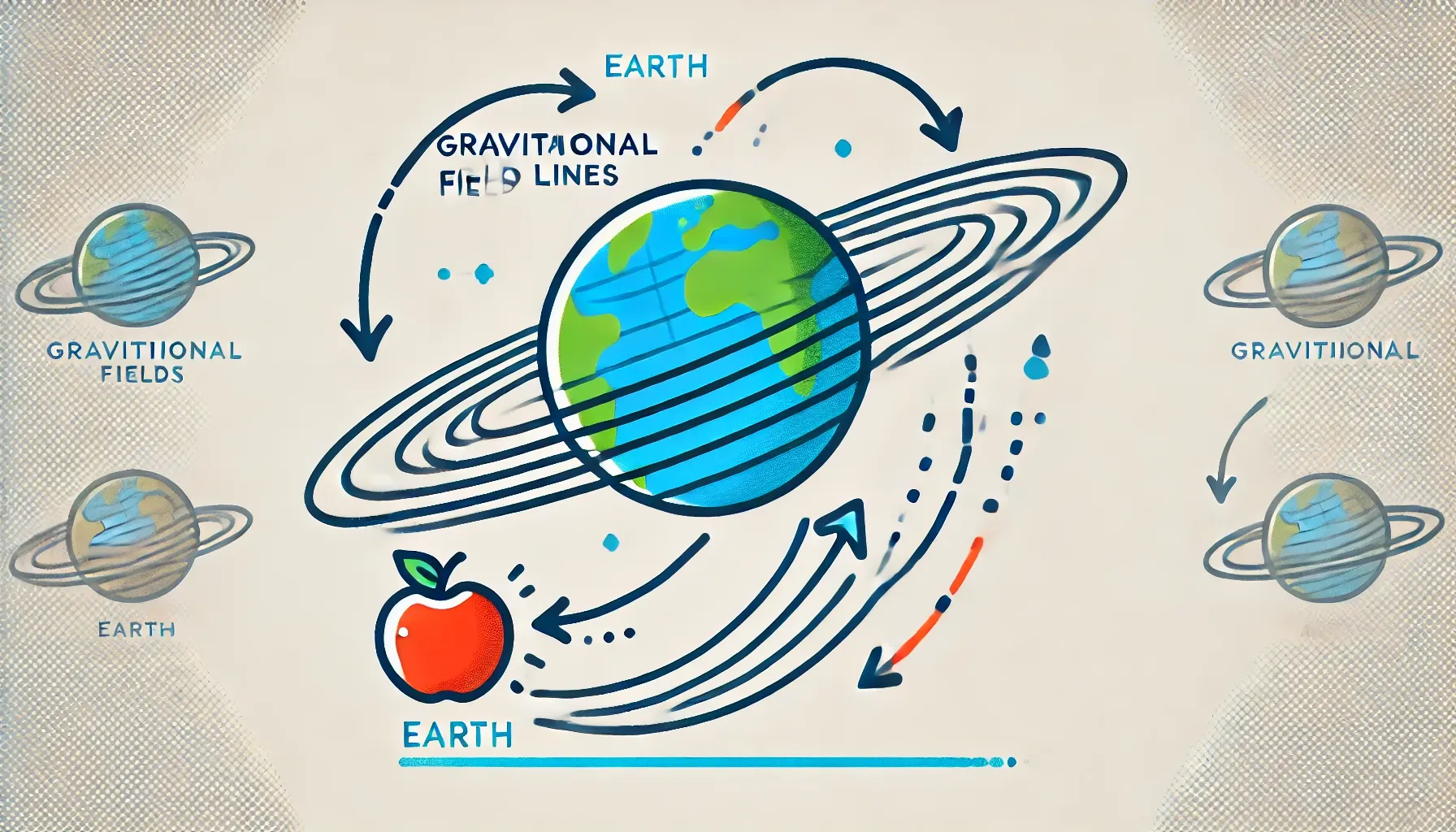
D.1.1 Newton's law of gravitation
Newton’s law of gravitation
•
Gravitational force between two objects can be calculated using Newton’s universal law of gravitation
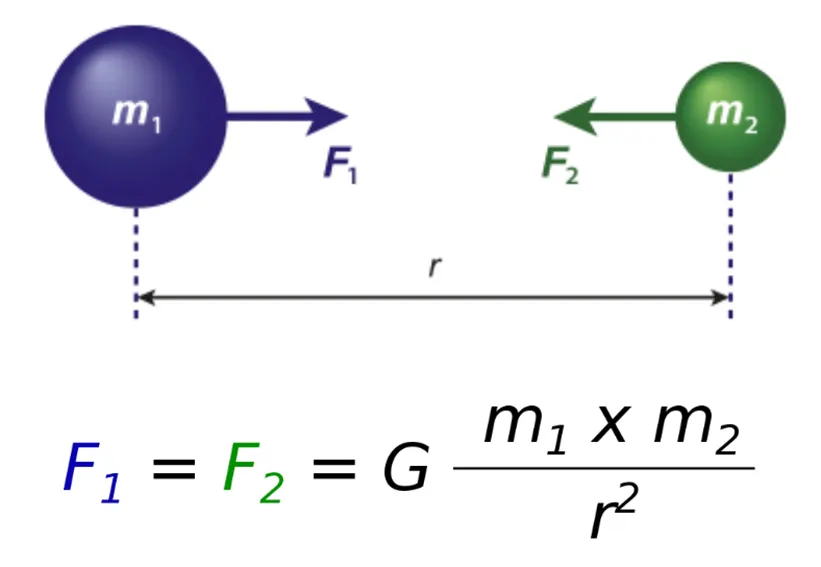
D.1.1-1 Diagram with equation explaining the gravitational force
•
Newton’s universal law of gravitation states that every object attracts other objects with a force
◦
It is directly proportional to the product of the masses
◦
It is inversely proportional to the square of the distance between the objects (It obeys the inverse square law

D.1.1-2 simplified graph explaining the relationship between the gravitational force and distance between objects
D.1.2 Gravitational field strength
Gravitational field strength
•
Gravitational field strength at a point is the force per unit mass experienced by a test mass at that point
•
The gravitational field strength due to an object is :

D.1.2-1 Graph of gravitational potential over distance between the objects
•
When throwing a ball high above from the surface of the Earth, the ball travels in an orbit.
◦
Newton proposed an imaginary cannon experiment high above the ground, that releases a ball in an orbit
◦
Centripetal force applied to the ball is equal to the gravitational force
◦
There is an equilibrium of forces, which makes the ball maintain its height

D.1.2-2 Diagram of the Newton’s cannon
◦
From this equation, we can derive the orbital speed:
◦
Revisiting topic 4, this can be converted into the equation of angular speed,
◦
Kepler’s 3rd law uses this founding from equations above, which defines the relationship between the period of the planet and its radius:
D.1.3 Gravitational Fields
About Field
•
General definition of field is :
◦
A region or area which an object experiences a specific force related to the origin of region in influence of distance

D.1.3-1 Diagram with equation of field
•
Field is shown in various areas and two main areas that construct field in every situation are :
◦
Gravitational Field
◦
Electrostatic Field
•
Gravitational Field :
◦
The gravitational force per unit mass exerted on a point mass

D.1.3-2 Line diagram of gravitational field
•
Field can be measured by the magnitude of strength
◦
We call it field strength
◦
Field strength can be calculated by dividing the force acting on a test object by the size of the test object
Uniform Fields
•
A gravitational field is a region of space in which objects with mass will experience a force
◦
The gravitational field strength can be calculated using the equation :
•
Gravitational force is always attractive towards both objects
•
It is important that gravitational field strength is always measured with the test point mass
◦
Which means that we are assuming the mass has no volume

D.1.3-3 Simple diagram of gravitational field between two masses
Radial Fields
•
A point charge and point mass produce a radial field around them
•
In calculation of magnitudes in radial field the charge or mass of two interacting masses or charges and distance between them are relative
•
Inverse Square Law : the field strength decreases by a factor of inverse square of distance
•
For Gravitational Field force between two masses :
D.1.4 Gravitational Field Lines
Gravitational Field Lines
•
The direction of a gravitational field is represented by gravitational field lines
•
The gravitational field lines around a point mass are radially inwards
•
The gravitational field lines of a uniform field, where the field strength is the same at all points, is represented by equally spaced parallel lines

D.1.4-1 Annotated diagram of point mass and surface mass
D.1.5 Gravitational Potential
Gravitational Potential
•
Gravitational potential energy : the energy an object possess due to its position in a gravitational field
•
Gravitational potential at a point can also defined as :
◦
The work done per unit mass in bringing a test mass from infinity to a point
•
This definition leads to the fact that the gravitational potential on an object will be zero when the distance between the object and mass is infinity

D.1.5-1 Diagram of gravitational potential earth
•
The gravitational potential at a point depends on :
◦
The mass of object that provides the field
◦
The distance between the centre of mass and the point

D.1.5-2 Diagram of satellite of earth
Calculating Gravitational Potential
•
The gravitational potential can be calculated :
•
Gravitational potential always is negative near an isolated mass
◦
The potential when r is at infinity is zero
◦
Work must be done to move a mass away from a planet
D.1.6 Potential Gradient & Difference
Gravitational Potential Gradient
•
A gravitational field can be defined in terms of the variation of gravitational potential at different points in the field :
◦
The gravitational field at a particular point is equal to the negative gradient of a potential-distance graph at that point
•
The potential gradient in a gravitational field is defined as :
◦
The rate of change of gravitational potential with respect to displacement in the direction of the field
•
Gravitational field strength, g and the gravitational potential
◦
Gravitatioal potential can be graphically represented against the distance from the centre of a planet, r :