

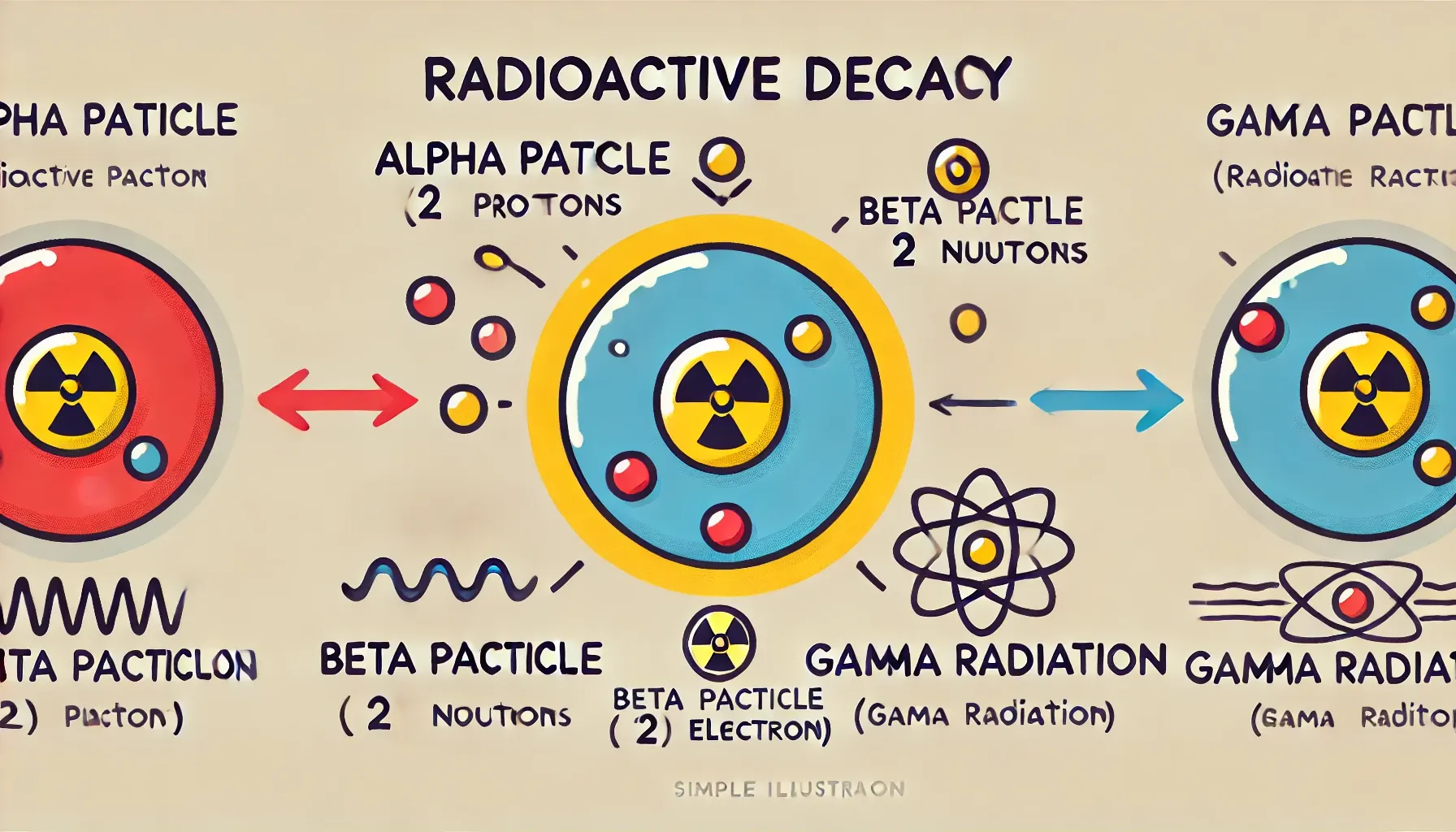
E.3.1 Radioactive Decay
Radioactive decay and Rate of decay
Random | Spontaneous |
We cannot predict which unstable nucleus in sample will decay or when there will be a decay | We cannot affect the rate of decay in a given sample any way |
•
Rate of decay is proportional to the number of particles left have not decayed
•
Activity A : rate of radioactive decay
Particles and Their Symbols
Particle | Symbol |
Nucleus | |
Proton | |
Neutron | |
Electron (beta minus particle) | |
Positron (beta plus particle) | |
Neutrino | |
Anti-neutrino | |
Alpha particle (helium nucleus) | |
Photon |
Types of decay:
1.
Alpha decay
•
An unstable nuclei emits an alpha particle (the same configuration as helium nucleus)
•
Proton number and nucleon number must be conserved.
•
For example,
2.
Negative beta decay
•
An electron and antineutrino are emitted from the parent particle
•
Proton number remains the same, but the nucleon number increases by one
•
For example,
3.
Positron decay
•
A proton and neutron are emitted from the parent particle
•
Proton number remains the same, but the nucleon number reduces by one
•
For example,
4.
Gamma ray emission
•
Gamma ray is emitted when an electron moves to the ground state.
•
This type of decay happens when the particle is in excited state
•
For example,
Radioactive Decay Comparison
Type of decay | Alpha decay | Beta decay | Gamma Decay |
Particles emitted | Alpha particle and a different nucleus | Electron, positron, neutrions, antineutrions and different nucleus | and same nucleus |
Penetrating power | medium | low | highest |
Ionizing Power | highest | medium | low |
Example | →
| →
→ | →
|
•
All of radioactive decay follow the conservation of mass and conservation of charge before and after the decay
E.3.2 Half-life
Half-life
•
Half-life is the time taken for number of particles of radioactive sample is halved
•
Any given nucleus has a 50% chance of decaying within a time interval equal to the half life

E.3.2-1 Process of half-life with their probability
E.3.3 Nuclear Binding Energy
Zone of stability
•
The nuclides within this zone are considered to be stable, and the nuclides outside this zone are unstable and spontaneously tending towards the stability zone.
•
It shows the trend of the neutron-proton number ratio.
•
Unstable nuclides that are neutron rich tend to have β decay.
•
Unstable nuclides that are proton rich tend to have β+ decay.

E.3.3-1 Zone of stability
Unified atomic mass unit
•
It is a unit of mass measured in atomic scale
•
Symbol: u
•
One-twelfth of the rest mass of the unbounded Carbon-12 atom in its nuclear and electronic ground state ( )
Mass and Energy
•
Mass of a nucleus is less than the sum of mass of its constituent nucleons
•
The difference in mass is called the mass defect
•
The energy equivalent to the mass defect is called binding energy, which mathematically equal to :
•
When a nucleus is broken up to its constituent nucleons, binding energy is supplied to the reaction
•
Mass of products is greater than the mass of reactants
•
Energy gained corresponds to the increase in mass of the products as compared to the reactants
•
When constituent nucleons are assembled to form a nucleus, binding energy is released from the reaction process
•
Mass of products is less than the mass of reactants in this case
◦
thus the energy lost corresponds to the loss in mass of the products as compared to the reactants
E.3.4 Fundamental Forces
Fundamental Forces
Electromagnetic force | Weak force | Strong force | Gravitational force | |
Act on | Particles with electric charge | Protonos, neutrons, electrons, neutrinos, during beta decay | Attractive force between protons and neutrons inside nuclei | Attractive force between masses |
Range | infinite | infinite | ||
Relative strength |
•
As more protons are added to a nucleus, the tendency for the nucleus to break apart increases
◦
All the protons repel each other through the electromagnetic force, which has infinite range
◦
But the strong force has a short range, so any one proton only attracts its very immediate neighbors
◦
To keep the nucleus together, we need more neutrons that will contribute to nuclear binding through the strong force, but which will not be added to the repulsive forces

E.3.4-1 graph of neutron and proton number through periodic elements
E.3.5 The Law of Radioactive Decay
•
As discussed in topic 7.1, radioactive decay is random and unpredictable.
•
The probability that an individual nucleus will decay is given a time interval is the decay constant λ ().
•
The activity of sample A is the number of nuclei decaying in a second (Bq).
The activity and the number of nuclei present (N) are negatively proportional since it is decaying:
The solution of this equation above is given by:
Its relation to the activity can be expressed as the equations:
= the activity of a sample of radioactive material at time t=0
Half-Life
•
Besides the whole number half-life we have learned in topic 7.1, we will now consider the half-life that is not a whole number.

E.3.5-1 Half-life decay of a number of nuclei
Since half-life is the time taken for the number of radioactive nuclei to decay to half, the half-life of the nuclei can be found by taking the process below:
•
Some nuclides have long half-lives that are longer than the possible time interval of radioactive decay observations.
•
A pure sample of the nuclide in a known chemical form needs to be separated, its mass measured, and then a count rate taken.
•
The activity can be calculated by multiplying the count rate by the ratio: