

Functions of money
•
Medium of exchange
◦
Acceptable as a means of payment in all market transactions.
•
Unit of account
◦
Express prices → measure and compare values of goods and services.
•
Store of value
◦
Hold purchasing power and wealth over time.
•
Standard of deferred payment
Banking system of a country
Central bank | Commercial bank |
• Note issuing authority of a country.
• Issues new government bonds.
• Conduct monetary policy: influence interest rates, and bank lending practices.
• Exchange rate policy: influences the competitiveness of a country’s exports.
• Regulate the way in which commercial banks operate.
• Lender of last resort: have enough cash to meet their cash obligations to depositors. | Commercial banks: financial institutions that bring borrowers and lenders together.
• Collect deposits.
• Keep a fraction of the deposits. |
Demand for money
•
Nominal income of a country increases → demand for money increases.
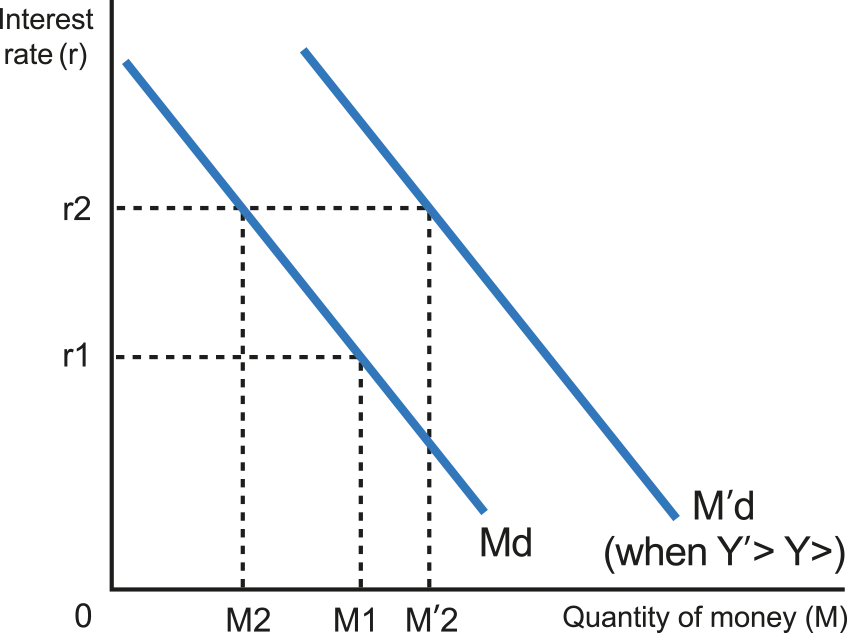
Figure 3.5.1 Demand curves for money
•
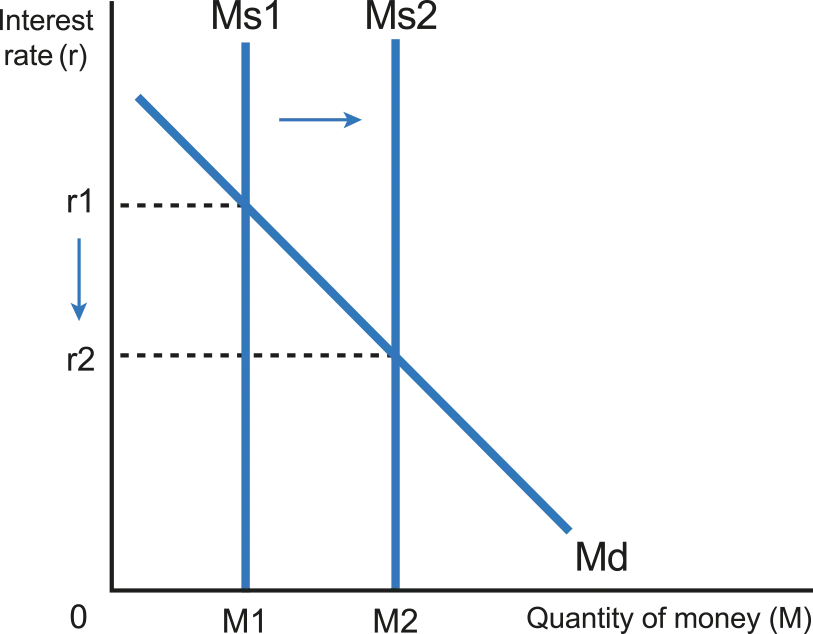
Interest rates increase (r1 → r2) → demand for money decrease (M1 → M2).
•
Movement along the Md (money demand) curve.
Supply of money
•
Determined by the central bank.

Figure 3.5.2 The money supply curve
•
Vertical at M (certain quantity of money).
Determination of interest rates by the central bank
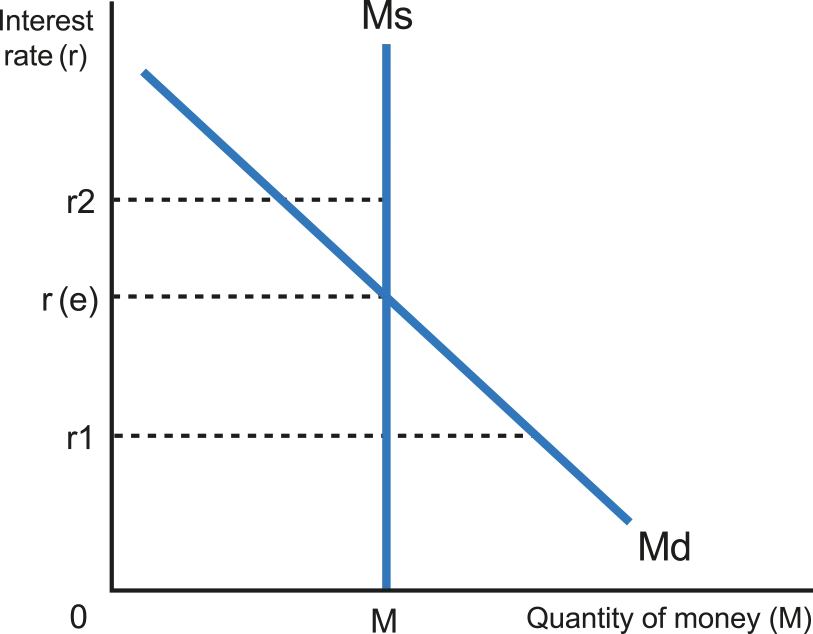
Figure 3.5.3 The money market
•
Determined by the interaction of the Md & Ms (money supply) curve.
Monetary policy
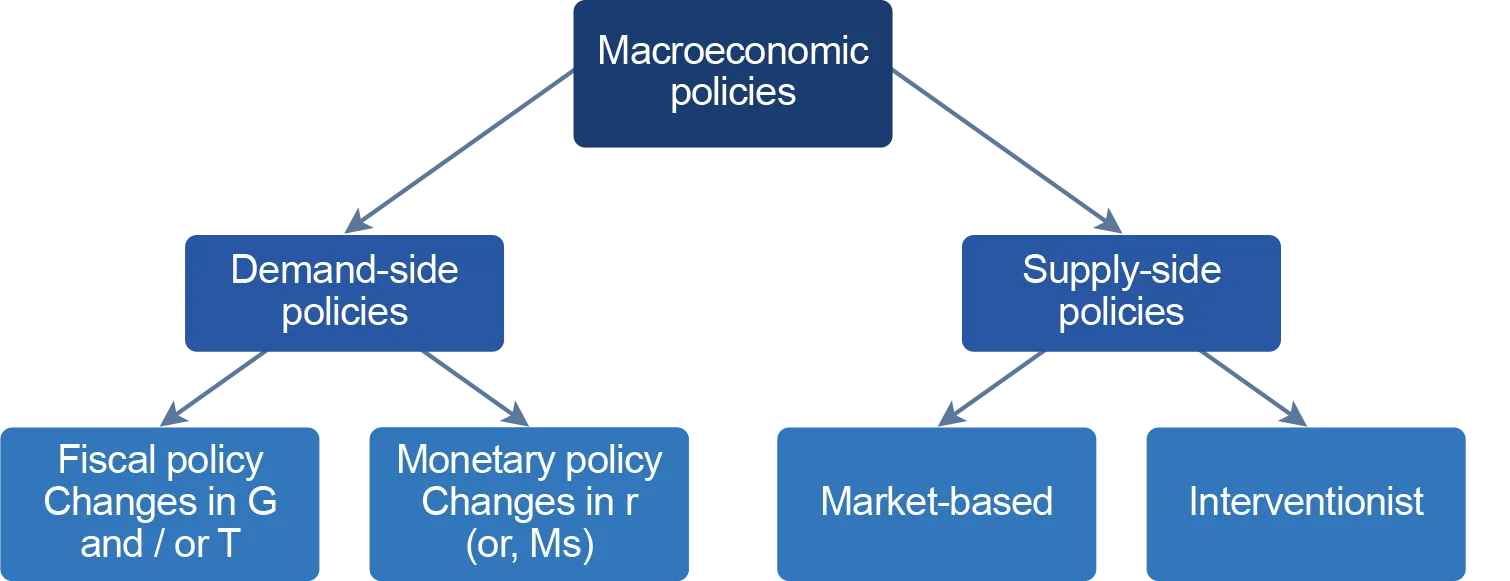
Monetary policy: demand-side policy carried out by a central bank that influences AD by changing interest rates, money supply, and access to credit.
Goals of monetary policy
Achieve and maintain price stability | Minimise fluctuations in the business cycle | Promote a stable and less uncertain macroeconomic environment |
Avoid the adverse consequences of inflation. | Permit central banks to act as ‘first responders’ to a risk of recession. | Low and stable inflation → higher investment spending → higher economic growth. |
Tools of monetary policy
Required reserve ratio | Quantitative easing | Open market operations |
Fraction of total deposits that a bank is legally obligated to keep and not lend out. | Central bank purchases a large amount of financial assets from commercial banks to increase the money supply and lower interest rates. | The central bank buys and sells bonds to commercial banks to influence the money supply and interest rates. |
How does the central bank change interest rates?
Increase interest rates
Decrease AD: contractionary monetary policy.
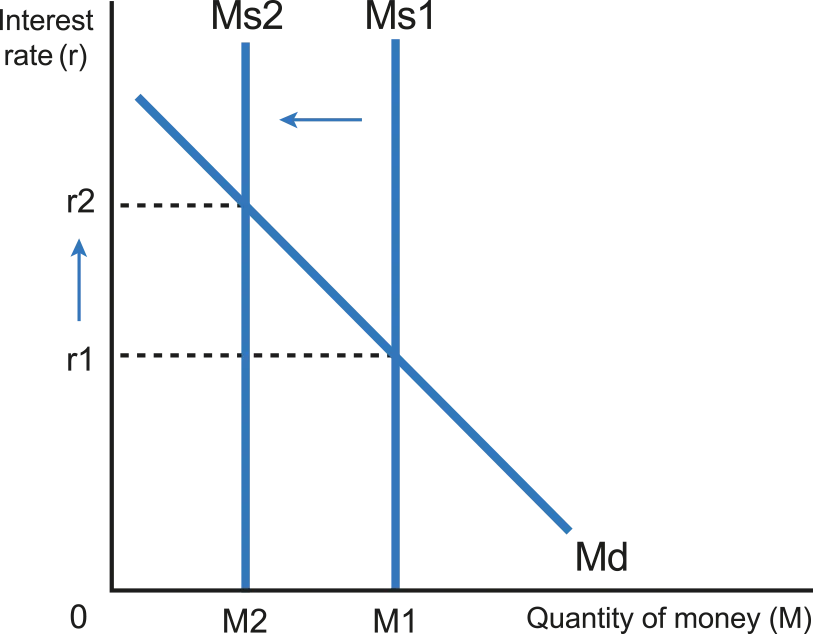
Decrease interest rates
Increase AD: expansionary monetary policy.
Effect of expansionary monetary policy on aggregate demand
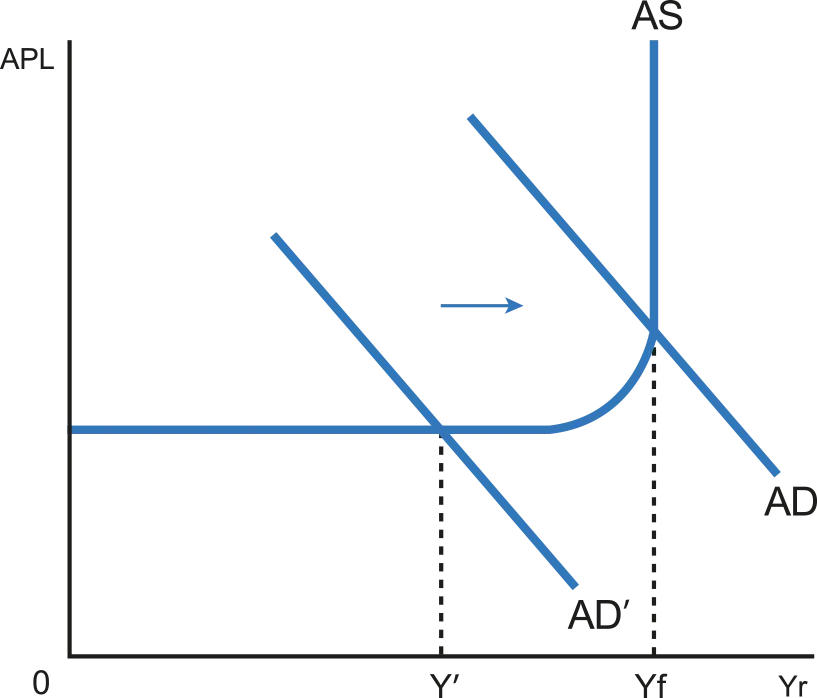
Figure 3.5.4 Expasionary monetary policy on AD
Increase consumption expenditures (C)
•
Lower interest rates → cost of borrowing for households ↓ → households borrow more from banks to consume more goods and services → C ↑ → AD ↑
•
Lower interest rates → incentive for households to save ↓ → incentive to spend more ↑ → C ↑ → AD ↑
Increase investment expenditures (I)
•
Lower interest rates → cost of borrowing for firms ↓→ firms borrow more to build new factories → I ↑ → AD ↑
Increase net exports (X-M)
•
Lower interest rates → rate of return for financial investors who have deposits ↓ → investors will sell the currency to purchase currencies of other countries → depreciation → exports are cheaper abroad → exports are more competitive abroad → exports ↑ → X-M ↑
Effect of contractionary monetary policy on aggregate demand

Figure 3.5.5 Contractionary monetary policy on AD
Decrease consumption expenditures (C)
•
Higher interest rates → cost of borrowing for households ↑ → borrowing ↓ → household expenditures ↓ → C ↓→ C is a component of AD → AD ↓ (AD’ → AD).
•
Higher interest rates → incentive for households to save ↑ → households save more → household expenditure ↓ . → C ↓ → AD ↓
Decrease investment expenditures (I)
•
Higher interest rates → cost of borrowing for firms ↑ → I ↓ → AD ↓
Decrease net exports (X-M)
•
Higher interest rates → rate of return for investors who own deposits in that country’s currency ↑ → demand for that country’s currency ↑ → appreciation → exports ↓ → (X-M) ↓ → AD ↓
The real interest rate
real interest rate = nominal interest rate - inflation rate
Real interest rate: interest rate adjusted for inflation
Effectiveness of monetary policy
Advantages | Disadvantages |
Flexible
• Respond quickly to changing economic conditions. | Less effective in fighting a recession. Low consumer & business confidence during a deep recession. |
Incremental
• Central banks can increase/decrease interest rates in a series of steps of 0.25% at a time. | Limited scope of reducing interest rates.
• Economies unable to exit a recession / deflation. |
Time lags
• Detection / recognition lag: the time it takes for policymakers to realise that there is an economic problem.
• Administrative / implementation lag: time it takes for policymakers to decide on the appropriate policy response.
• Impact / execution lag. |