

E.4.1 Fusion and Fission
•
The greater the binding energy per nucleon, the more stable the nucleus

E.4.1-1 Graph of nucleon numbers and and average binding energy per nucleon
•
As shown in the figure above, nickel Ni-62 has the highest average binding energy per nucleon
•
Elements to the left of Ni become more stable through nuclear fusion (light nucleis form into a heavier one)
◦
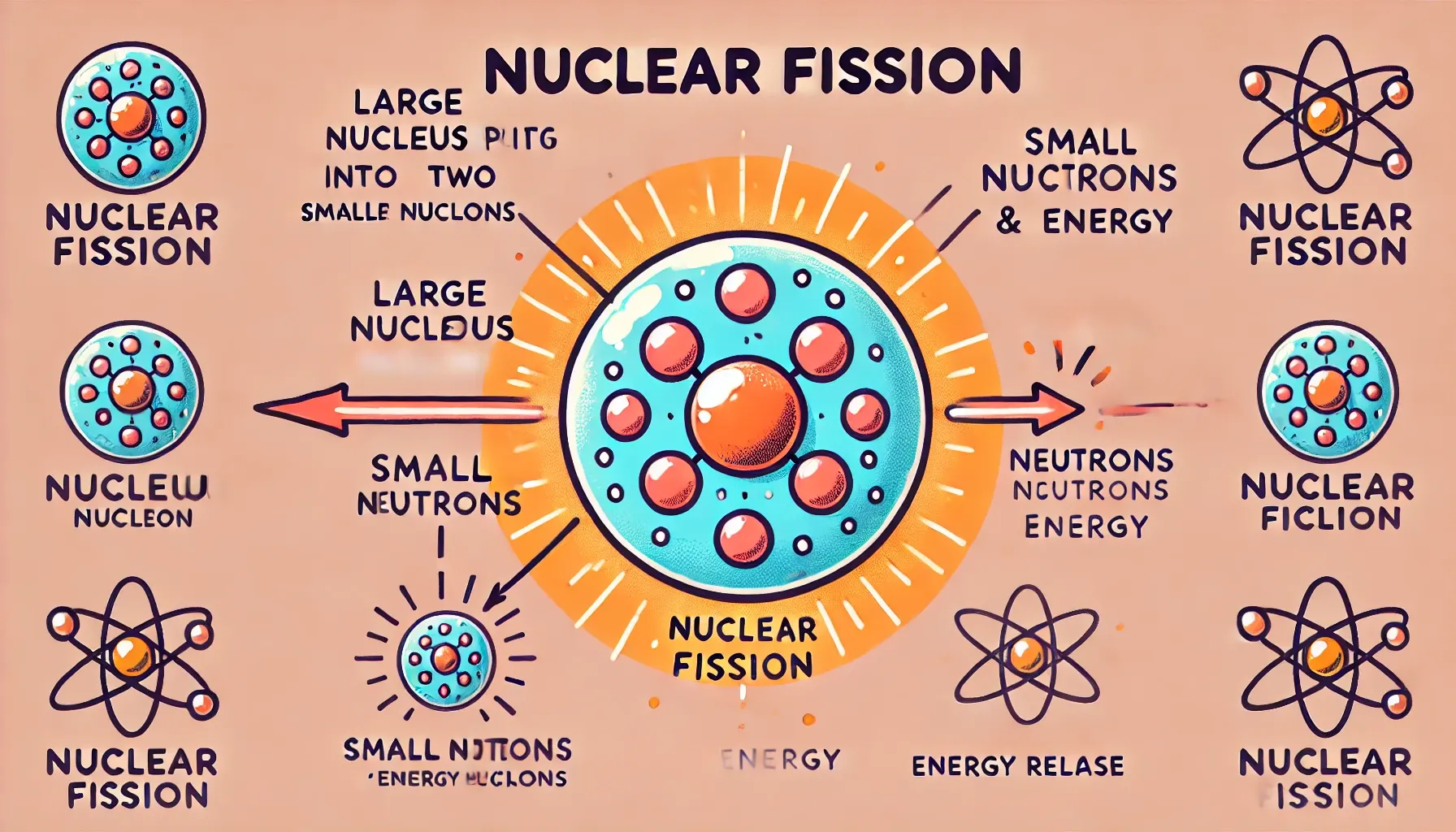
Elements to the right of Ni become more stable through nuclear fission
Neutron induced fission
The nuclear fission reaction of uranium-235 is:
•
•
The products are more or less random
If the products are unstable, they will further decay through alpha, beta, or gamma decay
The reaction will not start unless an external neutron is provided so this is called an induced reaction.
Energy Released From Each Fission
Kinetic energy of fission products:
Gamma rays
Kinetic energy of the neutrons
Energy from fission products
Gamma rays from fission products
Anti-neutrinos from fission products
165 MeV
7 MeV
6 MeV
MeV
6 MeV
9 MeV
200 MeV

E.4.1-2
Chain reactions
If one neutron from U-235 fission strikes another nucleus, it causes a chain reaction
If at least one neutron from each fission strikes another U-235 nucleus and initiates fission, the reactions will continue without slowing down
When this happens it is self-sustaining (it no longer needs external neutrons).
The mass required for a self-sustaining reaction is called critical mass.

E.4.1-3
Nuclear Reactors

E.4.1-4
Fission Products
When uranium-235 undergoes fission, the average of the fragment mass is about 118,
but very few fragments near that average are found.
It is much more probable to break up into unequal fragments, and the most probable fragment
masses are around mass 95 and 137.

E.4.1-5
Most of these fission fragments are highly unstable (radioactive), and some of them such as cesium-137 and strontium-90 are extremely dangerous when released to the environment.