

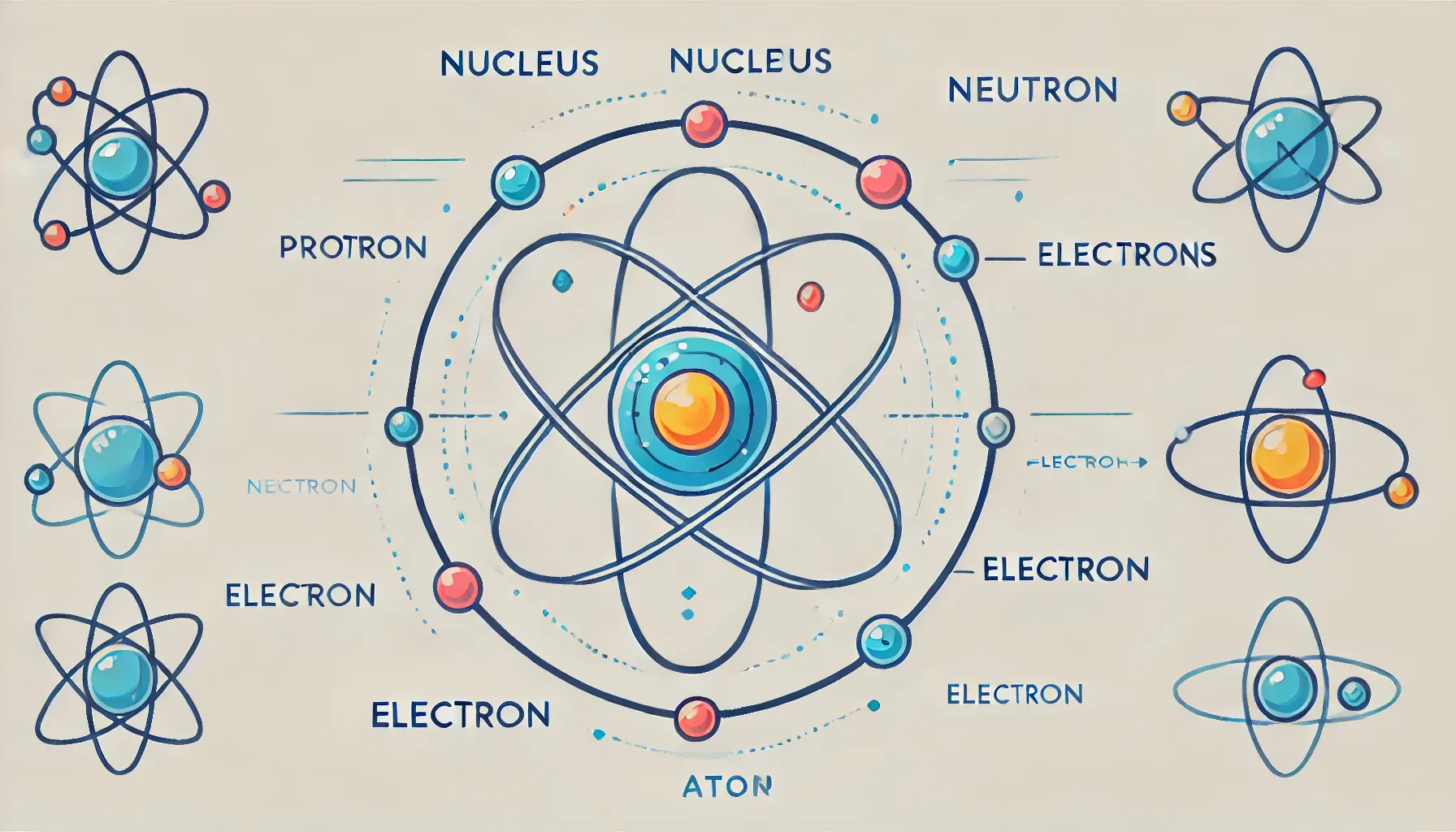
E.1.1 Discrete Energy
Discrete Energy Level and Spectrums
•
Photons are fundamental particles that make up all forms of electromagnetic radiation
•
A photon is a massless quantum of electromagnetic energy

E.1.1-1 Diagrams and equations explaining the duality of light
•
means that the energy is not transferred continuously but as discrete packets of energy
•
each photon carries a specific amount of energy and transfers this energy all in one go

E.1.1-2 lined graph of emission spectrum
•
Relation between emission spectrum and energy levels of electrons
◦
Wavelengths on the emission spectrum corresponds to the wavelengths of photons emitted as the atom falls from a higher energy level to a lower one
◦
Energy lost by one atom during a transition from a higher energy level to a lower one corresponds to energy of the photom emitted
•
For example :
→ When hydrogen atom makes a transition from energy leven n=3 to n=2
→ The energy lost by one hydrogen atom is therefore :
→ This is the same as the energy of the photon emitted by this atom
•
The formula for energy of a photon is :
•
Where
•
Important to note that
•
Therefore :
•
Then, substitute in constant
•
convert eV to SI units Joules () :
•
This is the exactly the wavelength of the red light in the emission spectrum of hydrogen
Existence of Energy Level
•
For hydrogen atoms, from any energy level greater than n=2 falls to n=2, visible light is emitted
•
From any energy level greater than n=1, fall to ground state n=1, UV light is emitted
•
understanding the relationship between energy level and emission spectrum
◦
concludes to that emission spectrum is an evidence of discrete energy levels in atoms

E.1.1-3 Energy Level and wavelength between the energy levels
•
From experiments, we know that each element has its own emission spectrum
•
The wavelengths in each spectrum is fixed and distinct
•
Since each wavelength corresponds to the energy of the photon emitted, every time the atom emits energy
•
only certain discrete amounts of energy can be emitted and not any arbitrary amount of energy
◦
can deduce that atoms have discrete energy levels, that is why the energy difference between energy levels is also fixed
◦
E.1.2 Absortion and Emission Spectra
Comparison between absorption and emission spectrum

E.1.2-1 Absorption (top) and emission (bottom) spectrum of hydrogen
Absorption spectrum | Emission Spectrum | |
How to obtain the spectrum? | Pass white light through a container of gas. | Expose gas at low pressure to a strong electric field. |
Explanation | Before the absorption of light, the electrons are in the ground state (n=1, at the lowest energy level).
Only light of certain wavelengths are absorbed, this is because when energy is supplied to an atom by photons, it will absorb the energy only if it exactly corresponds to the energy difference between a higher energy level and the current energy level (but if the energy is supplied by electrons, the atom will absorb the exact amount that is needed to jump to a higher energy level and leave the rest to the electron) | Electrons in atoms get excited by the electric field and move to higher energy levels. Then they quickly fall back to ground state (n=1). The electron lose energy in the form of photons, which is the smallest unit of light. Photons of different wavelengths are emitted, corresponding to the wavelengths on the emission spectrum. |
E.1.3 Matter Waves
Wave-Particle Duality and De Broglie Hypothesis:
•
Physicist De Broglie in 1924 proposed that just as light has both wave-like and particle-like properties, electrons, the particle, also have wave-like properties.
•
The relationship has since been shown to hold for all types of matter: all matter exhibits properties of both particles and waves.
The de Broglie equations relate the wavelength to the momentum:
h = Plank’s constant
In special relativity, the equation can be written as:
= the particle’s rest mass, v = the speed of the particle, c = the speed of light in vacuum, = the Lorentz factor