

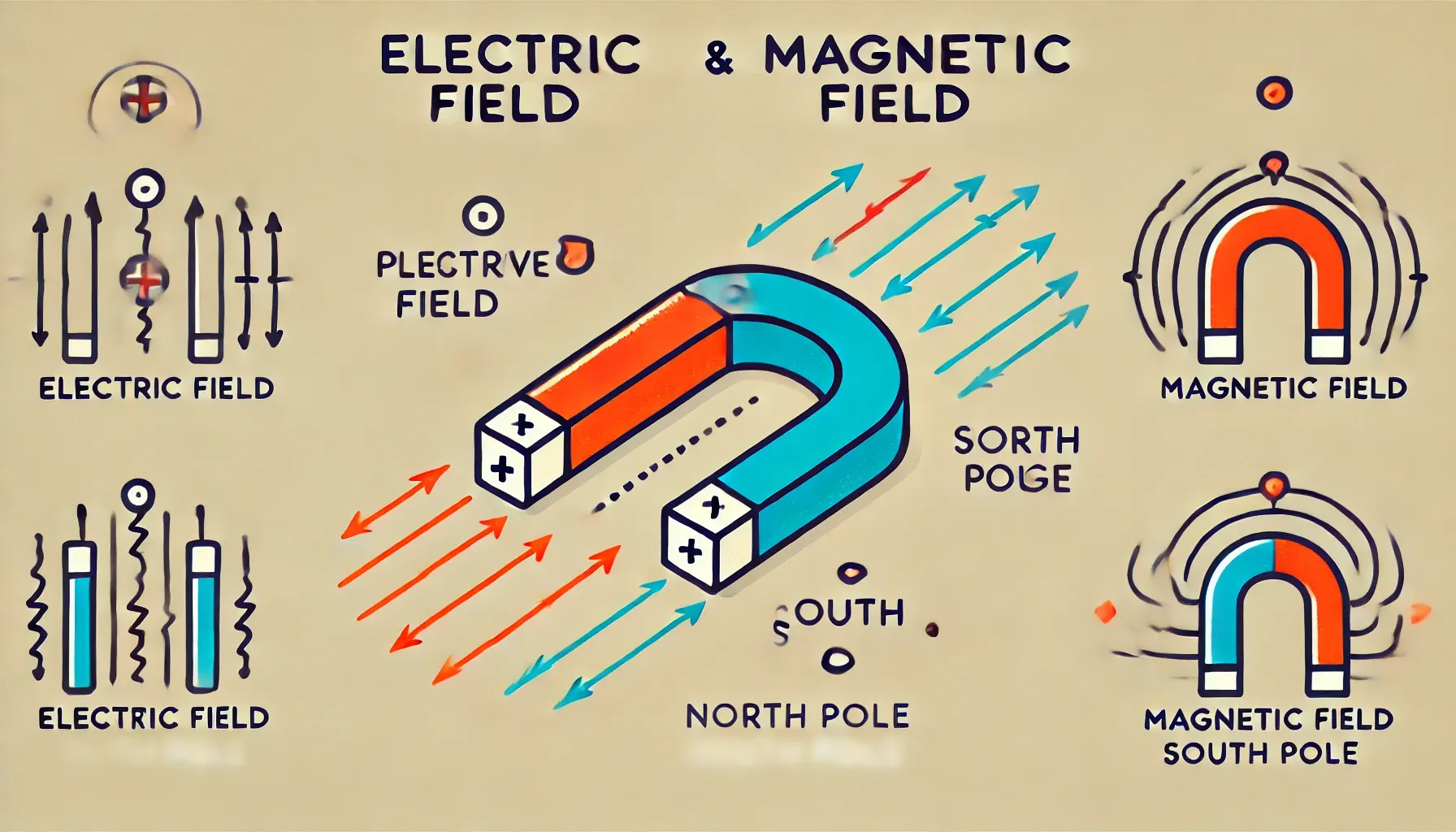
D.2.1 Charge and Coulomb Force
Charge
•
The unit of Charge is the coulomb (C), it is a scalar quantity
•
The coulomb is defined as the charge transported by a current of one ampere in one second
•
All electrons are identical with each one having a charge equal to 1.610-19C
•
Opposite Charge attracts, Like charge repel

D.2.1-1 Attractive and Repulsive force of charges
Force between charged objects
•
Coulomb force is a force between charged objects with formula :
•
Where F is the coulomb force, k is coulomb’s constant, q1 and q2 are the charge of each objects and r is the separation between two objects
•
Coulomb’s constant could be rewritten as :
•
is called the permittivity of free space
•
This equation appears to say nothing about the direction of the forces as Coulomb forces acting on both objects

D.2.1-2 Anotated diagram of repulsive force between
Electric Fields
•
The term field is used in physics for cases where two separated objects exert forces on each other
•
Inside of field, an object has the ability to exert force to the other object without any contact
◦
The size of a field is determined by the distance between two objects where they are no longer affected by the natural forces
•
The concept of the field is an extremely powerful one in physics because there are many ideas common to all fields

D.2.1-3 Diagram of Electric field with equations
Conventions for drawing electric field pattern :
•
The lines start and end on charges of opposite signs
•
An arrow is essential to show the direction in which a positive charge would move
•
Where the field is strong the lines are close together
◦
This is also called “Field Line Density”
•
They act to repel each other
•
The lines never cross
The lines must perpendicular to the conducting surface

D.2.1-4 Various Electric fields lines
The Electric Field Strength
•
The electric field strength is defined as electric force per unit charge experienced by a small, positive point charge q
◦
Where mathematically :
•
Note that the electric field is a vector quantity and the direction of the electric field is the same as the direction of force experienced by a positive charge at the given point

D.2.1-5 Electric Field around positive and negative charges
•
The field strength equation could be rearranged by substitute the F by using coulomb force’s formula
•
The force experienced by a test charge q placed by distance r from a point charge Q is (By coulmb’s law) :
•
From the definition of electric field strength, we can deduce that :
•
Therefore :
•
The electric field strengths can be added using either a calculation or a scale diagram as outlined in topic 1

D.2.1-6 Diagram of resultant Electric forces
D.2.2 Electric current
Electric current
•
In a conductor, the free electrons move randomly
◦
They do so with high speed
◦
This random motion, however, does not result in electric current, as many electrons move in one direction as in another and so no charge is transferred
•
Thus, the electric field inside a conductor is zero in static situation, and no current
•
However, if an electric field is applied across the conductor
◦
there will be a force that pushes those free electrons in the opposite direction to the direction of the field
◦
This motion of electrons in the same direction is a direct current (dc)
•
Current is defined as the rate of flow of charge through its cross-section
◦
Flow of current can be written in equation of :
•
When electrons are moving in a metallic wire, the average speed with which the electrons move in the direction opposite to the electric field is called the drift speed v

D.2.2-1 Diagram of moving electrons in wire
•
During the given time , there will be number of electrons drift and cover a displacement vt
•
the number of electrons could be found by using volume formula Ah
◦
which in here is
◦
Thus, the total charge is equal to Q=nAvqt, where n is the number of electrons inside of given volume and q is the charge for each electron
◦
Hence, the equation for current could be rearranged as :
Electric potential difference
•
When a charge moves to other place, it will experience the force
•
In moving charge, the work must be done
•
If the work done for moving charge q from point A to point B is W, then the potential difference between point A and point B defined as a ratio :
•
When there is an electric potential difference, there has to be an electric field
•
Remember work done is same as potential difference, kinetic energy concept might be used in the exam

D.2.2-2 Digram explaining potential difference with charges
D.2.3 Electrostatic Fields
•
Electrostatic Field :
◦
The electric force per unit charge exerted on a small positive test charge

D.2.3-1 Line diagram of Electric field
•
Field can be measured by the magnitude of strength
◦
We call it field strength
◦
Field strength can be calculated by dividing the force acting on a test object by the size of the test object
Field strength = force acting on a test objectsize of test object
Uniform Fields
•
For electric field, the test charges will experience a electric force in a region
◦
The electric field strength can be calculated using the equation :
Uniform Fields
•
For electric field, the test charges will experience a electric force in a region
◦
The electric field strength can be calculated using the equation :
•
It is important that electric field strength is always measured with the positive test charge
◦
Which meas that the direction of electric fields are based on the positive charge
•
So, the direction of electric field strength is :
◦
Away from the positive charge
◦
Towards a negative charge

D.2.3-2 Line diagram of Electric field
Radial Fields
•
For Electric Force between two point charges :
D.2.4 Electrostatic Field Lines
Electric Field Lines
•
The direction of electric fields is represented by electric field lines
•
Electric field lines are directed from positive to negative
◦
so the field lines must be pointed away from the positive charge and towards the negative charge
•
A radial field spreads uniformly to or from the charge in all direction

D.2.4-1 Line diagram of electric field
•
Around a point charge, the electric field lines are directly radially inwards or outwards
•
If the charge is positive :
◦
the field lines are radially outwards
•
If the charge is negative :
◦
the field lines are radially inwards
D.2.5 Electric Potential
Electric Potential
•
Electric Potential : the work done per unit charge in bringing a point test charge from infinity to a defined point

D.2.5-1 Diagram of Electric potential on charged sphere
•
electric potential can have a positive or negative sign :
◦
Positive around an isolated positive charge
◦
Negative around an isolated negative charge
◦
Zero at infinity
•
Positive work is done by the mass from infinity to a point around a positive charge and negative work is done around a negative charge :
◦
When a positive test charge moves closer to a negative charge, its electric potential decreases
◦
When a positive test charge moves closer to a positive charge, its electric potential increases

D.2.5-2 Lined Diagram of Electric field around point sources
Calculating Electric Potential
•
The electric potential energy can be calculated :
•
The electric potential changes according to the charge creating the potential as the distance r increases from the centre :
◦
If the charge is positive, the potential decreases with distance
◦
If the charge is negative, the potential increases with distance
D.2.6 Potential & Potential Energy
Work Done on Mass
•
The electric potential energy at a point in an electric field is defined as :
◦
The work done in bringing a charge from infinity to that point
•
The electric potential energy of a pair of point charges can be calculated by :

D.2.6-1 Equation of electric potential and diagram
•
The potential energy equation is defined by the work done in moving charge q from infinity to a point of charge Q
•
Electric potential energy can be represent with electric potential :
•
By noticing the difference between equation of electric potential energy and electric potential the equation of electric potential energy involving the electric potential can be evaluated
D.2.7 Potential Gradient & Difference
Electric potential Gradient
•
Potential gradient is defined by the equipotential lines
◦
It demonstrate the electric potential in an electric field and are always drawn perpendicular to the field lines

D.2.7-1 annotated diagram of point charge and electric field around
•
Equipotential lines are lines of equal electric potential
◦
Around a radial field, the equipotential lines are represented by concentric circles around the charge with increasing radius
◦
The equipotential lines become further away from each other
◦
In a uniform electric field, the equipotential lines are equally spaced
•
The electric field strength can be defined with the electric potential :
•
The minus sign is important to obtain an attractive field around a negative charge and a repulsive field around a positive charge
•
The electric potential around a positive charge decreases with distance and increases with distance around a negative charge

D.2.7-2 graph with electric potential over distance