

 Understanding points
C1.3.1 Transformation of light energy to chemical energy when carbon compounds are produced in photosynthesis
C1.3.2 Conversion of carbon dioxide to glucose in photosynthesis using hydrogen obtained by splitting water
C1.3.3 Oxygen as a by-product of photosynthesis in plants, algae and cyanobacteria
C1.3.4 Separation and identification of photosynthetic pigments by chromatography
C1.3.5 Absorption of specific wavelengths of light by photosynthetic pigments
C1.3.6 Similarities and differences of absorption and action spectra
C1.3.7 Techniques for varying concentrations of carbon dioxide, light intensity or temperature experimentally to investigate the effects of limiting factors on the rate of photosynthesis
C1.3.8 Carbon dioxide enrichment experiments as a means of predicting future rates of photosynthesis and plant growth
C1.3.9 Photosystems as arrays of pigment molecules that can generate and emit excited electrons (HL only)
C1.3.10 Advantages of the structured array of different types of pigment molecules in a photosystem (HL only)
C1.3.11 Generation of oxygen by the photolysis of water in photosystem II (HL only)
C1.3.12 ATP production by chemiosmosis in thylakoids (HL only)
C1.3.13 Reduction of NADP by photosystem I (HL only)
C1.3.14 Thylakoids as systems for performing the light-dependent reactions of photosynthesis (HL only)
C1.3.15 Carbon fixation by rubisco (HL only)
C1.3.16 Synthesis of triose phosphate using reduced NADP and ATP (HL only)
C1.3.17 Regeneration of RuBP in the Calvin cycle using ATP (HL only)
C1.3.18 Synthesis of carbohydrates, amino acids and other carbon compounds using the products of the Calvin cycle and mineral nutrients (HL only)
C1.3.19 Interdependence of the light-dependent and light-independent reactions (HL only) |
Photosynthesis
•
Conversion of light energy to chemical energy by algae, plants, cyanobacteria
•
6CO₂ + 6H₂O → C₆H₁₂O₆ + 6O₂
•
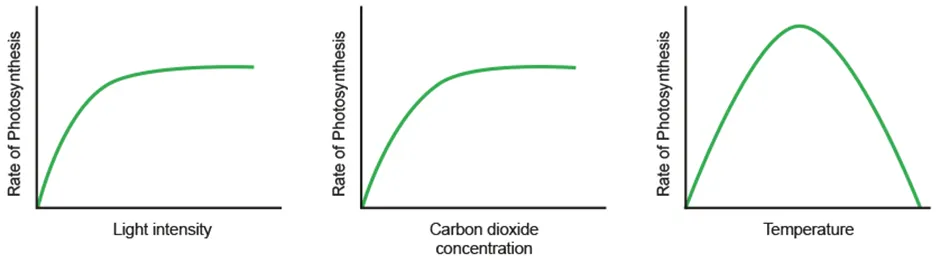
Limiting factors: temperature, light intensity, CO₂ conc


Chromatography
•
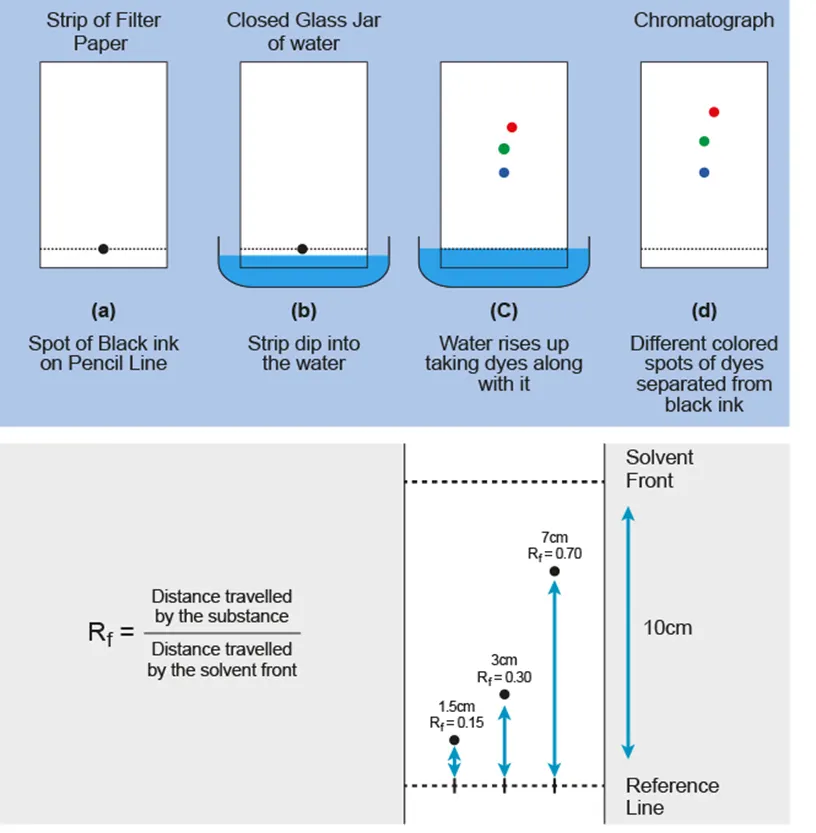
Separation of the components of a mixture


Photosynthetic pigments
•
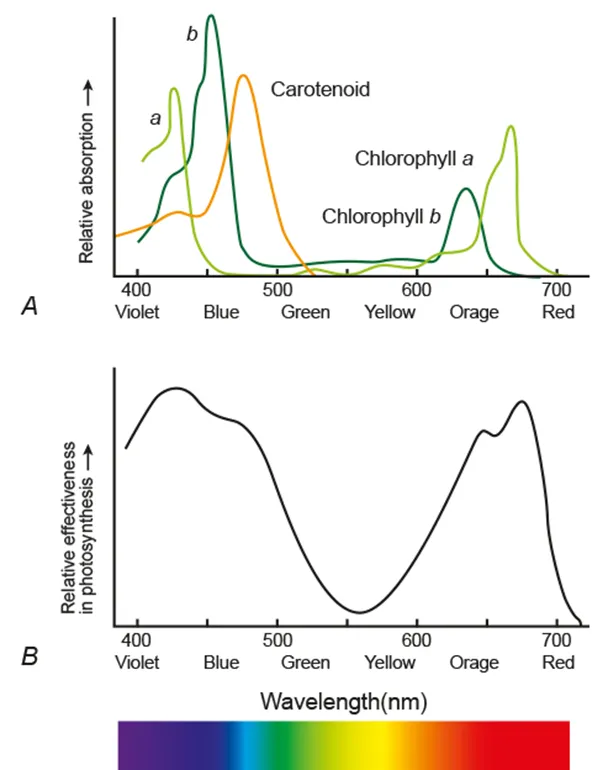
Visible light: 400~700 nm
•
Pigments allow electrons to jump from one energy level to a higher energy level (excitation)
•
Chlorophyll absorbs red and blue light most effectively, while reflecting green light


*(AHL)
Photosystems
•
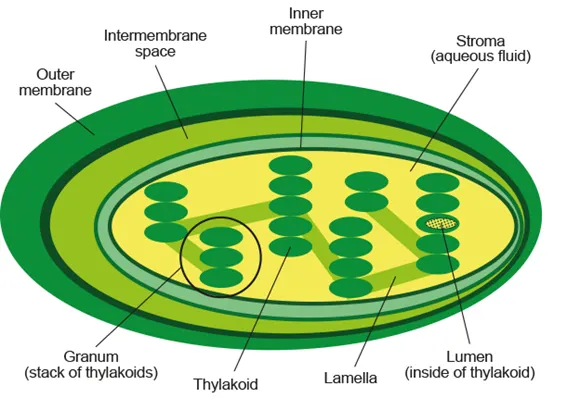
Located in chloroplast thylakoid membranes
•
Reaction center: chlorophyll, emits excited electrons
•
Antenna complexes: harvest light energy and funnel it to the reaction center
◦
Absorbs a wider range of wavelengths and supplies e⁻ at a faster rate
•
PS I (P700): stroma thylakoid
•
PS II (P680): grana thylakoid
Light dependent reaction
•
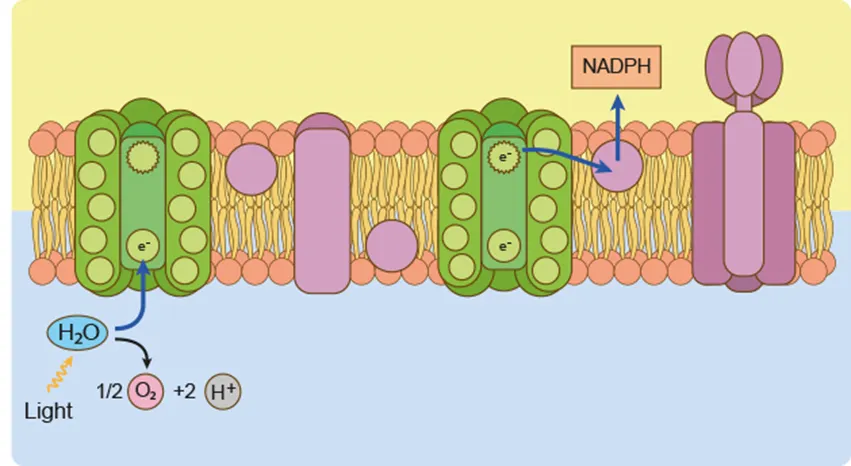
In chloroplast thylakoid membrane
•
Photolysis of water in PS II produces free electrons: H₂O → 2H⁺ + 2e⁻ + ½O₂
•
This free energy is used to pump H⁺ ions from the through thylakoid membrane = PMF
•
Protons pass through ATP synthase, producing ATP = Chemiosmosis


Photophosphorylation
Cyclic | Noncyclic |
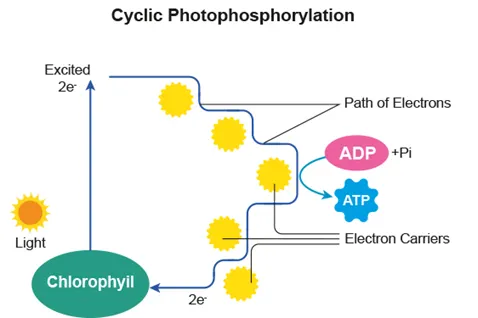
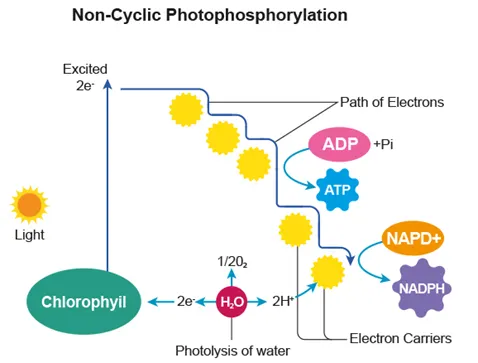
Only PS I | Both PS I and PS II |
e⁻ from photoactivation → ETC → producing ATP before returning to PS I
Produces ATP but not NADPH + H⁺ so cannot produce organic molecules | PS I and II absorbs light → excited e⁻ (photoactivation)
e⁻ from PS I → ETC → produce ATP by chemiosmosis
↓
e⁻ from PS I used to reduce NADP⁺ → NADPH + H⁺
↓
e⁻ lost from PS I replaced by e⁻ from PS II
↓
e⁻ lost from PS II replaced by e⁻ from photolysis
↓
Produces NADPH in addition to ATP |
Light independent reaction
•
= Calvin Cycle = Carbon fixation of RuBP
•
In chloroplast stroma
•
In plants, glucose is transformed into sucrose
•
Sucrose is actively translocated by the phloem from source (leaves) to sink (fruit)
•
Sucrose is converted to starch for storage
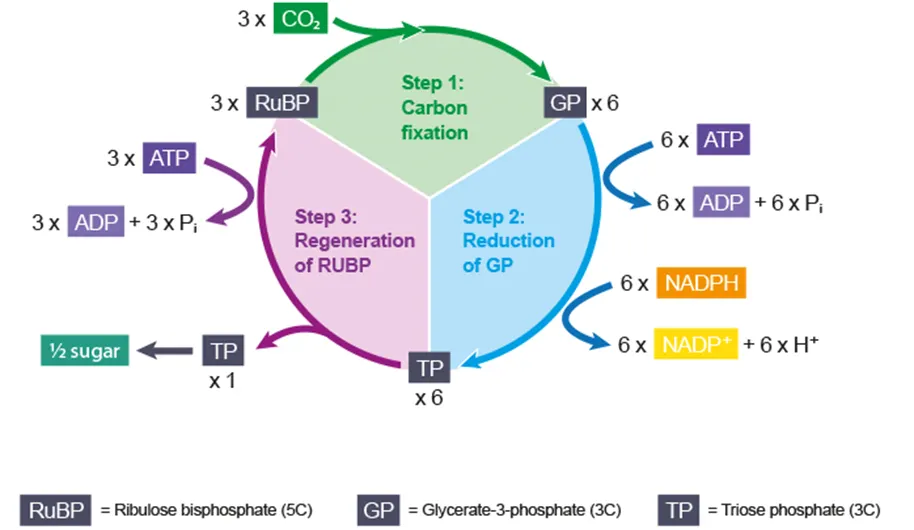
CO₂ combines with Ribulose biphosphate (RuBP) + catalyst Rubisco
↓
Unstable 6C molecule becomes 2 * 3C (GP glycerate-3-phosphate)
↓
GP is reduced using ATP & NADPH + H+ to TP (triose phosphate) called glyceraldehyde phosphate
↓
of TP produced = used to produce glucose phosphate
↓
Remaining TP used to regenerate RuBP |


Calvin cycle (Lollipop) experiment
Algae placed in “lollipop” apparatus with plenty of light, CO₂, radioactive C-14
↓
Samples taken at intervals
↓
Carbon compounds separated by chromatography
↓
¹⁴C radioactive-compounds identified using autoradiography showed that RuBP was phosphorylated
↓
Glycerate-3-phosphate (PG) labelled more than any other compound
↓
Hence, PG is first stable product
↓
Next compound to be detected containing radioactive carbon was triose phosphate
↓
A wide range of carbon compounds was quickly made in sequence in a cycle with regeneration of RuBP |