
 Understanding points
A3.2.1 Need for classification of organisms (HL only)
A3.2.2 Difficulties classifying organisms into the traditional hierarchy of taxa (HL only)
A3.2.3 Advantages of classification corresponding to evolutionary relationships (HL only)
A3.2.4 Clades as groups of organisms with common ancestry and shared characteristics (HL only)
A3.2.5 Gradual accumulation of sequence differences as the basis for estimates of when clades diverged from a common ancestor (HL only)
A3.2.6 Base sequences of genes or amino acid sequences of proteins as the basis for constructing cladograms (HL only)
A3.2.7 Analysing cladograms (HL only)
A3.2.8 Using cladistics to investigate whether the classification of groups corresponds to evolutionary relationships (HL only)
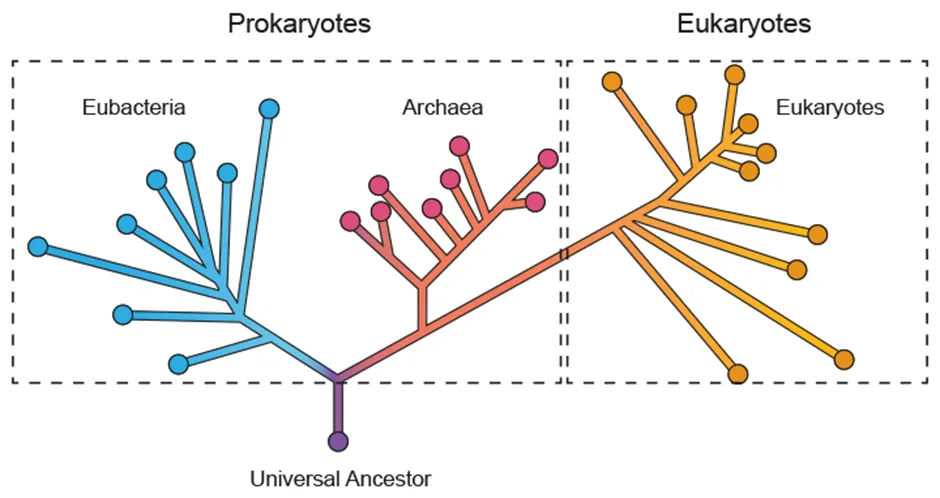
A3.2.9 Classification of all organisms into three domains using evidence from rRNA base sequences (HL only) |
Taxonomy
•
Taxa: groups used to classify organisms
•
Hierarchy of taxa: Domains – Kingdom – Phylum – Class – Order – Family – Genus – Species
•
Every organism that has evolved from a common ancestor is included in the same taxon
•
In each taxon, all the species are evolved from the same common ancestor

Phylogeny
The study of evolutionary ancestry
•
Phylogenetic classification is based on DNA sequence
•
Greater level of homology in their DNA = more closely related
•
Molecular clock: assuming that mutations occur at a constant rate, the number of differences in base sequence correlates to the time since two species diverged from a common ancestor
Cladistics
Categorizes organisms into groups based on most recent common ancestry
•
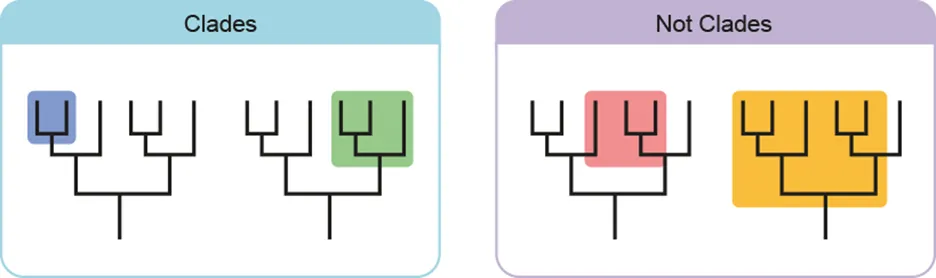
Clade: a group of organisms that have evolved from a common ancestor
•
Cladogram: a branching diagram that represents ancestor-descendant relationships
◦
The closer two species are in a cladogram, the more closely related they are
◦
There can be more than 1 possible cladogram
◦
Nodes indicate divergence and branch length indicates time since divergence
◦
The root represents the common ancestor and terminal branches represent clades


3 domains classification
•
All organisms are classified into three domains based on rRNA sequences