

 Understanding points
D3.2.1 Production of haploid gametes in parents and their fusion to form a diploid zygote as the means of inheritance
D3.2.2 Methods for conducting genetic crosses in flowering plants
D3.2.3 Genotype as the combination of alleles inherited by an organism
D3.2.4 Phenotype as the observable traits of an organism resulting from genotype and environmental factors
D3.2.5 Effects of dominant and recessive alleles on phenotype
D3.2.6 Phenotypic plasticity is the capacity to develop traits suited to the environment experienced by an organism, by varying patterns of gene expression
D3.2.7 Phenylketonuria as an example of a human disease due to a recessive allele
D3.2.8 Single-nucleotide polymorphisms and multiple alleles in gene pools
D3.2.9 ABO blood groups as an example of multiple alleles
D3.2.10 Incomplete dominance and codominance
D3.2.11 Sex determination in humans and inheritance of genes on sex chromosomes
D3.2.12 Haemophilia as an example of a sex-linked genetic disorder
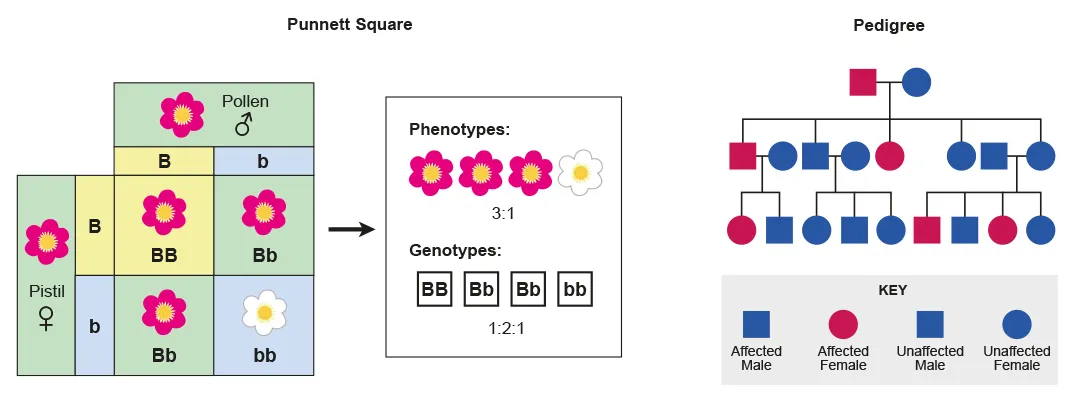
D3.2.13 Pedigree charts to deduce patterns of inheritance of genetic disorders
D3.2.14 Continuous variation due to polygenic inheritance and/or environmental factors
D3.2.15 Box-and-whisker plots to represent data for a continuous variable such as student height
D3.2.16 Segregation and independent assortment of unlinked genes in meiosis (HL only)
D3.2.17 Punnett grids for predicting genotypic and phenotypic ratios in dihybrid crosses involving pairs of unlinked autosomal genes (HL only)
D3.2.18 Loci of human genes and their polypeptide products (HL only)
D3.2.19 Autosomal gene linkage (HL only)
D3.2.20 Recombinants in crosses involving two linked or unlinked genes (HL only)
D3.2.21 Use of a chi-squared test on data from dihybrid crosses (HL only) |
Inheritance
Genotype | Phenotype |
Genetic composition of alleles
• Homozygous: 2 copies of the same alleles
• Heterozygous: 2 copies of different alleles | Physical characteristics expressed by the genotype
• Influenced by environmental factors |
•
Most traits follow a classical dominant/recessive pattern of inheritance:
◦
The dominant allele will mask the recessive allele when in a heterozygous state
◦
Homozygous dominant and heterozygous forms are phenotypically indistinguishable
◦
The recessive allele is only expressed in the phenotype in a homozygous state
◦
Exceptions: codominance, polygenic, multiple alleles


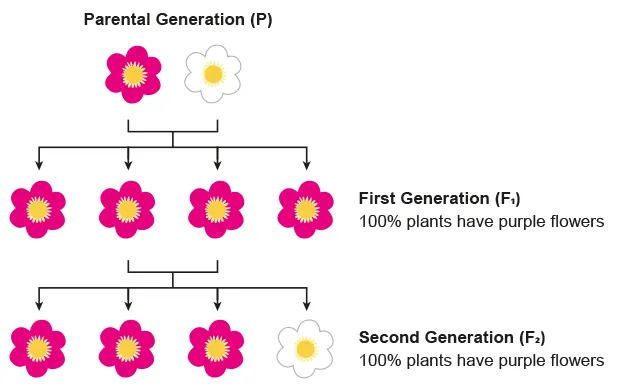
Genetic crosses




*(AHL) Mendel’s laws of inheritance
1.
Segregation: alleles are separated so that each gamete carries only one allele for each gene
2.
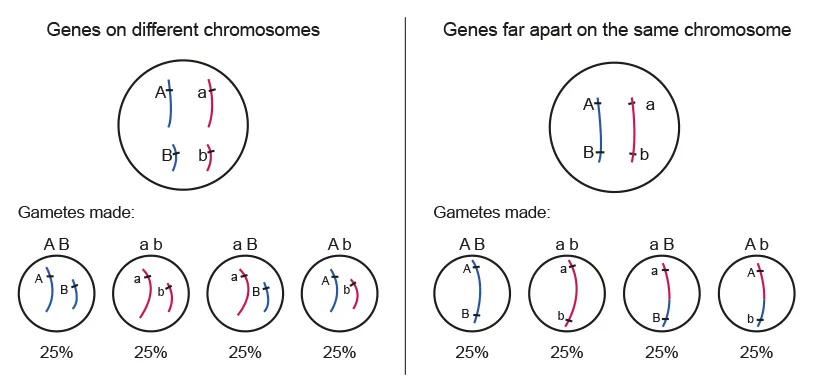
Independent assortment: the segregation of alleles for one gene occurs independently to that of any other gene
3.
Dominance: recessive alleles will be masked by dominant alleles
Non-Mendelian inheritance
Codominance
Both alleles are expressed equally in the phenotype of a heterozygous individual
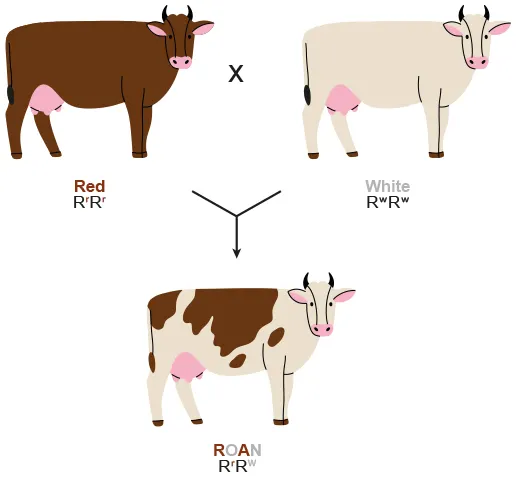
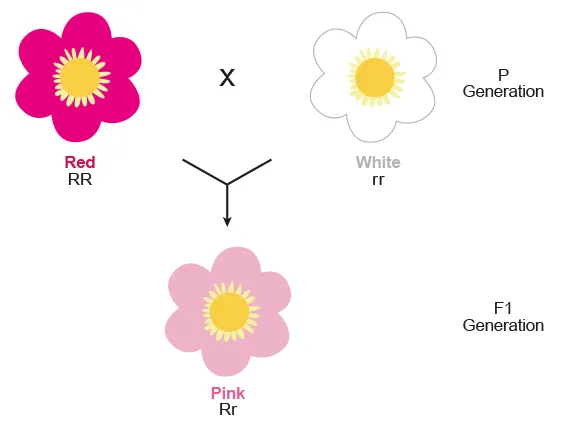
Incomplete dominance
The heterozygous phenotype is intermediate between the two homozygous ones
Multiple alleles
Phenotype is controlled by a single gene with multiple alleles
e.g. ABO blood types: A and B alleles are codominant, O allele is recessive
A allele = Iᴬ; B allele = Iᴮ; O allele = i (recessive)
Phenotype | Genotype |
Blood Type A | IᴬIᴬ or Iᴬi |
Blood Type B | IᴮIᴮ or Iᴮi |
Blood Type AB | IᴬIᴮ |
Blood Type O | ii |
*(AHL) Gene linkage
A group of genes whose loci are on the same chromosome and thus tend to be inherited together ≠ law of independent assortment
Sex linkage
e.g. Hemophilia, colour blindness: genes carried on X chromosome
Present in male (XʰY) = colour blindness
Heterozygous female (XᴴXʰ) = normal vision
Homozygous in females (XʰXʰ) = colour blindness


*(AHL) Dihybrid cross
Allele combination of 2 inheritable phenotypes
•
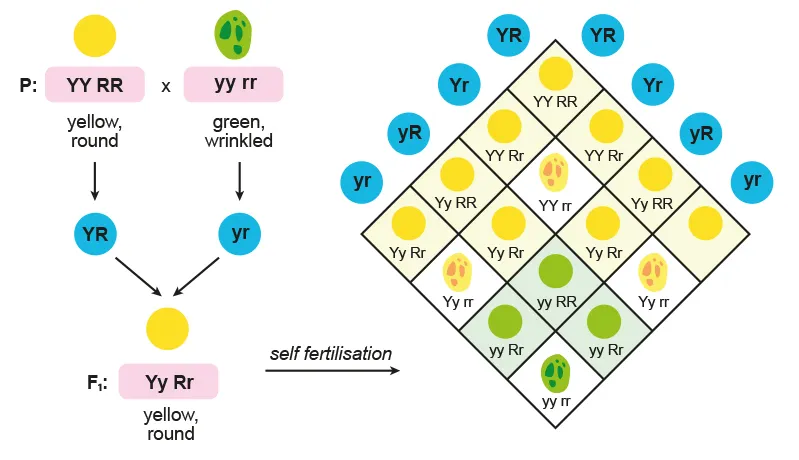
Unlinked: genes are separately inherited - dihybrid is just to verify the variety of the genotypic and phenotypic combinations of offspring
◦
F₂ phenotype ratio = 9:3:3:1
•
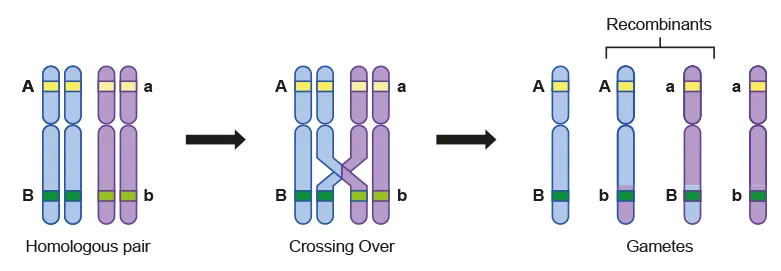
Linked: offspring ratios deviate due to formation of recombinants




Polygenic inheritance
•
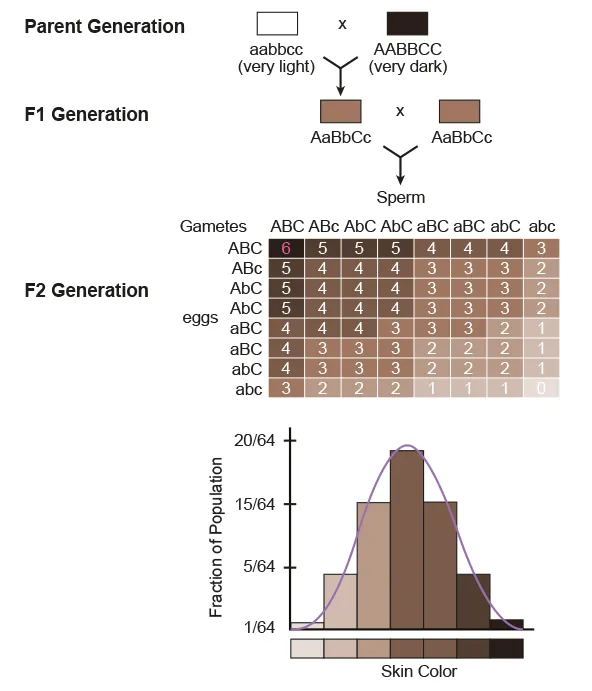
More than two codominant genes contribute to skin colour (amount of melanin)
•
Combination of alleles determines the phenotype → continuous variation of skin color
•
More recessive alleles → lighter skin
•
Environment also affects gene expression as more UV stimulates more melanin production
Phenylketonuria (PKU)
•
Autosomal recessive disease
•
Nonfunctional phenylalanine hydroxylase leads to accumulation of phenylalanine
•
Symptoms: impaired brain development
•
Treatment: dietary restriction of phenylalanine