
 Understanding points
D1.1.1 DNA replication as production of exact copies of DNA with identical base sequences
D1.1.2 Semi-conservative nature of DNA replication and role of complementary base pairing
D1.1.3 Role of helicase and DNA polymerase in DNA replication
D1.1.4 Polymerase chain reaction and gel electrophoresis as tools for amplifying and separating DNA
D1.1.5 Applications of polymerase chain reaction and gel electrophoresis
D1.1.6 Directionality of DNA polymerases (HL only)
D1.1.7 Differences between replication on the leading strand and the lagging strand (HL only)
D1.1.8 Functions of DNA primase, DNA polymerase I, DNA polymerase III and DNA ligase in replication (HL only)
D1.1.9 DNA proofreading (HL only) |
DNA replication
•
Occurs during S phase in interphase
•
Produces identical diploid daughter cells in mitosis
•
Semiconservative: each DNA molecule produced has one new strand and one parental strand
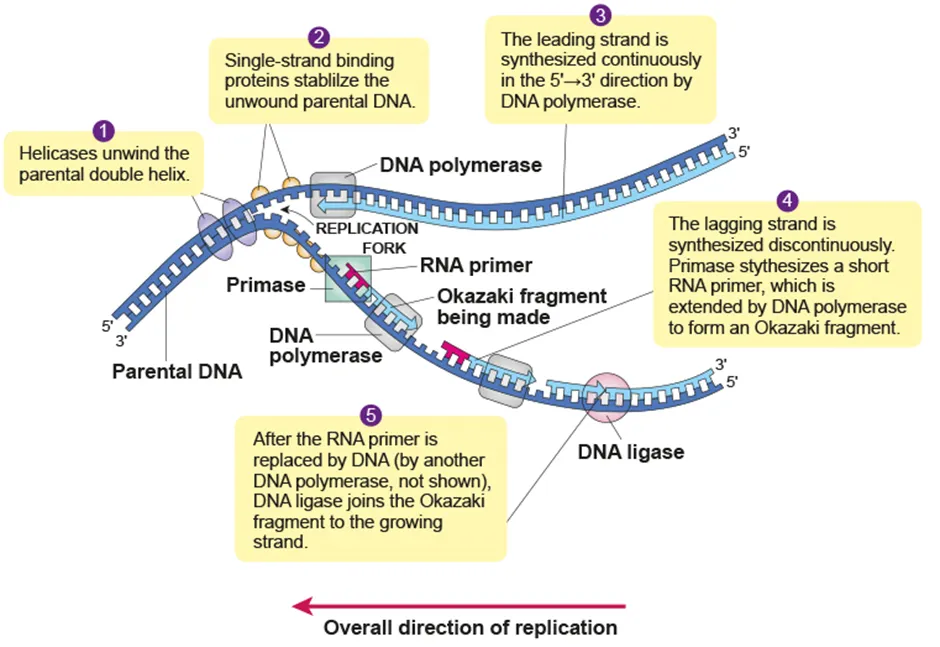
Helicase breaks H bonding to unwind DNA double helix
↓
*(AHL) DNA primase synthesizes RNA primer on parental DNA strand
↓
DNA polymerase III adds deoxynucleotides complementary to the 3’ end of template strands
↓
A-T and G-C complementary base pairing
↓
*(AHL) New strand synthesis occurs in 5’ → 3´ direction
↓
*(AHL) Synthesis is continuous on leading strand but discontinuous on lagging strand
↓
DNA polymerase I removes the RNA primers and replaces them with DNA
↓
*(AHL) DNA ligase joins Okazaki fragments in the lagging strand |


DNA replication enzymes
Helicase | Unwinds the DNA double helix and separates the strands by breaking the hydrogen bonds between bases |
*(AHL) DNA primase | Adds nucleoside triphosphates on the lagging strand to form a RNA primer |
DNA polymerase III | Adds deoxynucleotide triphosphates to the 3’ end
*(AHL) Also carries out DNA proofreading |
DNA polymerase I | Removes the RNA primer and replaces it with a DNA segment |
*(AHL) DNA ligase | Joins the Okazaki fragments together |
Tools for amplifying and separating DNA
•
Used for DNA profiling, Paternity testing, COVID testing
Polymerase chain reaction (PCR)
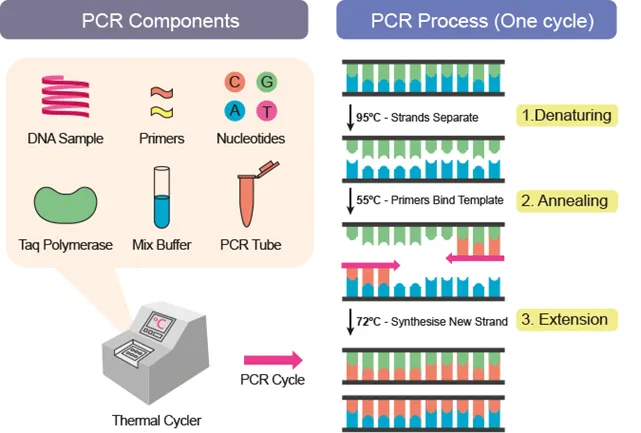
Need: DNA sample, Taq DNA polymerase, primers, nucleotides
Denaturation: heat DNA to separate strands
↓
Annealing: cool to attach primers
↓
Extension: DNA polymerase adds dNTP to synthesize new strand
↓
Repeat to amplify DNA sample
Gel electrophoresis
•
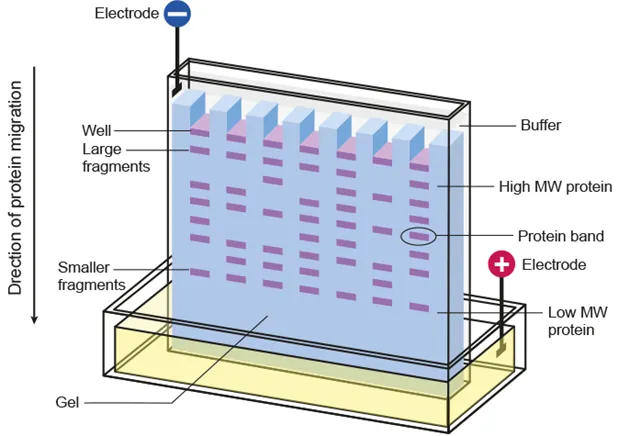
Separates DNA according to size
•
DNA is negatively charged due to phosphate group → migrates to positive electrode
•
Smaller fragments travel faster and thus farther in the gel