

 Understanding points
D4.3.1 Anthropogenic causes of climate change
D4.3.2 Positive feedback cycles in global warming
D4.3.3 Change from net carbon accumulation to net loss in boreal forests as an example of a tipping point
D4.3.4 Melting of landfast ice and sea ice as examples of polar habitat change
D4.3.5 Changes in ocean currents altering the timing and extent of nutrient upwelling
D4.3.6 Poleward and upslope range shifts of temperate species
D4.3.7 Threats to coral reefs as an example of potential ecosystem collapse
D4.3.8 Afforestation, forest regeneration and restoration of peat-forming wetlands as approaches to carbon sequestration
D4.3.9 Phenology as research into the timing of biological events (HL only)
D4.3.10 Disruption to the synchrony of phenological events by climate change (HL only)
D4.3.11 Increases to the number of insect life cycles within a year due to climate change (HL only)
D4.3.12 Evolution as a consequence of climate change (HL only) |
Climate change
Greenhouse effect | Greenhouse gas: water vapour, CO₂, CH₄, oxides of nitrogen
• Incoming shorter wave radiation from the Sun is absorbed by the Earth and re-radiated as longer wave radiation as heat
• This heat is captured by the greenhouse gases, increasing the atmospheric temperature
• Recent human activity has increased the normal level of greenhouse gases in the atmosphere → occurring at a higher rate than normal
• Ecosystem is threatened due to change in climatic patterns |
Global warming | An increase in temp. of the atmosphere, leading to climate change
• Greater ranges in temp. → melting ice caps leads to rising of sea level → loss of habitat
• Balance within the ecosystem breaks → changes in predator-prey relationships and increased success of pest species
• Increased rate of decomposition of detritus |
Anthropogenic causes | 1. Combustion of fossil fuels
2. Deforestation
3. Anaerobic decomposition in landfill sites
4. Melting of permafrost |


Positive feedback cycles in global warming
Proportion of reflected sunlight (albedo) | White snow and ice reflect sunlight back into space
• Global warming melts snow and reduces albedo |
Atmospheric [CO₂] | Increasing ocean temp. decreases the solubility of CO₂
• CO₂ is released into the atmosphere and contributes to the greenhouse effect |
Atmospheric [CH₄] | Permafrost contains undecomposed dead organic matter
• Melting of permafrost produces anaerobic soil and decomposition that produces methane |
Consequences of global warming
Reduced nutrient upwelling
Ocean stratification: warm, less salty water rises floats above denser, colder, saltier water
•
Ocean currents push deeper, colder water towards the coast and displace the warmer water
•
This causes an upwelling of nutrients and an increase in productivity
•
Global warming heats and dilutes the upper water by melting ice into freshwater
•
This leads to less mixing of water layers and decreases nutrient upwelling and productivity
Loss of arctic habitat
Penguins and walruses depend on polar ice caps for resting, breeding, and nursing
Shifting climate zones
Temperate zones are expanding towards the poles
Animals must migrate towards the poles or upslope in mountains
Coral bleaching
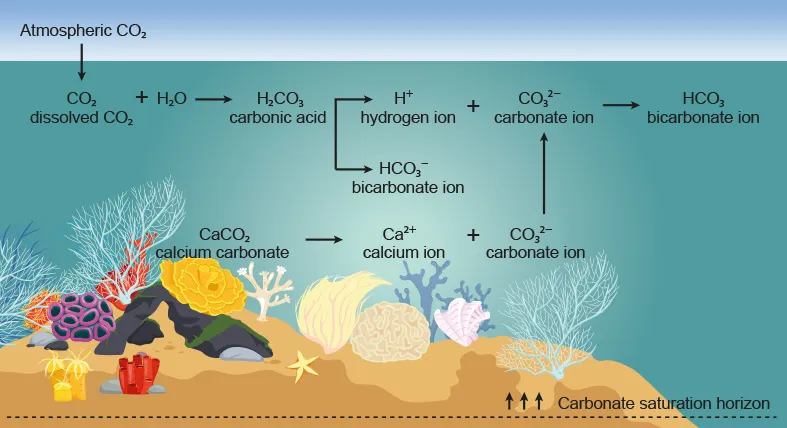
More CO₂ dissolving in the ocean has decreased its pH
This lowers [CaCO₃] in the water, making it difficult for corals to form their skeletons
Since corals are keystone species, this leads to collapse of the entire reef ecosystem
*(AHL) Evolution
Milder winters and less snow has increased the population of brown owls in Finland


Carbon sequestration
Capture and storage of CO₂ from the atmosphere
1.
Afforestation: planting trees in areas where they do not exist
2.
Wetland restoration: peatlands act as carbon sinks that contain decaying organic matter
*(AHL)
Phenology
Study of the timing of seasonal events
•
Organisms use photoperiod and temperature as cues to determine the appropriate time of activities such as flowering, migration, giving birth
•
Global warming has increased temperatures and thus the timing of animal activities
◦
e.g. Earlier availability of vegetation is advancing reindeer migration
◦
e.g. the life cycle of spruce bark beetles has become shorter