

 Understanding points
D2.2.1 Gene expression as the mechanism by which information in genes has effects on the phenotype (HL only)
D2.2.2 Regulation of transcription by proteins that bind to specific base sequences in DNA (HL only)
D2.2.3 Control of the degradation of mRNA as a means of regulating translation (HL only)
D2.2.4 Epigenesis as the development of patterns of differentiation in the cells of a multicellular organism (HL only)
D2.2.5 Differences between the genome, transcriptome and proteome of individual cells (HL only)
D2.2.6 Methylation of the promoter and histones in nucleosomes as examples of epigenetic tags (HL only)
D2.2.7 Epigenetic inheritance through heritable changes to gene expression (HL only)
D2.2.8 Examples of environmental effects on gene expression in cells and organisms (HL only)
D2.2.9 Consequences of removal of most but not all epigenetic tags from the human ovum and sperm (HL only)
D2.2.10 Monozygotic twin studies (HL only)
D2.2.11 External factors impacting the pattern of gene expression (HL only) |
Gene expression
•
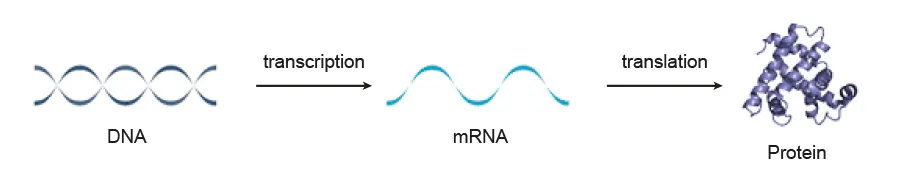
Process of turning genotype into phenotype
•
The pattern of gene expression determines that cell’s route of differentiation
Genome | The entire genetic information of a cell
Includes both coding and noncoding sequences |
Transcriptome | The entire set of mRNAs transcribed in a cell |
Proteome | The entire set of proteins produced by a cell |
Regulation of gene expression
•
Internal factors
1.
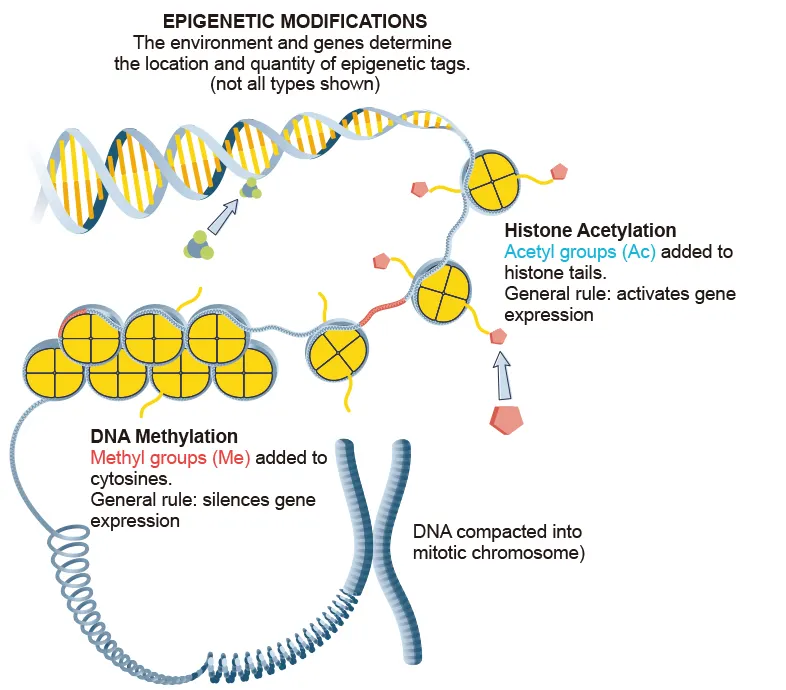
Nucleosome: methylation / demethylation of DNA
2.
Transcription factors: proteins that bind to DNA and prevent or enhance transcription
3.
mRNA degradation: determined by the length of the poly A tail
•
External factors
◦
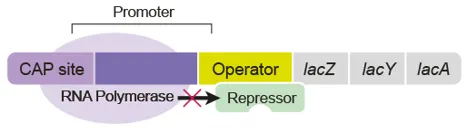
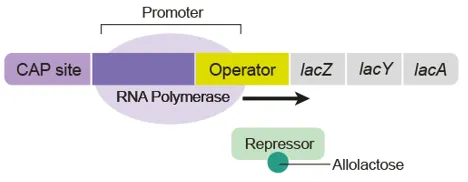
Lac operon in bacteria
◦
No lactose: When lactose is absent, the lac repressor binds tightly to the operator. It gets in RNA polymerase’s way, preventing transcription.
◦
With lactose: Allolactose (rearranged lactose) binds to the lac repressor and makes it let go of the operator. RNA polymerase can now transcribe the operon.
Epigenesis
•
The development of a plant or animal from undifferentiated cells
•
Epigenetic tags: reversible chemical modifications to the DNA
◦
The pattern of epigenetic tags is influenced by environmental factors
•
Epigenetic inheritance: the pattern of some epigenetic tags is passed on to daughter cells
◦
99% of epigenetic tags are removed during the production of gametes
Twin studies
•
Dizygotic: share 50% of their DNA
•
Monozygotic: share 100%l of their DNA
◦
Any differences in phenotype are due to the environment, not the genotype
◦
Useful for studying the impact of the environment on phenotype