

 Understanding points
A2.3.1 Structural features common to viruses (HL only)
A2.3.2 Diversity of structure in viruses (HL only)
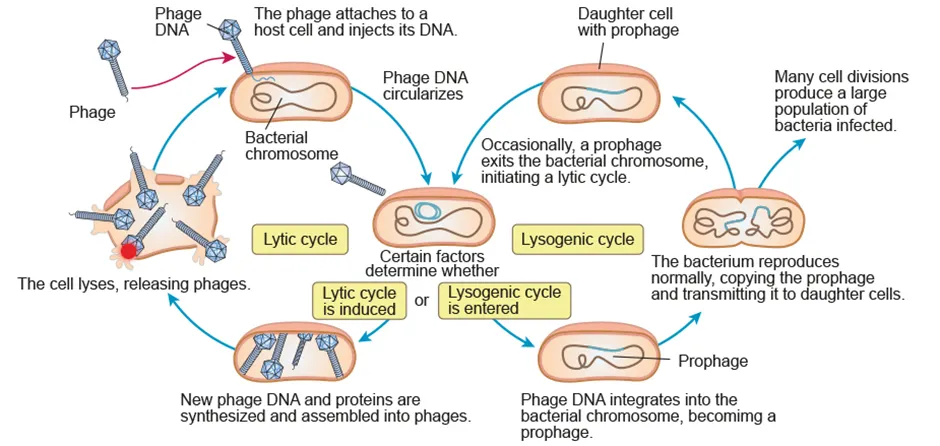
A2.3.3 Lytic cycle of a virus (HL only)
A2.3.4 Lysogenic cycle of a virus (HL only)
A2.3.5 Evidence for several origins of viruses from other organisms (HL only)
A2.3.6 Rapid evolution in viruses (HL only) |
Virus
•
Virus: non-living agents that infect host cells to reproduce inside them
•
Small and fixed size
•
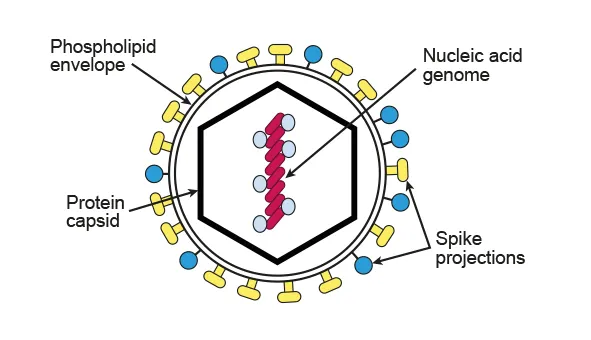
Contains nucleic acid as genetic material
◦
DNA virus: transcribes their DNA directly
◦
RNA virus:
▪
Positive-sense RNA virus: uses their RNA genes directly as mRNA
▪
Negative-sense RNA virus: transcribe their RNA genes to make mRNA
▪
Retrovirus: synthesizes dsDNA from their RNA genes and transcribe the DNA to produce mRNA
•
Capsid: protein coat that encloses genetic material
•
Envelope: viruses that infect animal cells are covered in host plasma membranes


Lytic cycle vs Lysogenic cycle


Origin of viruses
Progressive hypothesis | Regressive hypothesis |
Viruses are built in a series of steps by taking and modifying cell components
Evidence: virus-like components found in some cells
e.g. retrotransposons: the gene codes for enzymes that allow reverse transcription of RNA into DNA and insertion of the copy at random locations, causing gene duplication → similar to retroviruses | Viruses developed in steps as cells lost their components
Evidence: existence of large viruses
e.g. Mimivirus: complex structures and enzymes of its own
e.g. Chlamydia: parasitic bacteria that replicates inside a host |


Rapid evolution in viruses
•
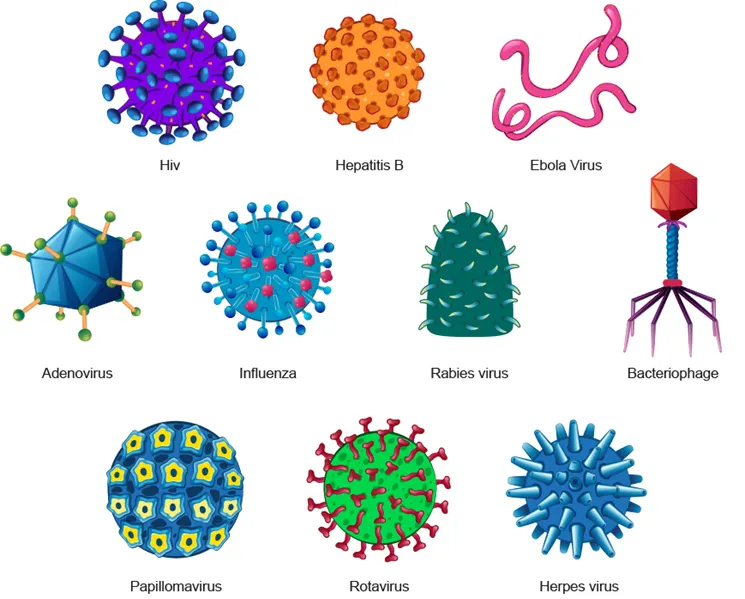
Influenza virus: ssRNA virus
◦
High rate of mutation due to the lack of proofreading function of RNA replicase
•
HIV: retrovirus
◦
High rate of mutation due to lack of proofreading function in reverse transcriptase