

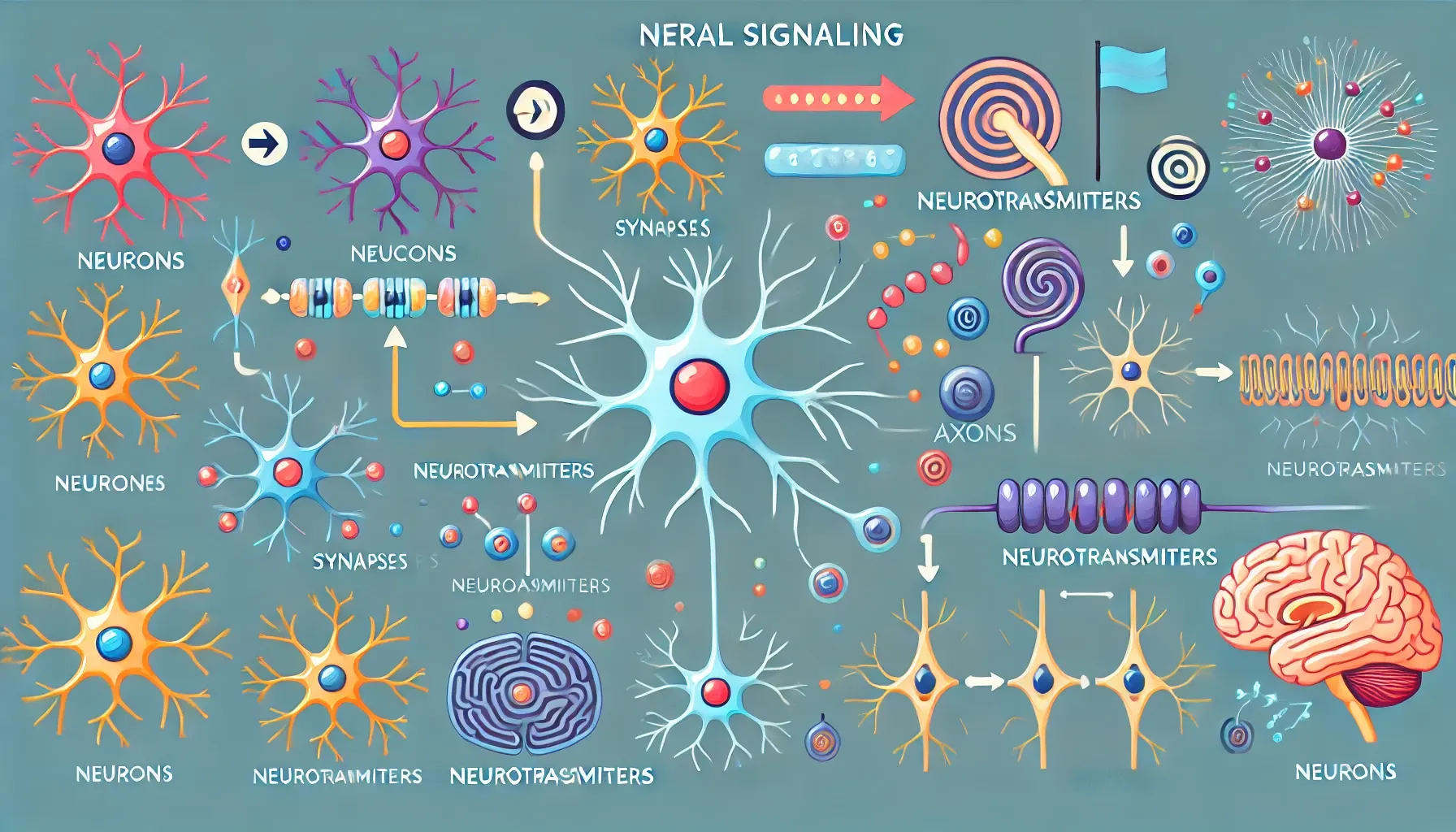
 Understanding points
C2.2.1 Neurons as cells within the nervous system that carry electrical impulses
C2.2.2 Generation of the resting potential by pumping to establish and maintain concentration gradients of sodium and potassium ions
C2.2.3 Nerve impulses as action potentials that are propagated along nerve fibres
C2.2.4 Variation in the speed of nerve impulses
C2.2.5 Synapses as junctions between neurons and between neurons and effector cells
C2.2.6 Release of neurotransmitters from a presynaptic membrane
C2.2.7 Generation of an excitatory postsynaptic potential
C2.2.8 Depolarization and repolarization during action potentials (HL only)
C2.2.9 Propagation of an action potential along a nerve fibre/axon as a result of local currents (HL only)
C2.2.10 Oscilloscope traces showing resting potentials and action potentials (HL only)
C2.2.11 Saltatory conduction in myelinated fibres to achieve faster impulses (HL only)
C2.2.12 Effects of exogenous chemicals on synaptic transmission (HL only)
C2.2.13 Inhibitory neurotransmitters and generation of inhibitory postsynaptic potentials (HL only)
C2.2.14 Summation of the effects of excitatory and inhibitory neurotransmitters in a postsynaptic neuron (HL only)
C2.2.15 Perception of pain by neurons with free nerve endings in the skin (HL only)
C2.2.16 Consciousness as a property that emerges from the interaction of individual neurons in the brain (HL only) |
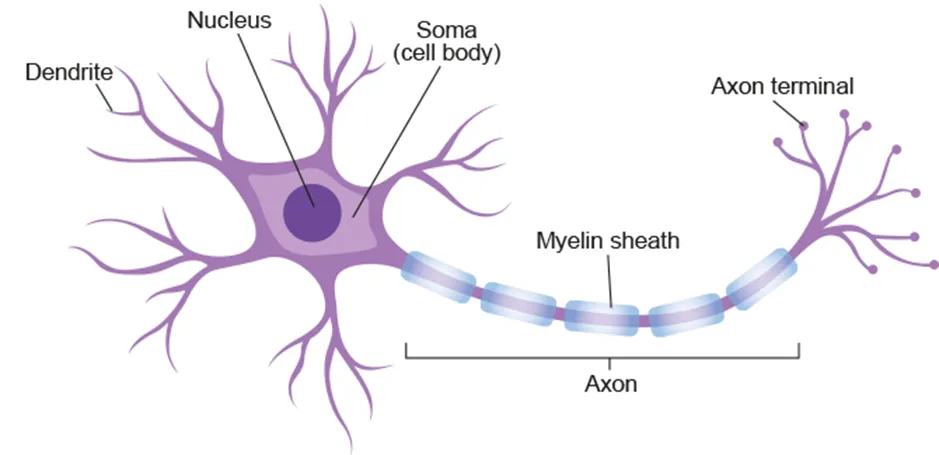
Neuron
•
Cells of the nervous system
•
The speed of nerve impulse transmission is increased by:
1.
Wider axon diameter: reduces resistance
2.
Myelination: *(AHL) enables saltatory conduction where action potentials only occur at Nodes of Ranvier


Nerve impulse
•
Electrical signal
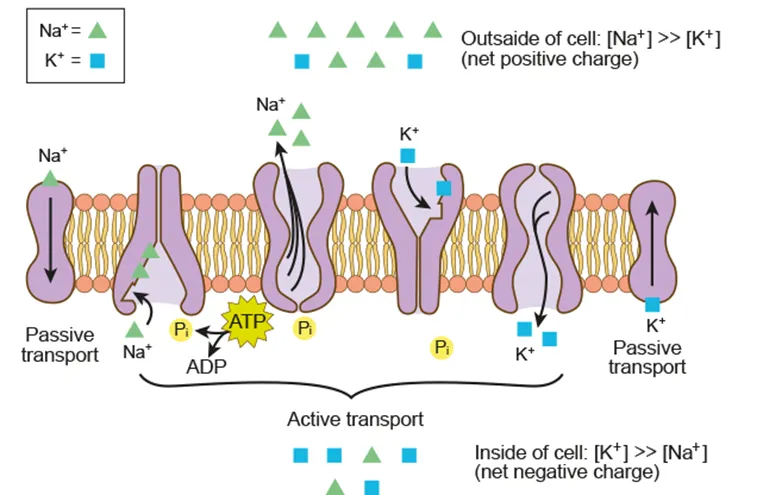
Resting potential
Maintained at -70mV by Na⁺/K⁺ pump
Action potential
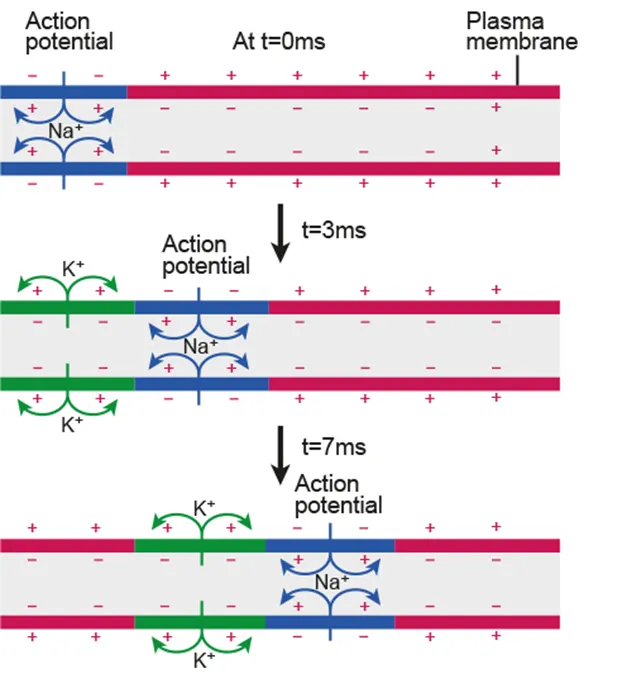
A brief reversal of the resting potential of a neuron’s membrane due to facilitated diffusion of Na⁺ and K⁺ ions
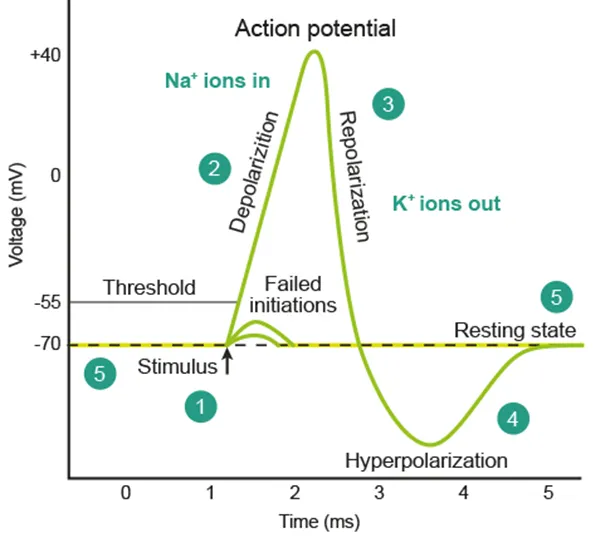
*(AHL) Propagation
Local currents of Na⁺ ions allow action potentials to travel down the axon
Synaptic transmission
•
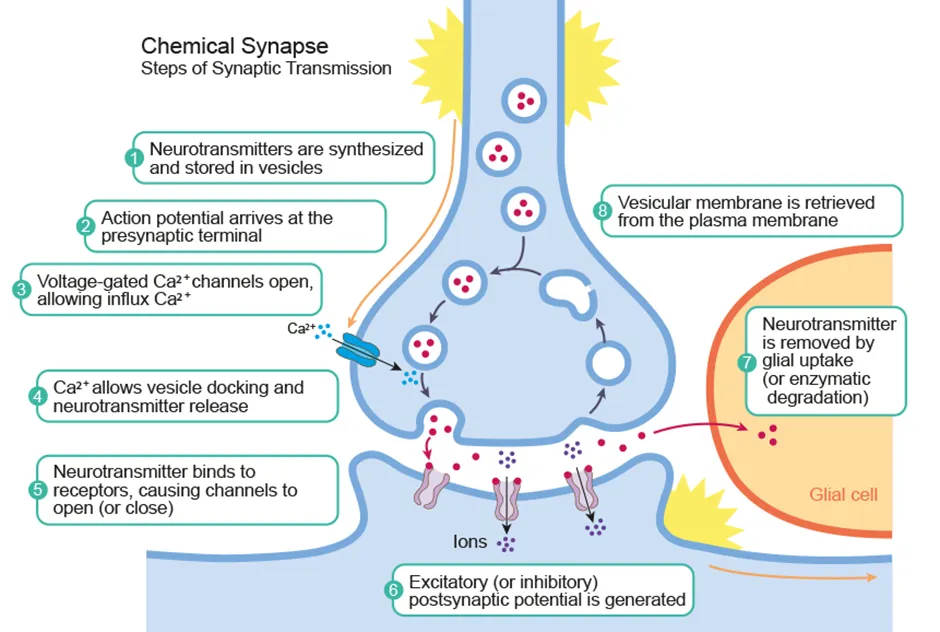
Chemical signal
•
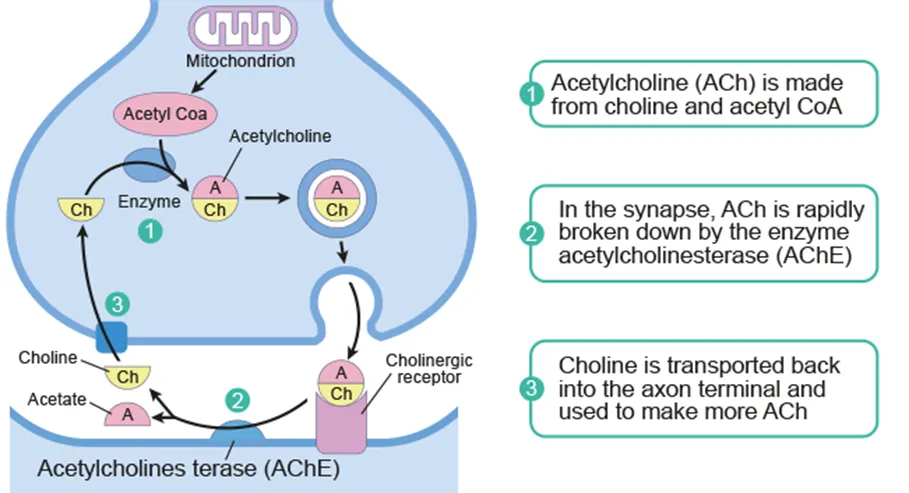
e.g. Acetylcholine: excitatory postsynaptic potential
*(AHL)
Exogenous chemicals and synaptic transmission
•
Neonicotinoids: bind irreversibly to acetylcholine receptors in insect central nervous systems
◦
Overstimulation of the cholinergic synapse leads to paralysis and death
•
Cocaine: inhibits dopamine reuptake transporters
◦
Continuous stimulation of the dopaminergic synapse leads to euphoria
Excitatory vs inhibitory neurotransmitters
Excitatory | Inhibitory | |
Channel type | Cations (Na⁺) | Anions (Cl⁻) |
Postsynaptic potential | Rises from -70mV (depolarization) | Falls from -70mV (hyperpolarization) |
Example | Acetylcholine | GABA |
Summation
•
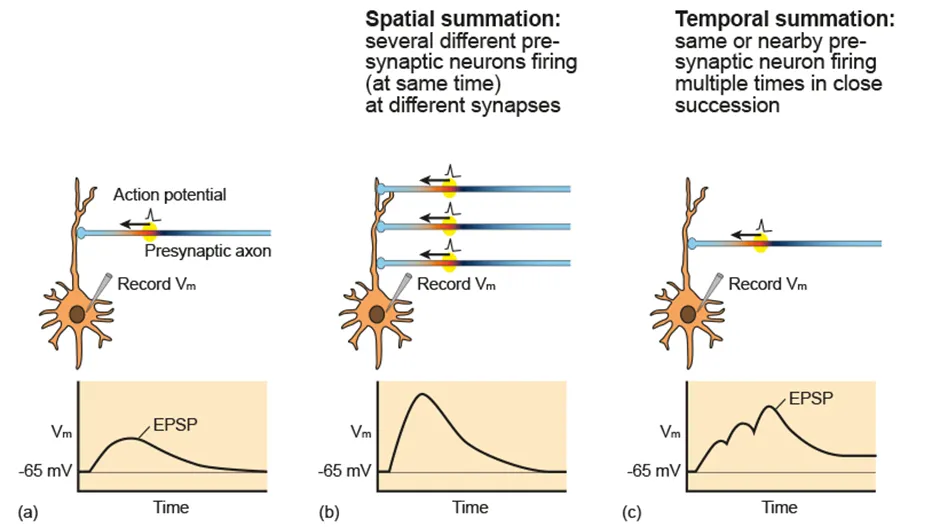
Stimulation of an action potential as a result of multiple releases of excitatory neurotransmitter


Pain perception
•
Pain receptors are the endings of sensory neurons that convey impulses to the cerebral cortex
•
Ion channels open in response to high temperature, acid, and certain chemicals