
 Understanding points
B2.1.1 Lipid bilayers as the basis of cell membranes
B2.1.2 Lipid bilayers as barriers
B2.1.3 Simple diffusion across membranes
B2.1.4 Integral and peripheral proteins in membranes
B2.1.5 Movement of water molecules across membranes by osmosis and the role of aquaporins
B2.1.6 Channel proteins for facilitated diffusion
B2.1.7 Pump proteins for active transport
B2.1.8 Selectivity in membrane permeability
B2.1.9 Structure and function of glycoproteins and glycolipids
B2.1.10 Fluid mosaic model of membrane structure
B2.1.11 Relationships between fatty acid composition of lipid bilayers and their fluidity (HL only)
B2.1.12 Cholesterol and membrane fluidity in animal cells (HL only)
B2.1.13 Membrane fluidity and the fusion and formation of vesicles (HL only)
B2.1.14 Gated ion channels in neurons (HL only)
B2.1.15 Sodium–potassium pumps as an example of exchange transporters (HL only)
B2.1.16 Sodium-dependent glucose cotransporters as an example of indirect active transport (HL only)
B2.1.17 Adhesion of cells to form tissues (HL only) |
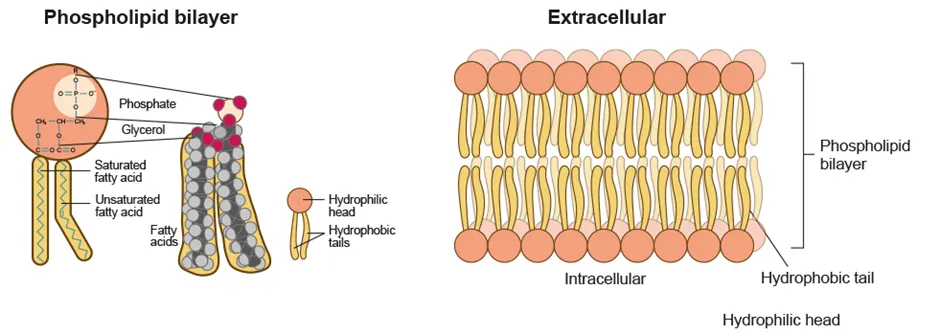
Phospholipid bilayer
•
Phospholipids have hydrophilic and hydrophobic regions
•
Hydrophilic heads are attracted to water → face watery environment
•
Hydrophobic tails are repelled by water → arrange themselves inwards


Models of membrane structure
Early model | Membranes are partially permeable + organic solvents penetrate faster than water
Chemical analysis showed membranes consist mainly of proteins and lipids
Monolayer with nonpolar away water and polar towards water |
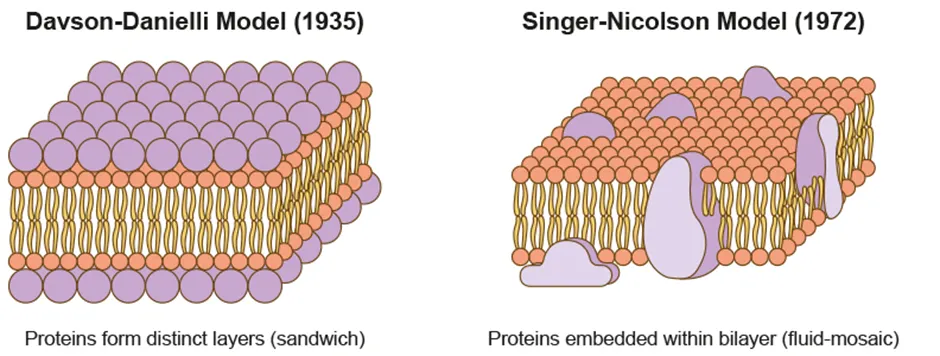
Davson–Danielli Model | Phospholipid bilayer coated with protein molecules on both surfaces
Used electron microscopy: 3 layers observed like a sandwich
BUT no evidence for hydrophobic proteins |
Fluid Mosaic Model - Singer-Nicholson | Used fluorescent labelling
Proteins project partially and sometimes through lipid bilayer |
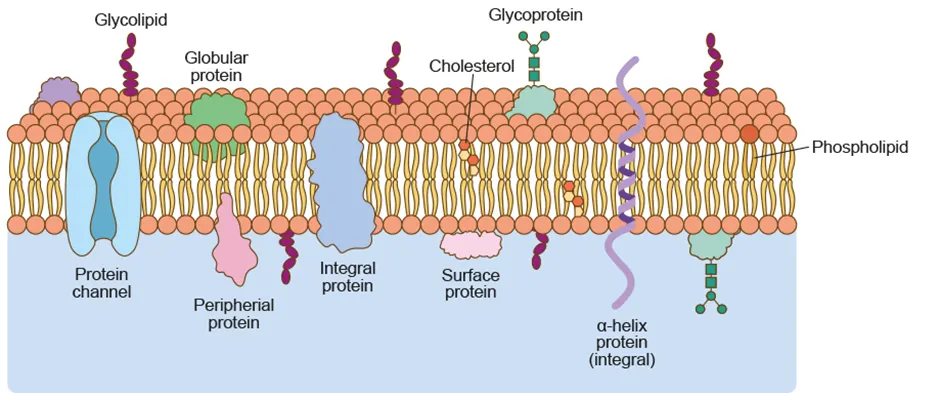
Membrane proteins
Integral | Embedded in the membrane
Channel, carrier proteins - passive transport
Protein pumps - active transport |
Peripheral | Located on the surface of the membrane
Maintain cell shape
May be enzymes which catalyze reactions in the cytoplasm |
Glycoproteins | Proteins modified by carbohydrate chains attached
Cell communication - part of immune system
Hormone binding sites, enzymes |
Membrane transport
Passive | Active |
High → Low concentration | Low → High concentration |
Down the con. gradient | Against the con. gradient |
Simple diffusion:
Small and non-polar substances | Protein pump & ATP required
e.g. Na⁺/K⁺ pump, endocytosis, exocytosis
Material binds to protein pump
↓
ATP binds to protein pump
↓
Conformational change
↓
Material released, ATP detaches
↓
Shape returns to original |
Facilitated diffusion:
Diffusion of particles that cannot pass through the phospholipid bilayer
Involves specific protein channels | |
Osmosis:
Movement of water molecules from high to low water potential (Low → High solute con.) |


*(AHL)
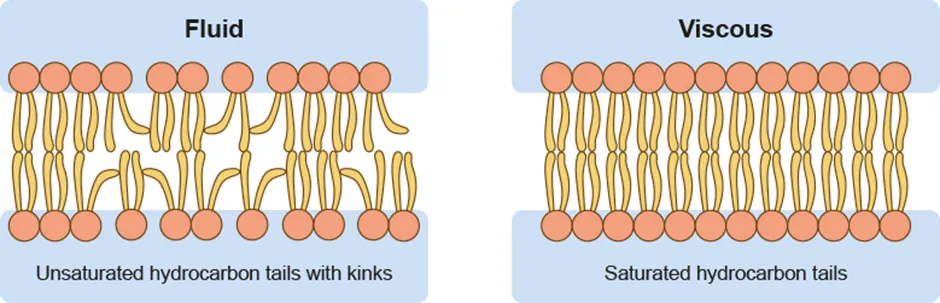
Fatty acid composition and membrane fluidity
•
Saturated: straight chains allow tight packing, which reduces membrane fluidity
•
Unsaturated: bent chains lead to loose packing, which increases membrane fluidity
Cholesterol and membrane fluidity
•
Mostly hydrophobic but a partly hydrophilic hydroxyl group on one end
•
Functions as fluidity buffer that regulates the membrane fluidity
◦
Its irregular placement prevents the membrane from crystallizing
◦
Restricts molecular motion and provides rigidity to prevent excessive permeability
•
Renders a curved shape which facilitates the formation of vesicles during endocytosis
Bulk transport
Endocytosis | Exocytosis |
e.g. Phagocytosis and pinocytosis
Membrane encloses target particles
↓
Membrane sinks inward and edges fuse
↓
Inner membrane becomes outer (vice versa)
↓
Vesicle breaks away | e.g. Exocytosis of neurotransmitter, hormone
Vesicles carry material to plasma membrane
↓
Vesicle fuses with membrane
↓
Material released from the cell
↓
Membrane flattens |
Vesicle transport: used to secrete substance as hormones and enzymes |
Vesicles formed from rER transport proteins to Golgi apparatus
↓
Fusion with the membrane of Golgi apparatus
↓
Golgi apparatus processes protein
↓
Vesicles leave Golgi apparatus and move through cytoplasm
↓
Vesicles fuse with plasma membrane and release contents |
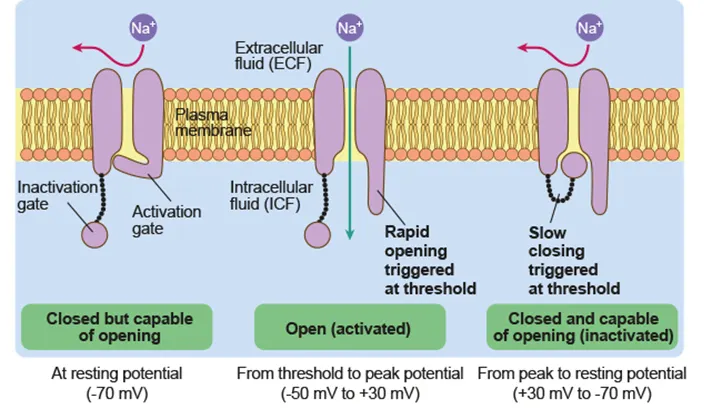
Ion channels in neurons
Voltage gated ion channels
Nerve impulse generation
Nicotinic acetylcholine receptors
Synaptic transmission
Binding of Ach causes a conformational change in the receptor, allowing Na⁺ ions to enter the cell and generate an action potential
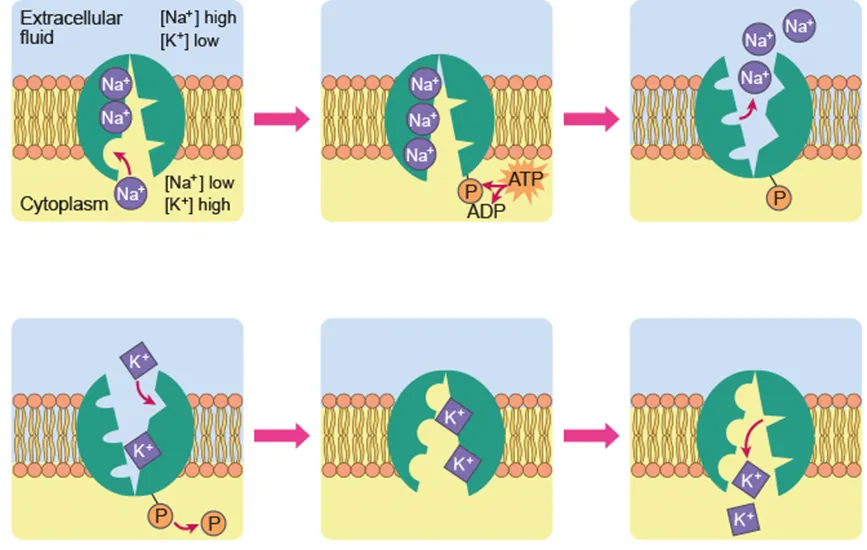
Sodium-potassium pump
•
Exchange transporter
•
Uses ATP to transport 3Na⁺ out, 2K⁺ in
•
Generates a negative resting membrane potential (-70mV)
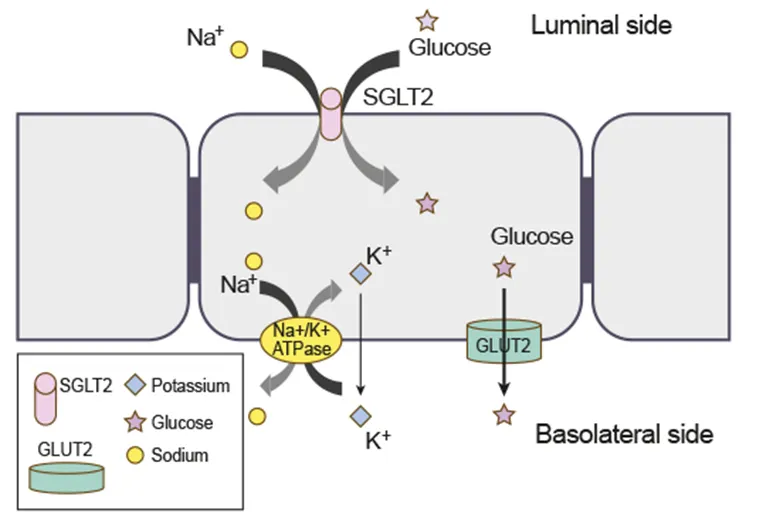
Sodium-glucose cotransporter
•
Indirect active transport
•
Transports Na⁺ and glucose together into the cell
•
Na⁺ moves down its con. gradient, glucose moves against its con. gradient
•
Depends on Na⁺/K⁺ pumps that transport Na⁺ out of the cell to maintain low intracellular Na⁺ con.