Mission
People
Join Us
Pricing
FAQ
Mentoring Program Curriculum (1)
/
Subjects
/
Maths AA
/
Topics
/
2. Functions
/
Sub-topics
Mentoring Program Curriculum (1)
/
Subjects
/
Maths AA
/
Topics
/
2. Functions
/
Sub-topics
Share
Mission
People
Join Us
Pricing
FAQ
Sub-topics
Gallery view
Search
•
A
relation
is any set of points which connect two variables.
•
A
function
, sometimes called
mapping
, from a set
X
X
X
to a set
Y
Y
Y
assigns to each element of
X
X
X
exactly one element of
Y
Y
Y
.
Function has different properties:
1.
Domain
is the set of values of
x
x
x
in the relation. (the set
X
X
X
)
2.
Range
is the set of values of
y
y
y
in the relation. (the set
Y
Y
Y
)
3.
Function must pass the
vertical line test
.
a.
Allowed maximum one intersection with vertical lines across the real axis
b.
Multiple inputs
→
\rightarrow
→
one input (ok)
c.
One input
→
\rightarrow
→
multiple output (no)
4.
Function notation:
f
:
X
→
Y
,
x
↦
x
+
3
f: X → Y, x ↦ x+3
f
:
X
→
Y
,
x
↦
x
+
3
5.
Domain and Range are written in set notation; ex.
{
x
∣
2
<
x
<
4
x | 2<x<4
x
∣2
<
x
<
4
},
x
∈
[
1
,
3
)
x ∈[1, 3)
x
∈
[
1
,
3
)
6.
Colored dot =
inclusive;
empty dot =
exclusive
7.
All real number; ex. domain: {
x
∣
x
∈
R
x | x∈ ℝ
x
∣
x
∈
R
}
8.
Substitute
x
=
0
x = 0
x
=
0
to obtain
y
y
y
intercept, and vice versa.
2.1 Functions
Exponential is an inverse operation of logarithm; i.e.
a
x
=
b
⇒
x
=
log
a
b
a^x=b ⇒ x = \log_ ab
a
x
=
b
⇒
x
=
lo
g
a
b
.
Therefore, exponential function and logarithm function are an inverse of each other.
Exponentials
:
There are few exponential rules to be aware of:
•
a
m
⋅
a
n
=
a
m
+
n
a^m · a^n = a^{m+n}
a
m
⋅
a
n
=
a
m
+
n
•
a
m
a
n
=
a
m
−
n
\frac {a^m}{a^n}=a^{m-n}
a
n
a
m
=
a
m
−
n
•
a
n
m
=
a
n
m
a^{\frac nm}= \sqrt [m] {a^n}
a
m
n
=
m
a
n
•
a
−
n
=
1
a
n
a^{-n}=\frac 1{a^n}
a
−
n
=
a
n
1
Treat the exponentials like a variable in factorization and expansion.
For the general form
f
(
x
)
=
k
⋅
a
b
x
+
c
+
d
f(x) =k · a^{bx+c}+d
f
(
x
)
=
k
⋅
a
b
x
+
c
+
d
, we have:
1.
Horizontal asymptote:
y
=
d
y=d
y
=
d
2.2 Exponents and Logarithms
There are 3 types of transformations to remember.
1.
Translation by
(
a
b
)
\binom ab
(
b
a
)
to obtain
f
(
x
−
a
)
+
b
f(x-a)+b
f
(
x
−
a
)
+
b
a.
Horizontal translation by
(
a
0
)
\binom a0
(
0
a
)
to obtain
f
(
x
−
a
)
f(x-a)
f
(
x
−
a
)
b.
Vertical translation by
(
0
b
)
\binom 0b
(
b
0
)
to obtain
f
(
x
)
+
b
f(x) + b
f
(
x
)
+
b
2.
Stretch by scale factor
k
k
k
a.
Horizontal stretch by scale factor
k
k
k
to obtain
f
(
1
k
x
)
f(\frac 1kx)
f
(
k
1
x
)
b.
Vertical stretch by scale factor
k
k
k
to obtain
k
f
(
x
)
kf(x)
k
f
(
x
)
3.
Reflection
a.
Reflection by the
y
y
y
-axis:
f
(
−
x
)
f(-x)
f
(
−
x
)
b.
Reflection by the
x
x
x
-axis:
−
f
(
x
)
-f(x)
−
f
(
x
)
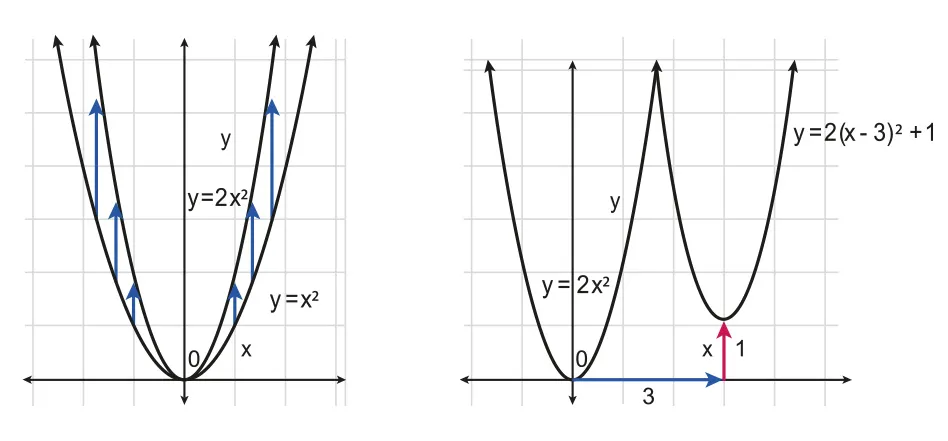
Figure 2.3.1
Graphical representation of vertical stretch by a factor of 2 (left) and horizontal transformation by 3 units and 1 unit vertically (right)
2.3 Transformation
Linear
General form:
a
x
+
b
y
+
c
=
0
ax + by + c = 0
a
x
+
b
y
+
c
=
0
Standard form:
y
=
a
x
+
b
y = ax + b
y
=
a
x
+
b
From the standard form, we have:
1.
Slope, or Gradient:
a
=
∆
y
∆
x
a = \frac {∆y}{∆x}
a
=
∆
x
∆
y
, the rate of change in
y
y
y
relative to
x
x
x
.
a.
a
>
0
a > 0
a
>
0
: ascending rightwards
b.
a
<
0
a < 0
a
<
0
: descending rightwards
c.
a
=
0
a = 0
a
=
0
: horizontal line
2.
y
y
y
intercept:
b
b
b
3.
If
l
1
=
a
x
+
b
l_1=ax + b
l
1
=
a
x
+
b
and
l
2
=
a
′
x
+
b
′
l_2 = a'x+b'
l
2
=
a
′
x
+
b
′
, then:
a.
a
=
a
′
:
l
1
/
/
l
2
a = a': l_1 // l_2
a
=
a
′
:
l
1
//
l
2
b.
a
a
′
=
−
1
:
l
1
⊥
l
2
aa' = -1: l_1 ⊥ l_2
a
a
′
=
−
1
:
l
1
⊥
l
2
Quickest way to draw this function:
1.
Plot
x
x
x
and
y
y
y
intercepts.
2.
Connect the two intercepts.
Find intersection by solving the simultaneous equation. If
l
1
=
a
x
+
b
l_1=ax + b
l
1
=
a
x
+
b
and
l
2
=
a
′
x
+
b
′
l_2 = a'x+b'
l
2
=
a
′
x
+
b
′
, solve:
2.4 Polynomials